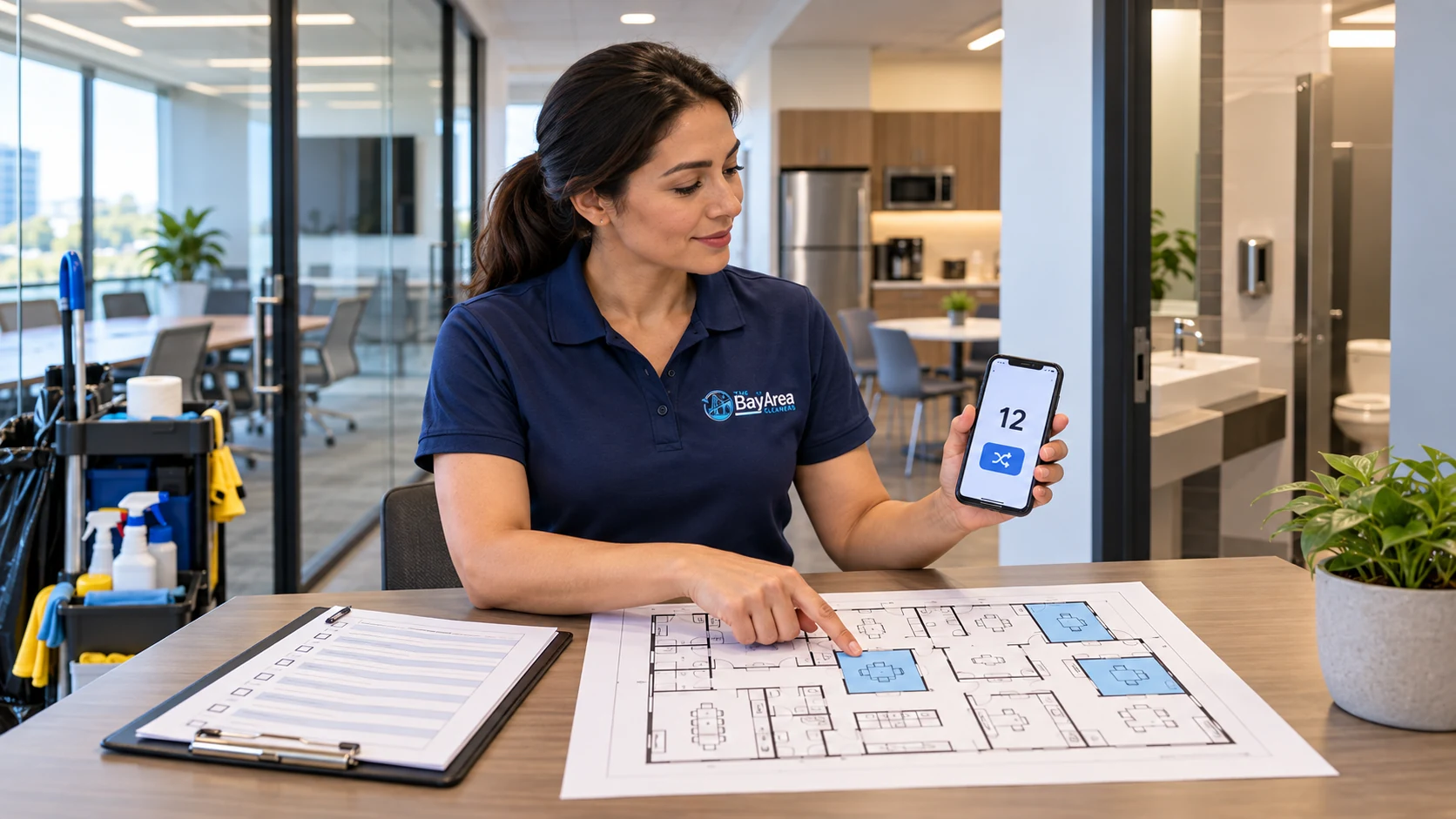

The final clean is usually the last trade on a commercial job, and its budget line is often the thinnest. By the time anyone prices it, the contingency is gone and the walkthrough date is set. Post construction cleaning costs are easier to carry when you set them at preconstruction, next to the other Division 01 items. Build them from the drawings, not from a round number.
This guide is for general contractors, owners and property managers who budget commercial work in the Bay Area. It shows you where the money sits and how to build the number. Then it covers five costs that are easy to miss. They’re labels and film, the route in an occupied building, prevailing wage on public works projects, waste sorting on CALGreen projects, and allowances for a return visit and a day of overtime.
The quick version: Put post construction cleaning costs in the budget at preconstruction, and tie the scope to the final cleaning section of the specs. Decide early whether the general contractor, the owner or the tenant pays. Build the number from a base rate for the floor area, a setup charge and adders for counted items such as labels and film. Then add allowances for a return visit and a day of overtime. In an occupied building, budget for the route the trades used, not just the suite. Public works projects pay prevailing wage for the final clean, and CALGreen projects need the crew’s waste to go in the right bins.
Where Post Construction Cleaning Costs Sit in a Project Budget
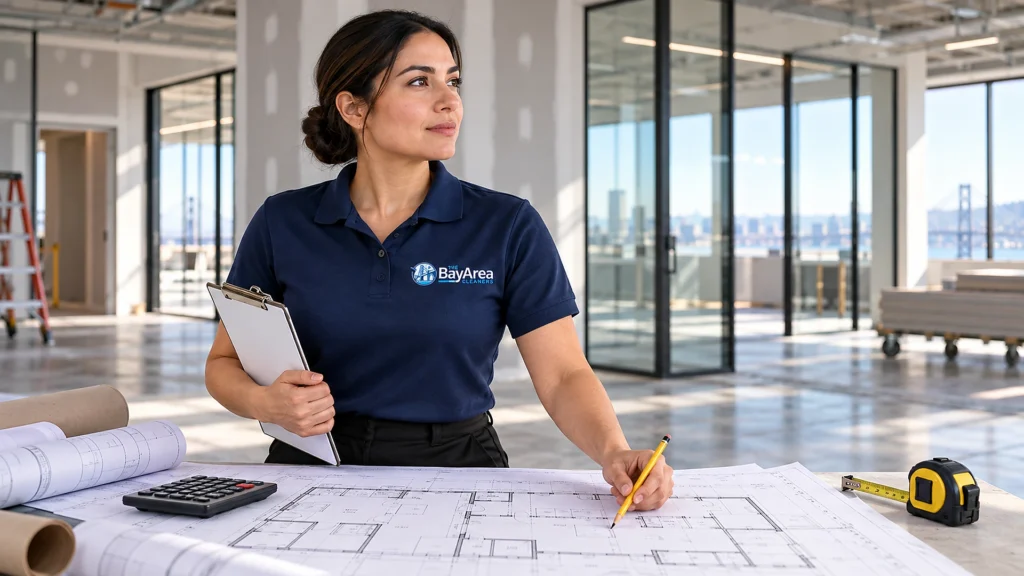
Most commercial specs follow the CSI MasterFormat system, which puts cleaning in Division 01, General Requirements. Section 01 74 13 covers progress cleaning during the job, and Section 01 74 23 covers final cleaning before turnover. Some project manuals put final cleaning under 01 77 00, Closeout Procedures, instead. Whichever section your manual uses sets the standard for the walkthrough, so write the cleaning scope and budget against it.
You may also like: Post Construction Cleaning: A 3-Phase Checklist for Contractors and Property Managers
On most commercial jobs, post construction cleaning costs land in one of three places. Each one changes how the cost is carried and what you need to settle in writing.
| Where the money sits | Who hires and pays the crew | What to settle in writing |
| General conditions | The general contractor, out of its own job costs | Whether the clean meets the spec’s final cleaning section or stops at broom clean |
| Trade line in the schedule of values | The general contractor, billed to the owner as a trade | The line’s value, and how retention on it gets released |
| Owner’s or tenant’s move-in budget | The owner or tenant, directly, after turnover | The condition the contractor hands over, and who pays to clean up after late punch work |
Final payment, and any retention held on the contract, usually waits for completion. The walkthrough is where completion gets decided, so a final clean that fails the walkthrough can hold up money for every trade on the job. That’s the best reason to fund professional post construction cleaning early, before the last month of the job. Final cleans for general contractors are a regular part of our work.
Takeaway: Pick one home for the final clean in the budget, tie it to the final cleaning section, and fund it before the last month of the job.
Base, Setup, Adders and Allowances in a Post Construction Cleaning Calculator

A post construction cleaning calculator works best in five parts. The base covers the floor area at a rate per square foot, and the setup charge covers each visit’s travel, equipment and on-site supervision. Adders cover counted items the base rate doesn’t capture, such as labeled items, route cleaning and freight elevator time. Allowances cover work you can’t count yet: a return visit after punch work, and overtime if the schedule compresses.
| Part | Sample input | Sample amount |
| Base | 12,000 sq ft × $0.35 | $4,200 |
| Setup | 1 visit × $450 | $450 |
| Adders | 102 items with labels or film × $4 | $408 |
| Return visit allowance | 25 percent of the base, setup included | $1,050 |
| Overtime allowance | 17 percent of the base | $714 |
| Total | All five parts | $6,822 |
These are round numbers to show the math, not Bay Area rates. Swap in the post construction cleaning price per square foot from your quotes, your setup charge and the unit prices for your adders. The base is usually the biggest line. The adders and allowances are where post construction cleaning costs tend to outrun the budget.
Size the return visit allowance to the job. A plain office buildout with few late trades may need one return visit. A lab, a kitchen or a space with late equipment installs can need two, and those extra visits belong in post construction cleaning costs from day one.
Keep the parts apart in your own budget, whatever format the signed quote uses. When the scope changes, you’ll know which part moved.
Takeaway: Keep base, setup, adders and allowances as separate lines in your budget.
Take the Counts From the Construction Drawings
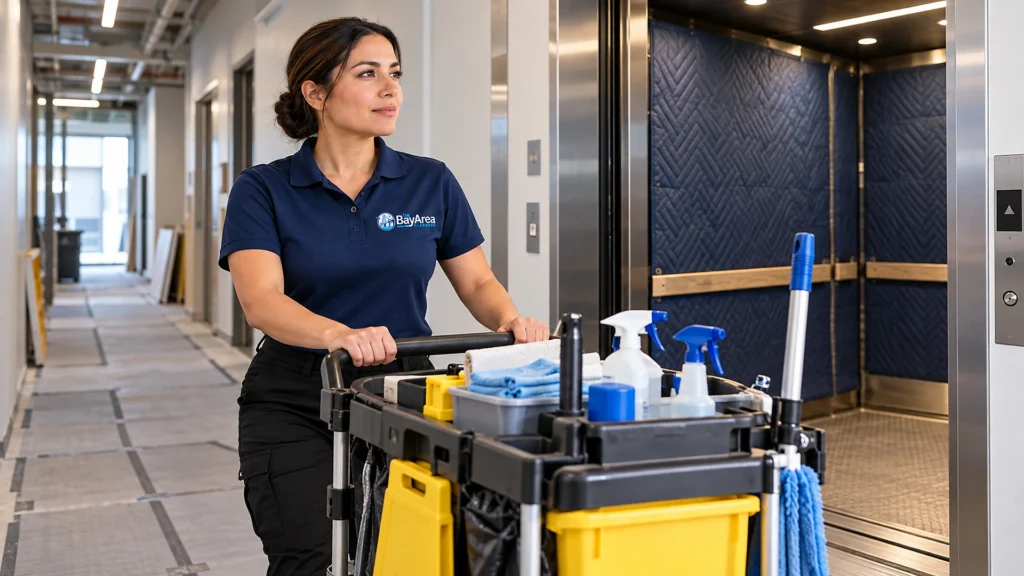
The drawings already hold most of the counts your calculator needs. A few hours with the finish plan and the door, glazing, plumbing and equipment schedules turn a loose scope into numbers the whole team can check.
| Drawing | What to count | Where it goes in the calculator |
| Finish plan and finish schedule | Square feet of each floor finish | Base |
| Door schedule | Doors with film or labels | Adders |
| Glazing or storefront elevations | Glass panels with labels | Adders |
| Plumbing fixture schedule | Fixtures with tags or adhesive dots | Adders |
| Equipment or appliance schedule | Units shipped under film or stickers | Adders |
For a 12,000-square-foot office buildout, a sample count might read 34 doors, 46 interior glass panels, 16 plumbing fixtures and 6 appliances. That’s the 102 labeled items in the calculator. Post construction cleaning costs built from counts like these can be rechecked line by line when the scope changes.
If your floor finishes vary, split the base by finish. New carpet tile, resilient plank and sealed concrete each take a different first clean, and each one needs floor care matched to its surface. The finish schedule tells you how many square feet of each to price.
Takeaway: Take the counts from the finish plan and the door, glazing, plumbing and equipment schedules, not from a walk through a half-built space.
Price Labels, Stickers and Protective Film by the Item

New buildings arrive covered in stickers. Glass carries manufacturer labels, and appliances and elevator doors ship under peel-off film. Plumbing fixtures come with paper tags and adhesive dots. None of it grows with floor area, so it belongs in the adders.
You may also like: How to Clean Stainless Steel Rust in Commercial Buildings
Film peels off cleanly when it’s fresh. Left for months, or baked by sun through a window, it bonds harder and leaves glue behind, and each item takes longer.
Final cleaning sections often list label removal and glass cleaning. Your post construction cleaning costs should carry a unit price for every labeled item on the takeoff. Sticker and residue removal on new glass is part of our glass work on new and renovated spaces.
Some labels have to stay. The fire rating label on a fire door or its frame stays for the life of the door, so no crew should peel it or paint over it. Before the clean, confirm which labels the building inspector still needs to see, and mark those doors and panels on the takeoff.
Takeaway: Price film and label removal per item, and mark every label the inspector still needs before the crew starts.
Tenant Improvements Inside Occupied Buildings
A tenant improvement in an occupied office building spreads dust past the suite. Trades roll carts from the loading dock through the freight elevator, the service corridor and sometimes a shared restroom. The building expects all of it back in shape before the new tenant moves in.
You may also like: Elevator Cleaning: Why a Six-by-Six Room Gets Noticed More Than the Lobby
Budget the final pass on that route as an adder. Measure the path from the dock to the suite, count the elevator cabs and restrooms the trades used, and price a cleaning pass on each. Get the building’s contractor rules before you set post construction cleaning costs.
Many building managers want the route cleaned at the end of every workday as well. That daily pass is progress cleaning, so decide early whether the general contractor’s laborers or a cleaning crew handles it. Buildings often ask for floor protection along the route too, and when the protection comes off, the floor under it needs a clean.
Freight elevator time is a cost of its own. Most buildings book the freight car in time slots, and a crew waiting for its slot is still on the clock. Put the booked hours on the schedule and in the adders, and ask whether the building charges for an operator or for time past the booking.
Small suites carry a higher post construction cleaning price per square foot. The route, the elevator bookings and the crew’s setup cost about the same whether your suite is 3,000 or 30,000 square feet.
Takeaway: Price the dock-to-suite route and the elevator bookings as adders, and decide early who handles the daily pass.
Public Works Projects Pay Prevailing Wage for the Final Clean
On a California public works project, the final clean isn’t routine janitorial work. The Labor Commissioner’s Public Works Manual explains that routine janitorial services are exempt from prevailing wage. That exemption doesn’t cover non-routine cleanup during or at the end of a public works construction project. So the cleaning crew gets prevailing wage, which state law requires on public works projects over $1,000.
Prevailing wage rates are set by trade and by area in the state’s wage determinations. They include fringe benefits on top of the base pay. Look up the determination that applies to your project before you set the budget. School districts and cities spell out the requirement in their bid documents, so carry it into the cleaning line when you price the job.
The gap from a market rate can be wide. Post construction cleaning costs on a school or a city building won’t match those of a private office the same size. The post construction cleaning price per square foot runs higher on public works projects, and the rule reaches every subcontractor on the job.
Public works projects come with their own payroll records and paperwork. Ask any cleaning contractor whether it has handled public works projects before it bids on yours.
Takeaway: On public works projects, price the final clean at the prevailing rate that applies to your project, not at a janitorial market rate.
CALGreen Counts the Cleaning Crew’s Bags Too
California’s green building code sets a waste target for commercial construction. According to CalRecycle, CALGreen requires nonresidential projects to divert at least 65 percent of construction and demolition waste. New buildings can instead keep disposal at or under 2 pounds per square foot. The rule covers new nonresidential buildings, additions of 1,000 square feet or more and alterations with a permit valuation of $200,000 or more.
The final clean fills its own bags and boxes. If the crew throws recyclable material into the landfill bin, it counts against the diversion rate the contractor has to document. Ask which containers the crew should use, and whether the project’s waste report needs weight tickets or receipts for the crew’s loads.
Sorting adds a little crew time to post construction cleaning costs on CALGreen projects. Budget it as an adder, and match the wording to the project’s waste section, which is usually Section 01 74 19 in MasterFormat. Settle this before the job starts. The waste report builds as the project runs, and a missing ticket is hard to recreate at closeout.
Takeaway: On CALGreen projects, tell the cleaning crew which bins count toward diversion, and budget the sorting time.
Allowances for Return Visits and Overtime
Build an allowance into post construction cleaning costs for at least one return visit after punch work. Price it before the job starts, and write down who pays for a second one.
Compressed schedules cost more in California for a plain legal reason. State overtime rules require time and a half for hours over 8 in a workday and double time over 12. If the trades run late and the clean has to fit into one day, post construction cleaning costs priced at straight time will come up short.
Say a four-person crew planned two 6-hour days, 48 labor hours in all. Now the job gets squeezed into one day, and the contractor can’t add people on short notice. Each person works 12 hours: 8 at straight time and 4 at time and a half. The same 48 hours now cost about 17 percent more, which is where the overtime allowance in the calculator comes from.
Carry the overtime premium for one compressed day as an allowance. If you don’t use it, it stays in the budget.
Takeaway: Budget one return visit and the overtime premium for one compressed day before the job starts, not after the punch list opens.
Update the Number at Three Points
A budget set at preconstruction is a starting point. Post construction cleaning costs shift as the drawings firm up, as quotes come in and as the punch list opens. Check the number at three points, and write down what changed each time.
| When | What to update | What usually moves |
| Preconstruction | Base area and the first takeoff | Floor area and labeled item counts |
| Buyout | Base rate, setup and adder prices from signed quotes | The rate per square foot and the price per labeled item |
| Punch list | Allowances used and left | Return visits and overtime |
If the finish schedule changes after buyout, run the takeoff again before the change order is priced. A switch from painted drywall to glass partitions can add dozens of labeled panels to a single floor.
Takeaway: Recheck post construction cleaning costs at preconstruction, at buyout and when the punch list opens.
Frequently Asked Questions
Who pays post construction cleaning costs on a tenant improvement?
The lease and its work letter decide. When the final clean is in a contract paid from the tenant improvement allowance, that allowance covers it, up to its cap. When the tenant hires cleaning after turnover, post construction cleaning costs come out of the tenant’s own move-in budget. Settle it before construction starts, since the work letter is hard to change later.
How do you run a post construction cleaning calculator for a phased move-in?
Treat each move-in date as its own job. A building that turns over floor by floor needs a final clean before each walkthrough, and each one carries its own setup and allowances. Run the post construction cleaning calculator once per turnover, then add the results.
Is retention held on professional post construction cleaning?
When the clean is a subcontract, it usually is. The general contractor holds back part of each payment and releases it after completion, on the same terms as the other trades. When the owner or tenant hires professional post construction cleaning after turnover, retention depends on that separate contract. For a clean that’s part of the construction contract, a failed walkthrough delays completion, and completion is what releases the money.
Why is the post construction cleaning price per square foot higher on small suites?
Setup costs about the same on any size job. Travel, equipment and on-site supervision add up to a fixed amount per visit. Say setup runs $450: spread over a 3,000-square-foot suite, that’s $0.15 a square foot, and over 30,000 square feet it’s $0.015.
Conclusion
Post construction cleaning costs hold up when your budget gives them a home from the start. Tie the scope to the final cleaning section, build the number from base, setup, adders and allowances, and take the counts from the drawings. Then add the five costs budgets tend to miss. They’re labels and film, the route in an occupied building, prevailing wage on public works projects, waste sorting on CALGreen projects, and allowances for a return visit and a day of overtime.
The Bay Area Cleaners provides professional post construction cleaning for general contractors and property managers from Vallejo to San Mateo. Call 707-656-9339 with your walkthrough date and square footage to request a written, itemized estimate.