The breakroom fridge is the one appliance everyone uses and nobody owns. By January it holds holiday leftovers, three unlabeled containers and a smell that greets whoever opens the door first. Knowing how to clean a fridge that every team opens means keeping two habits: a short weekly cleanout and a full wash every few months.
The steps draw on federal food safety guidance and appliance maker instructions.
The quick version: Keep the fridge at 40°F or colder and the freezer at 0°F, and check both with appliance thermometers. Pick one weekly cleanout day, ask staff to label food with a name and a date, and toss anything unlabeled or past its date. Every three months or so, empty the fridge into a cooler and unplug it. Let the shelves warm up, then wash the inside with warm water and dish soap or a baking soda mix. Skip abrasives, solvents and harsh cleansers. For a smell, find the source before you reach for an odor absorber. Water on the floor in front of the fridge, or ice in the bottom of the freezer, can point to a clogged drain. That’s how to clean a fridge your coworkers can trust.
The Numbers That Keep a Shared Fridge Safe
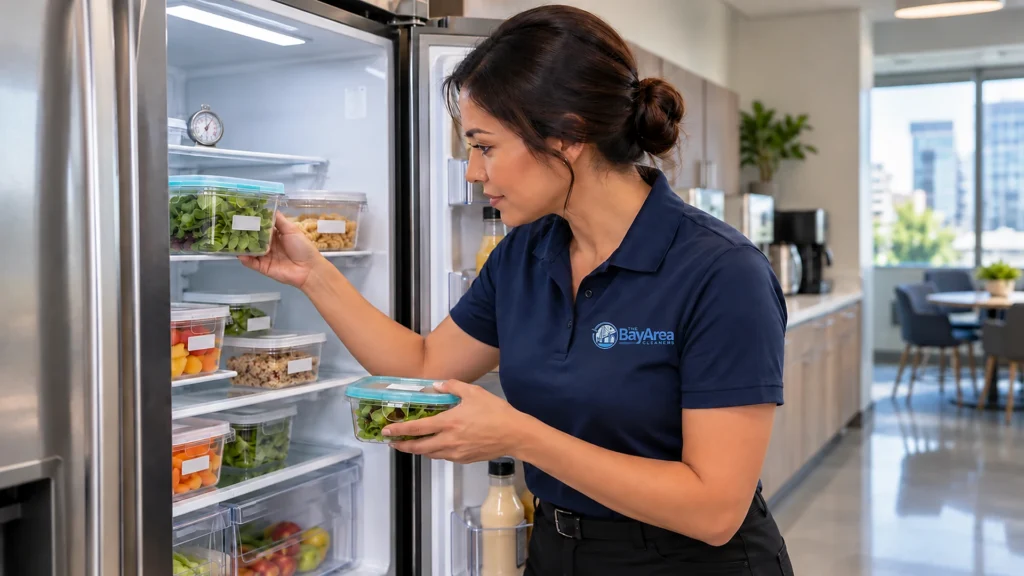
A shared fridge needs a few numbers posted where people can see them. The USDA’s Food Safety and Inspection Service (FSIS) says the refrigerator should hold 40°F or colder throughout. The FDA puts the freezer at 0°F and suggests a freestanding appliance thermometer in each compartment, checked often.
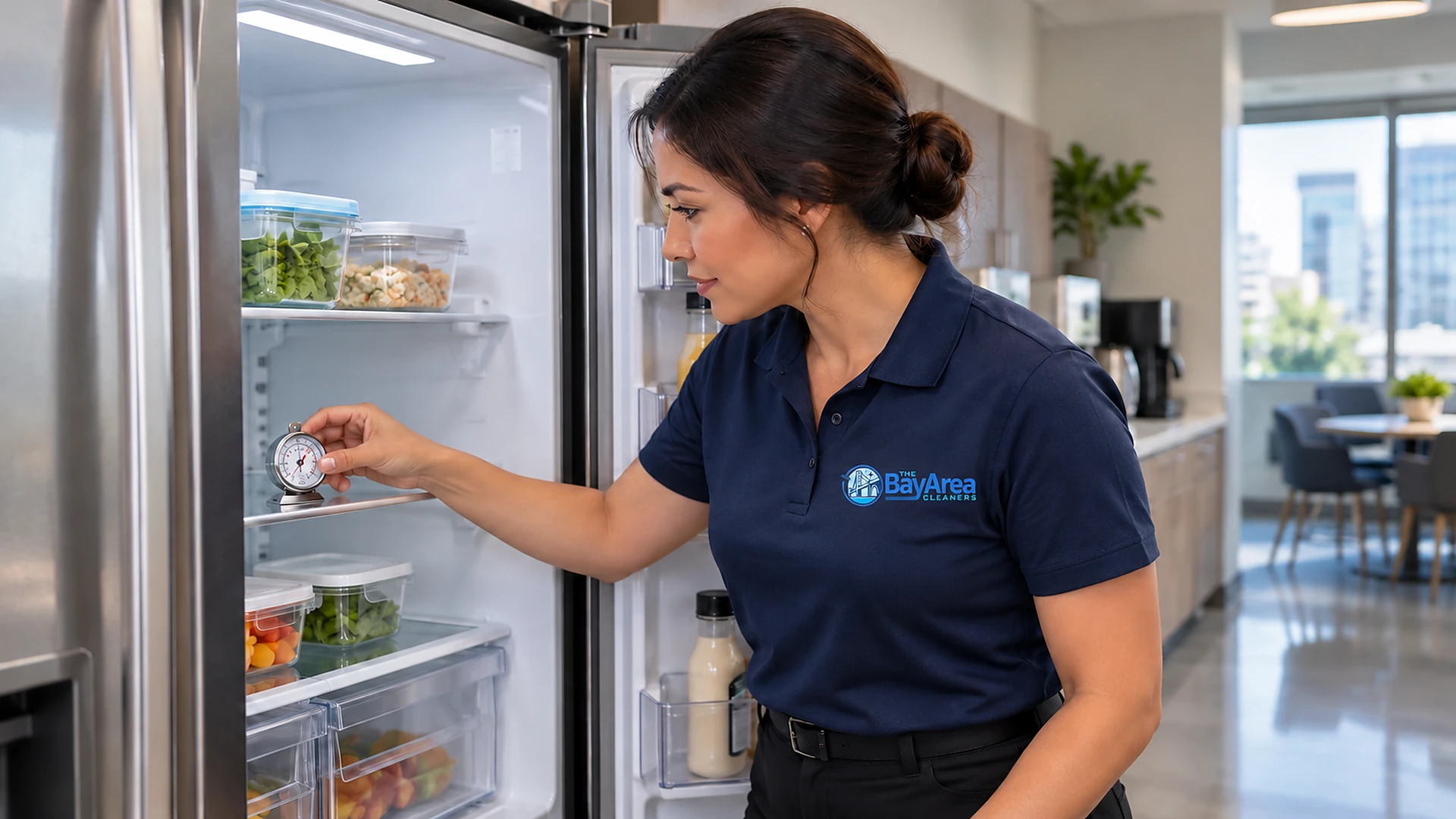
Thermometers matter more in a shared fridge. The door opens dozens of times before lunch, and a dial set to the middle shows you nothing about the shelf where the yogurt sits. Put one thermometer on a middle shelf and one in the freezer, and glance at both on cleanout day.
Time counts as much as temperature. The FDA caps perishable food at 2 hours at room temperature, or 1 hour when the air tops 90°F. FSIS’s rule of thumb for cooked leftovers is 4 days in the fridge, and 1 to 2 days for raw poultry and ground meat.
Crowding works against all of it. The FDA warns against overpacking, since cold air has to circulate around food to keep it chilled. Perishable foods don’t belong in the door either, per FSIS, so move the office milk and creamer to a shelf.
Takeaway: Hold the fridge at 40°F or colder and the freezer at 0°F, check both with thermometers, and leave room for cold air to move.
A Weekly Cleanout With a Posted Cutoff
Once a week, FSIS suggests, throw out perishable food that should no longer be eaten. In a shared breakroom, that habit only works with a fixed day and a posted rule. Friday afternoon works well, since nothing forgotten sits over the weekend.
Keep the rule short enough to read with the door open:
- Label every item with your name and the date it went in.
- Anything unlabeled, spoiled or past its date goes out at the posted time.
- Pick one fate for reusable containers left after the cutoff, the sink or the trash, and print it.
- Medication and stored breast milk in the marked bin stay put.
Send a reminder the morning of the cleanout so people can take home what they want. Rotate the job between teams month by month, and put the current team’s name on the posted rule. A cleaning crew shouldn’t decide whose lunch is still good, so food calls stay with the office.
Tossed food shouldn’t sit in the breakroom bin over the weekend. Bag it and take it out that afternoon, or hand the bags to a day porter on light trash duty.
You may also like: Breakroom Cleaning Checklist for Hayward Offices
California Labor Code section 1031 requires employers to give a lactating employee access to a sink with running water and a refrigerator suitable for storing milk, close to the workspace. If a refrigerator can’t be provided, the law allows another cooling device, such as an employer-provided cooler. Some employers with fewer than 50 employees may be exempt under certain conditions, according to the state’s Labor Commissioner. If your shared fridge is the one your office offers for stored breast milk, keep that milk in the marked bin the cleanout never empties.
Takeaway: Hold the cleanout at the same time each week, ask for a label on every item and keep one marked bin for medication and stored milk.
How to Clean a Fridge Inside Out Every Three Months?
A weekly cleanout handles food. The full wash handles spills, crumbs and the film that builds up on shelves. Whirlpool’s guide puts the full cleaning at every three months, and a busy shared fridge may need it sooner.
Plan the wash for a slow hour and work through it in order:
- Move the food to a cooler with ice packs. Whirlpool’s guide says food shouldn’t sit outside the fridge for more than two hours, so plan a wash that fits that window.
- Unplug the fridge or switch it off at the electrical panel.
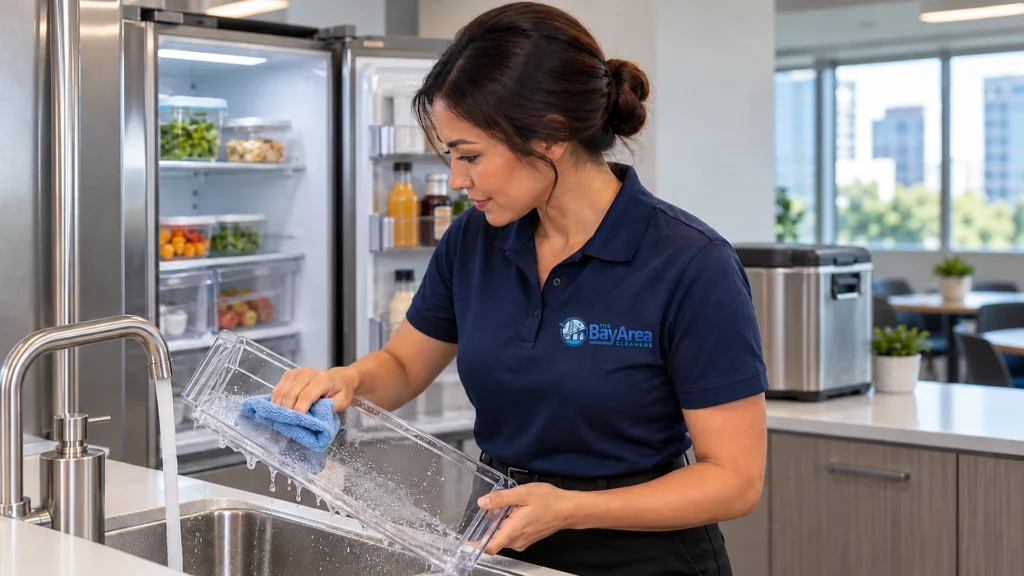
- Pull out the shelves and drawers, and let them warm to room temperature before you wash them.
- Wipe the walls, ceiling and floor of the fridge with warm water and dish soap, or with two tablespoons of baking soda in a cup of hot water.
- Wash the door bins, then clean the door seal with mild dish soap and water.
- Rinse and dry every surface, the door seal most of all, then put the shelves and drawers back.
- Plug the fridge back in, restock only labeled food that’s still in date, and check later that day that the thermometer reads 40°F or colder.
Use fresh cloths inside the fridge, not the ones that just wiped the counters or the trash can lid.
You may also like: Color Coding Cleaning Cloths in a Building With More Than One Crew
Keep solvent cleaning agents, abrasives and any cleanser that may leave a chemical taste on food or ice cubes out of the fridge, as FSIS directs. Abrasive tools, harsh cleansers, flammable fluids and bleach are on Whirlpool’s avoid list, so check your owner’s manual before anything stronger than soap goes inside.
Takeaway: Move the food to a cooler, unplug the fridge, let the shelves warm up and wash with dish soap or baking soda. Keep solvents, abrasives and harsh cleansers out of the fridge.
How to Clean a Fridge That Smells?
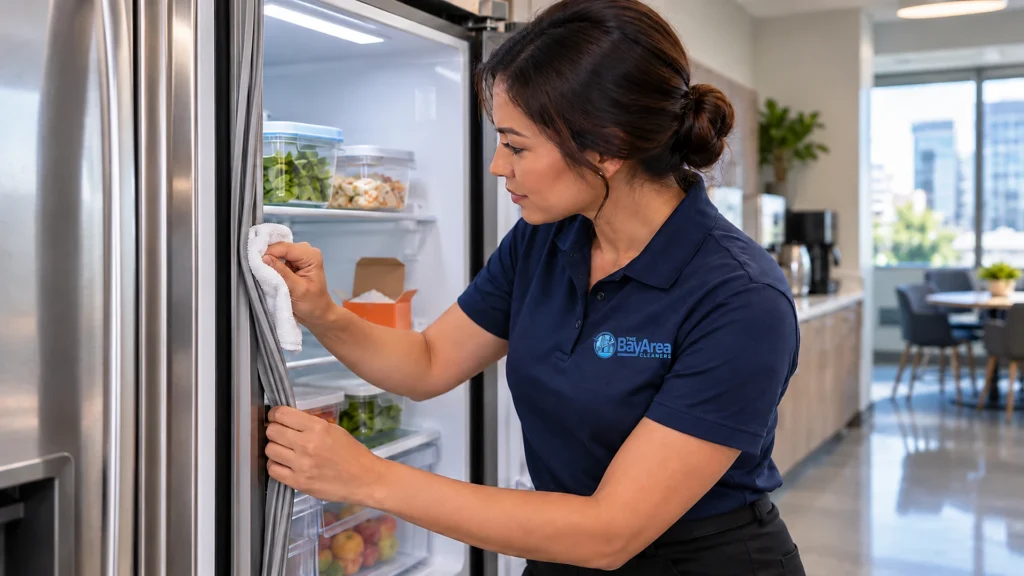
Find the source before you treat the smell. In an office fridge, it’s usually a forgotten container in the back, a spill that dried under a crisper drawer or a drip in a door bin. Pull every drawer out and look under it, and check the folds of the door seal with a flashlight.
FSIS publishes a short routine for how to clean a fridge that smells after food has spoiled:
- Throw out any spoiled or questionable food.
- Wash the shelves, crisper drawers and ice trays with hot water and detergent.
- Rinse them with a sanitizing solution of 1 tablespoon of unscented liquid chlorine bleach per gallon of water.
- Wash the inside of the fridge and freezer, including the door and gasket, with hot water and baking soda, then rinse with the same solution.
- Leave the door open for about 15 minutes so air can move through.
There’s one conflict to settle first. In Whirlpool’s guide, bleach isn’t a recommended cleaning solution for refrigerators, so read your manual before step 3. If the manual rules bleach out, wash with hot water and baking soda and skip the bleach rinse.
When the odor hangs on, FSIS offers more options. If you used the bleach rinse, go over the inside with plain water and let the fridge air out first. Then wipe it with equal parts vinegar and water, or set out baking soda or fresh coffee grounds in a wide, shallow dish. Or close the door on a cotton swab soaked in vanilla for 24 hours.
FSIS suggests an opened box of baking soda on a shelf to keep a clean fridge smelling fresh, and Whirlpool suggests baking soda in a container between deep cleans. It won’t fix a spill you haven’t found, so the drawer check comes first. If the odor outlasts every option for how to clean a fridge that smells, FSIS says the unit may need to be discarded.
Takeaway: Find the source, throw out spoiled food, wash with hot water and baking soda and air the fridge out. Check the manual before any bleach rinse.
How to Clean a Fridge Drain Hole?
A frost-free fridge melts its own frost and sends the water down a small drain. When that drain clogs, the water has nowhere to go. You may find ice where it shouldn’t be or a puddle on the floor in front.
GE Appliances describes the signs on its side-by-side models. Look for water on the floor in front of the fridge once or twice a day, and ice under the bottom basket in the freezer.
Check first, since not every fridge can be flushed in place. On GE’s side-by-side line, built-in models and most freestanding models need service to clear a clogged drain. Fridge designs vary by brand and style, so learn how to clean a fridge drain hole from your own owner’s manual before anyone pokes at it.
On models that can be cleared without a technician, the drain hole sits on the back wall of the freezer. Look near the center, just up from where the floor slopes toward the back. Other models hide it behind a plastic panel held by a screw.
Where the manual allows it, GE’s method for how to clean a fridge drain hole is simple:
- Mix 1 tablespoon of baking soda into 2 cups of hot tap water.
- Squeeze the mix into the drain hole with a bulb baster until you hear water running into the drain pan underneath.
- Once or twice a year, pour in the same mix, made with hot water that isn’t boiling, to keep the drain clear.
Mop up any water in front of the fridge and put out a wet floor sign right away. Then report the leak to whoever handles building repairs.
Takeaway: Water on the floor or ice in the freezer can mean a clogged drain. Flush it only if the manual allows, and call service for models that need it.
How to Clean a Fridge and Freezer Together?
Most fridge-freezers sold today don’t need defrosting by hand, per FSIS, though some units still let frost build up. That second group can include compact fridges in conference rooms and under desks. If yours has a thick layer of frost, plan how to clean a fridge and freezer as one job.
A thick layer can take hours to melt, longer than food should sit outside the fridge, so send perishables home or to another fridge first. Then unplug the unit, lay towels along the bottom and let the frost melt at room temperature.
Don’t use any electrical heating device, ice pick, knife or other sharp object to remove frost. FSIS points out that they can damage the inner lining. Once the frost is gone, wash the freezer and any ice trays with warm soapy water, rinse and dry. Plug the unit back in and wait for the thermometers to read 40°F or colder in the fridge and 0°F in the freezer before food goes back.
A compact fridge often gets skipped on cleanout day, since it isn’t in the breakroom. Add each one to the posted rule by room name. Once you know how to clean a fridge and freezer in the breakroom, the small units take the same wash, plus a defrost on models that build up frost.
Takeaway: Defrost by unplugging and letting the frost melt. Never chip at it, and wait for both thermometers before restocking.
The Outside, the Grille and the Coils
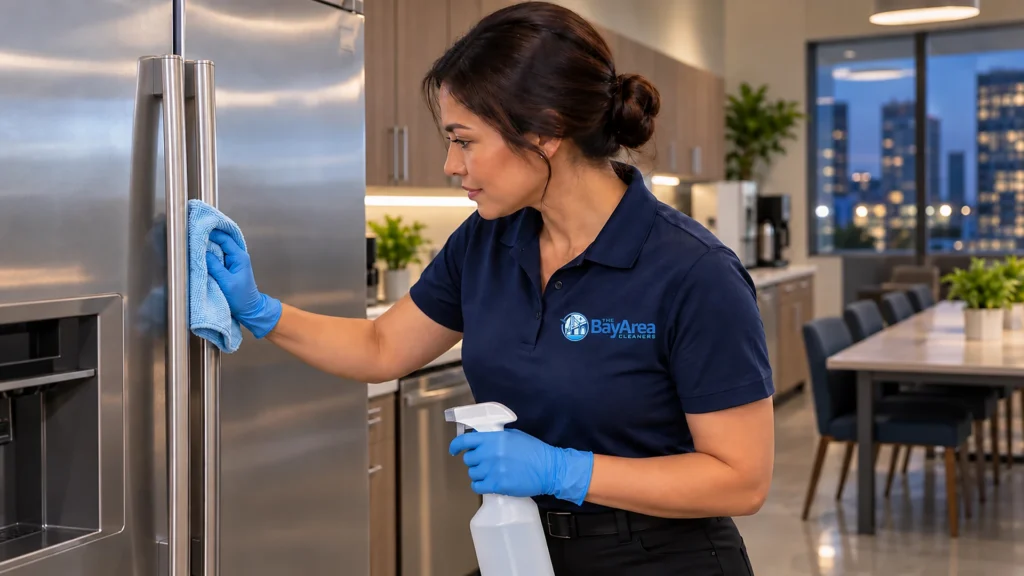
Every hand in the office touches the outside of the fridge. Handles, door edges and the water dispenser panel collect fingerprints and drips all day. Office kitchen cleaning that reaches microwaves and fridge exteriors puts those surfaces on the crew’s list for each visit.
Stainless doors streak when a cleaner dries on them. A cleaner made for stainless steel avoids streaks and residue, per Whirlpool, so ask your crew which one they use on the fridge.
You may also like: How to Clean Stainless Steel Rust in Commercial Buildings
Low on the front, the grille needs attention too. Keep it free of dust and lint so air can reach the condenser. FSIS puts coil cleaning with a brush or vacuum at several times a year. Whirlpool describes the same job with a vacuum and a long, soft-bristled brush.
Coil cleaning means unplugging the fridge and sometimes moving it, so treat it as a facilities task. Put it on the same calendar as the three-month wash, and you’ll pull the plug only once.
Takeaway: Wipe handles and doors often, dust the grille and have facilities clean the coils several times a year.
Before and After a Holiday Closure
If your office closes between the holidays, a fridge left full over that break greets everyone in January with the worst smell of the year. Hold a cleanout on the last workday before the closure, and send every perishable item home or to the trash. The first morning back, before anyone restocks, is the easiest time all year to show the new month’s team how to clean a fridge from top to bottom.
If the fridge stays on, leave the thermometers in place and ask staff to take medication and stored milk home before the break. A reading on the first morning back can’t show how long the fridge sat warm during an outage. If the building lost electricity, throw out perishable food left inside, since FSIS says food held warmer than 40°F for more than 2 hours shouldn’t be eaten.
Office parties fill the fridge fast. Trays of leftovers go in at 4 p.m. and stay until someone notices. Give party food a one-day limit, and add it to the posted rule.
When the party leaves more than the fridge behind, book a post-party cleanup for the office so the breakroom is ready for the first Monday back.
Takeaway: Empty the fridge before a holiday closure, send medication and stored milk home and toss perishables after any outage.
Frequently Asked Questions
Does everyone on the rotation need to know how to clean a fridge?
Yes, if the job moves between teams. Tape the numbered steps inside a cabinet door near the fridge, and store the cooler and ice packs nearby. Whoever has the month starts with the cooler, since Whirlpool’s guide caps food’s time outside the fridge at two hours.
Where else can an odor hide once you know how to clean a fridge that smells?
Under the crisper drawers, in the door bins and deep in the folds of the door seal, which a quick wipe misses. If those are clean, check the freezer for forgotten containers and wash the ice trays.
Can facilities staff figure out how to clean a fridge drain hole on their own?
On some models. GE sends built-in models and most freestanding side-by-side models to a technician, and the owner’s manual says whether yours can be cleared in place. If there’s no hole behind the panel, or the water keeps coming back after a flush, book service.
Should the posted rule explain how to clean a fridge and freezer in each meeting room?
Yes, by room name, with a note on the units that build up frost. Those need a defrost before the wash. Empty them first, let the frost melt on towels and skip any heater or sharp tool, which can damage the inner lining.
Conclusion
In a shared office, knowing how to clean a fridge starts with a label on every container. The weekly cleanout handles the food, and a full wash every three months handles the shelves, seals and drawers. Thermometers tell you whether the fridge is doing its job.
Odors, leaks and frost each have a cause you can find. Track it down, follow your owner’s manual and send drain or coil work to facilities when the manual points there.
Fridge exteriors, microwaves and breakroom counters are part of office cleaning with The Bay Area Cleaners, from Vallejo to San Mateo. Call 707-656-9339 for a free estimate, with the breakroom visit timed around your office’s cleanout day.