
A visitor walks through a lobby in about ten seconds. Their eyes move fast, split between the reception desk, the signage, the exit. Then they step into an elevator. The doors close. For the next thirty to sixty seconds, there is nothing else to look at. No phone signal worth checking, no conversation to have with a stranger. Just the four walls, the panel, and whatever is or is not on them. Elevator cleaning as a task gets less attention than almost any other space in a building, and it is the one space where people have nothing to do but notice.
The quick version: Elevator cleaning has to cover three things a lobby pass does not: the button panel, which the CDC lists by name as a high-touch surface, the stainless steel and mirror surfaces that show every fingerprint at close range, and the door tracks, which collect grit that a vacuum never reaches. None of this takes long. It just has to happen on a schedule that matches how confined and how visible the space actually is.
A Small Room Hides Nothing

Most surfaces in a building get judged from a distance or in passing. An elevator cab does not work that way. A typical passenger cab runs about 6 feet by 6 feet, lit directly overhead, with roughly 150 square feet of wall, mirror, and panel surface within arm’s reach. People stand close enough that nobody can politely look away from a smudge the way they might in a hallway.
You may also like: How to Clean Stainless Steel Rust in Commercial Buildings
That proximity changes what counts as dirty. A scuff on a lobby floor twenty feet away reads as normal wear. The same mark at arm’s length, under direct light, reads as neglect. Elevator cleaning gets judged by a stricter standard than the rest of the building simply because of how close people stand to every surface in it.
The ride is also long enough to notice more than one thing. Thirty seconds is enough time to notice a smear on the mirror. Then the dull spot on the handrail. Then the worn corner of the floor.
A single flaw might go unnoticed. Three or four small issues together read as a pattern. Patterns are what people remember when they describe a building to someone else.
Multi-tenant buildings compound this. The same cab serves every floor and every tenant, so a mark left by one visitor gets seen by the next fifty people who ride before anyone wipes it. A single elevator cleaning lapse has more total viewers per hour than almost any other surface in the building, simply because of how many people cycle through the same six feet of space.
Takeaway: An elevator does not get a pass for being small. Its size is exactly why every mark on it gets noticed.
Elevator Cleaning Starts With the Button Panel

Elevator cleaning is the routine servicing of a cab interior: the button panel, the stainless steel and mirrored wall surfaces, the floor, and the door tracks. It is distinct from elevator maintenance, which covers the mechanism that moves the car.
Of those surfaces, the panel carries the most risk. Every passenger touches the same handful of buttons, often within seconds of touching a door handle, a phone, or nothing sanitary at all. The CDC names elevator buttons directly as a high-touch surface, in the same category as door handles and stair rails, and recommends cleaning surfaces like these regularly rather than only when they look dirty.
You may also like: How to Clean Walls: The Paint Finish Decides Everything
That distinction matters. A button panel can look completely clean and still carry the most germs in the cab. Visible dirt and germ load are not the same thing. Elevator cleaning routines built around “wipe it if it looks smudged” miss this every time, since the panel rarely looks smudged even when it has not been touched by a cloth in days.
The fix is not complicated. Run a microfiber cloth with a mild cleaner across the buttons and the surrounding plate on every visit, not just an occasional one. That habit closes the gap between what a routine looks like and what it actually protects against.
Buildings that log this as its own line item tend to keep it consistent. Buildings that bury it inside “wipe down surfaces” tend to skip it whenever the cab looks fine at a glance.
There is a practical reason to log this separately from the rest of the cab, beyond consistency. A crew working through a checklist tends to spend time in proportion to what looks like it needs attention, and a clean-looking panel gets skipped in favor of a visibly scuffed wall. Naming the panel as its own line item removes that judgment call entirely.
Takeaway: The panel does not need to look dirty to need cleaning. Treat it as a fixed task on every visit, not a judgment call based on appearance.
Stainless Steel and Mirrors Show Every Touch at Close Range
Elevator interiors lean heavily on stainless steel and mirrored panels. Both surfaces record fingerprints the moment someone leans a hand against them. At six feet away, nobody notices. At arm’s length under overhead light, every print shows.
You may also like: What Does Proper Baseboard Cleaning Really Involve?
The material itself is not fragile. What damages it is the wrong product. Abrasive pads dull the brushed finish, leaving faint scratch patterns that catch light differently than the surrounding metal.
That scratch pattern is more noticeable than the fingerprint it was meant to remove. A soft microfiber cloth with a cleaner made for stainless steel, applied in the direction of the grain, lifts prints without altering the finish.
Mirrored panels need a separate approach. Glass cleaner works, but it has to go on the cloth first, not sprayed directly onto the panel. Overspray can seep behind the frame and cloud the backing over time. That single habit, spraying the cloth and not the mirror, is the difference between a mirror that stays clear for years and one that develops a foggy edge nobody can clean away.
Rust and pitting on stainless steel are a different problem with a different fix, and they show up more in high-moisture entryways than in an elevator panel. That topic is worth reading on its own rather than folding in here.
Test any new product in a corner panel first, since some stainless steel finishes react differently to the same cleaner. That five-minute check is most of how to clean elevator stainless steel without learning the hard way on a wall every rider sees.
Takeaway: Wipe with the grain, spray the cloth and not the glass, and skip anything abrasive. The finish is more durable than people assume, right up until the wrong pad touches it.
What the Door Tracks Collect That Nobody Sees
Everything carried into an elevator eventually lands in the track the doors slide along. Grit off shoes. Dropped debris. The fine dust that settles into any groove low to the ground.
A vacuum with a standard attachment glides right past it. The track sits lower than where a nozzle naturally rests.
That buildup is not just cosmetic. Grit in the track adds friction to a mechanism built for smooth, repeated motion. Enough of it makes the doors close roughly or catch slightly, in a way a rider feels even if they could not say why. Elevator cleaning that stops at the visible cab and skips the tracks solves the part people see and ignores the part that affects how the doors feel to use.
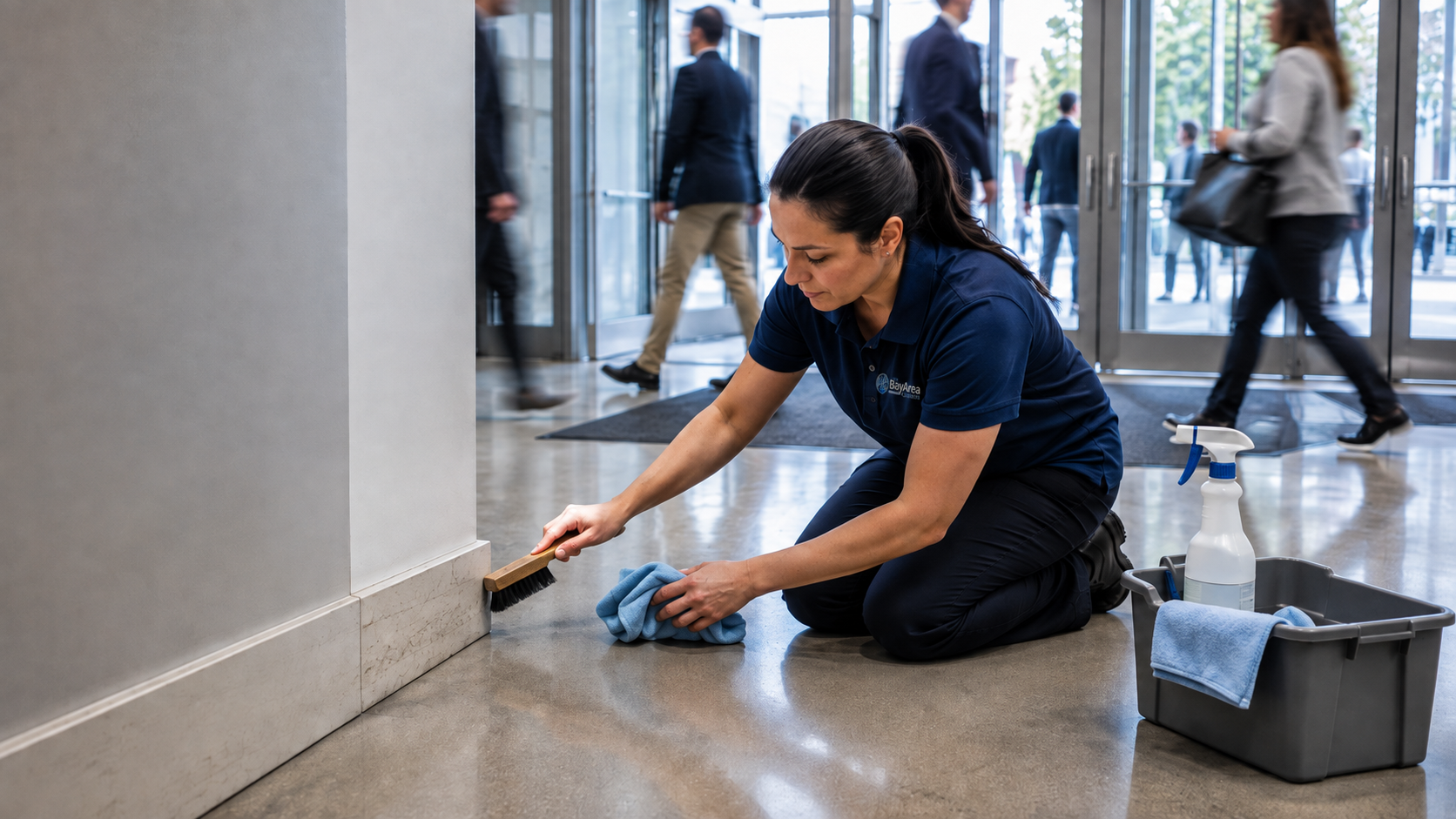
How to clean elevator tracks comes down to a stiff brush or a narrow crevice tool, run along the groove in a couple of minutes per door. It is not a specialist task. It just requires someone to check a spot most cleaning checklists never mention by name.
Landings collect the same problem on the other side of the doors, and that side gets missed even more often than the cab, since it is not technically inside the elevator at all. A floor care pass that includes landing edges catches what a cab-only routine leaves behind.
Takeaway: The tracks do not show up in a walkthrough, but they show up in how the doors move. A two-minute check catches it before it becomes a felt problem.
Cleaning the Cab Is Not the Same Job as Maintaining the Elevator
One confusion causes more missed service than any product or technique. Cleaning the inside of the cab and maintaining the mechanism that moves it are two different jobs, handled by two different providers. Treating them as one is how gaps open up.
A janitorial crew cleans what riders touch and see: panels, mirrors, floors, walls, door tracks. A licensed elevator company handles what makes the car run. Cables, motors, sensors, code compliance, safety inspections.
Neither provider assumes responsibility for the other’s scope unless a contract spells it out. An unspecified gap defaults to nobody’s job, not either one’s.
The building manager caught in between usually finds out during a walkthrough, when the cab looks worn despite an active elevator maintenance contract that was never scoped to include cosmetic cleaning at all. Asking a mechanical vendor to also polish the panel is asking them to do a job they were never priced or trained for, and it usually shows.
A recurring janitorial services agreement that names elevator cabs explicitly closes that gap. Our deep cleaning service covers the cab-interior side on its own schedule, separate from whatever mechanical contract already exists for the equipment itself.
This split also affects who answers a complaint. A tenant reporting a smudged mirror is a janitorial issue, resolved same day. A tenant reporting a slow or noisy door is a mechanical issue, routed to a different vendor entirely. Knowing which is which before the complaint arrives saves a round of back-and-forth about whose job it was to begin with.
Takeaway: A maintenance contract for the mechanism and a cleaning routine for the cab are not the same thing. Confirm both exist before assuming either one covers the other.
Frequently Asked Questions
How often should elevator cleaning happen in a busy building?
Daily for the panel and high-touch points, since those get contact from nearly every rider regardless of total traffic. Full cab detailing, including mirrors, walls, and tracks, runs two to three times a week in a moderate-traffic office building and daily in high-traffic retail. As a planning figure, a standard cab takes about 8 to 12 minutes for a full detail and roughly 2 minutes per door for the tracks.
What should elevator cleaning services include beyond wiping the panel?
A complete service covers the button panel and surrounding plate, stainless steel and mirrored wall panels wiped with the grain, the floor and any mats, and the door tracks on both the cab and each landing the elevator serves. Landing-side tracks collect the same debris as the cab side and get missed just as often.
How do you clean elevator stainless steel without leaving streaks or scratches?
Use a soft microfiber cloth and a cleaner formulated for stainless steel, applied in the direction of the brushed grain rather than in circles. Skip anything abrasive, including scouring pads or all-purpose degreasers not rated for the finish, since both can leave a scratch pattern that shows more than the fingerprint it removed.
How do you clean elevator tracks without damaging the door mechanism?
A stiff brush or a narrow crevice vacuum attachment clears loose grit without touching the moving parts, which sit above the track itself. Avoid spraying liquid cleaner directly into the track, since it can pool in the mechanism rather than drain away, and stick to dry removal unless a spot is visibly sticky enough to need it.
Conclusion
Elevator cleaning gets judged by a different standard than the rest of a building, because a six-by-six room under direct light gives riders nothing to do but notice what is on the walls. Getting it right means treating the button panel as a fixed daily task rather than a visual judgment call, using the right method on stainless steel and mirrors so the fix does not create a new mark, and clearing the door tracks that a standard vacuum pass never reaches.
If your building’s elevator cleaning has fallen behind on the details that a thirty-second ride puts on full display, The Bay Area Cleaners can build a routine that runs alongside whatever mechanical maintenance you already have in place. Call 707-656-9339 to talk through what your building needs.