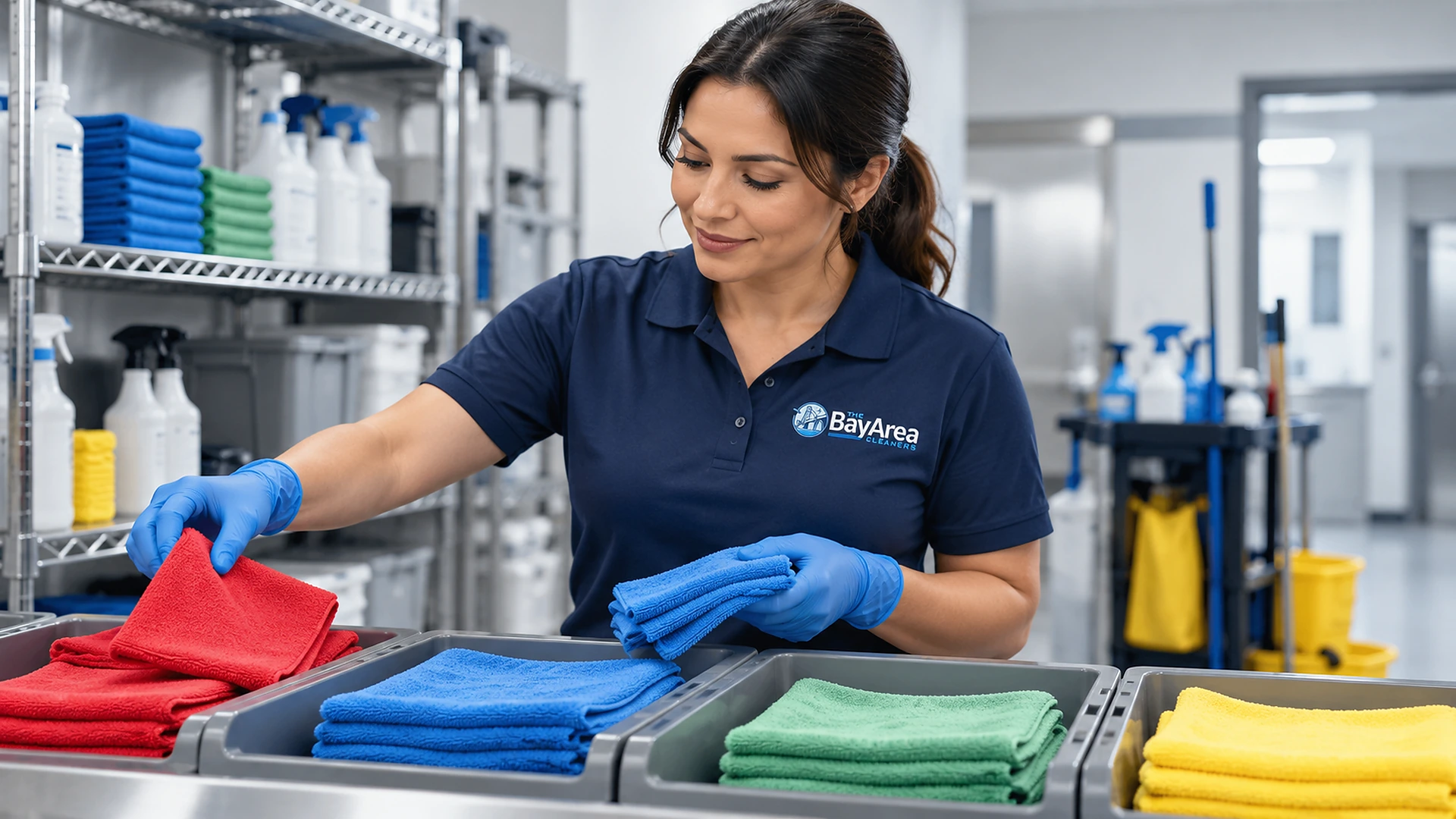
A red cloth means one thing to your night crew. It can mean something else to the day porter, the kitchen contractor or the vendor who cleans a tenant suite upstairs. Color coding cleaning cloths only works when every person who picks one up in your building reads the colors the same way. That takes a chart, backup cues for people who see some colors differently, and wash rules that keep each color apart.
This guide is for facility and property managers who oversee more than one cleaning crew or vendor in a commercial building. It covers where the common colors for color coding cleaning cloths come from, how to set zones and which tools carry each color. It then covers color vision, laundering, disposable cloths, a shared legend for every contractor and how to change over to new colors.
The quick version: Color coding cleaning cloths gives each zone of a building its own color, and every tool used there carries it. England’s national scheme uses red for bathrooms, blue for general areas, green for kitchens and yellow for isolation areas. A New York State custodial manual assigns colors by surface and task instead, with green for dusting. The same color can mean different things to different crews, so one building needs one legend. About 1 in 12 men have color vision deficiency, most often with red and green, so pair each color with a word or mark. Wash each color apart from the others, and change every tool to new colors on the same night.
Where the Common Colors Come From

No U.S. agency sets a color chart for cleaning tools that every commercial building has to follow. What’s out there is a set of examples, and they don’t always agree.
England’s health service has the clearest scheme. Its national standards of healthcare cleanliness describe one national color scheme for all cleaning materials and equipment. Red covers bathrooms, washrooms, showers, toilets, basins and bathroom floors. Blue covers general areas, green covers kitchens and food service, and yellow covers isolation areas.
You may also like: What Does Proper Baseboard Cleaning Really Involve?
New York State’s Office of General Services takes another route in a 2009 restroom cleaning training manual. Its example of color coding cleaning cloths goes by surface and task: yellow for horizontal surfaces, green for dusting, blue for mirrors and bright work, and red for urinals and toilets.
Both sources use red for toilets. After that they split. Green means food areas in one and dusting in the other. That’s why color coding cleaning cloths in a shared building starts with choosing one scheme for every crew.
There’s a practical reason to keep red for toilets instead of inventing your own color. Cleaners who have worked in other buildings may already know red as the toilet color. A chart that matches what they know is easier for your crews to learn, and color coding cleaning cloths sticks from the first shift.
Takeaway: Red for toilets is the common ground. Past that, published schemes disagree, so every building needs one chart that all its crews share.
Color Coding Cleaning Cloths by Zone or by Surface
The two schemes show two ways to split colors. England’s assigns a color to each zone. New York’s assigns a color to each surface or task inside the restroom.
For a building with several crews, zones are easier to share. A zone here is a group of surfaces whose tools never go anywhere else. A sample chart for an office building looks like this:
| Color | Zone it covers | Tools that carry the color |
| Red | Restrooms: toilets, urinals, sinks, counters and floors | Cloths, mop heads, buckets, toilet brushes, reusable gloves |
| Blue | Offices, corridors, lobbies and meeting rooms | Cloths, mop heads, buckets, dusters |
| Green | Break rooms, kitchens and food service areas | Cloths, sponges, buckets, reusable gloves |
| Yellow | Isolation areas, where a building has them | Cloths, mop heads, buckets |
England’s scheme puts restroom basins under red, and this chart does the same. Some U.S. programs give restroom sinks and counters yellow instead, as New York’s manual does for horizontal surfaces. If yours does, yellow can’t mean isolation too.
Pick one meaning for each color across the whole building. A split like yellow for restroom sinks works, as long as yellow means nothing else. Trouble starts when a color does two jobs, such as green for restroom dusting and green for the break room.
Takeaway: Color by zone is the simplest method to share across crews. Whatever split you pick, give each color one meaning.
The Zone Color Goes Past the Cloth

Color coding cleaning cloths is the easy part. The rest of the zone’s tools need the same color. England’s scheme covers all cleaning materials and equipment. It names reusable and disposable cloths, mops, buckets and non-disposable gloves, and red items are used only in bathroom facilities.
A zone’s mop head and bucket stay in that zone. The toilet brush goes further. It stays in its own restroom and doesn’t ride the cart to the next one. Give each restroom its own brush holder, so the brush has a place to go after every use.
The English scheme draws one line worth copying. Cleaning products, the chemicals and detergents, don’t need a color. Color coded cleaning tools carry the zone color, and each product goes where its label allows.
Whoever supplies the tools, your building or the contractor, should buy color coded cleaning supplies in whole sets. A red cloth with a blue bucket sends a mixed message. Matching sets make a wrong tool easy to spot.
Pick a color only if it comes in every tool type the zone uses. A color sold only as cloths leaves the zone’s bucket and mop head without a match.
Takeaway: Cloths, mop heads, buckets, brushes and reusable gloves carry the zone color. Chemicals don’t, and the toilet brush never leaves its restroom.
Plan for Crew Members Who Mix Up Red and Green
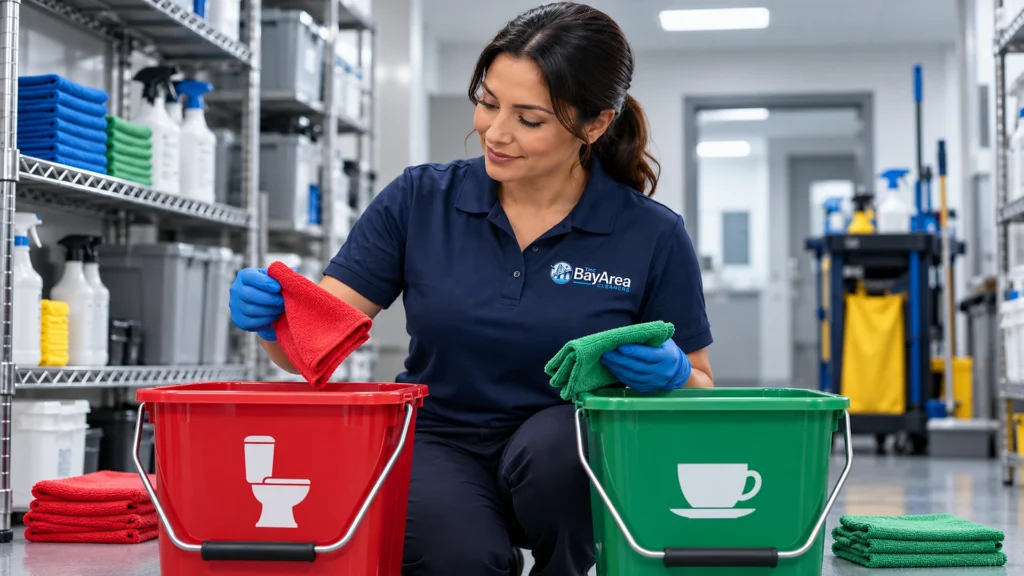
Here’s a weak point in any chart built on color alone. The National Eye Institute says about 1 in 12 men have color vision deficiency. The most common type makes it hard to tell red from green.
You may also like: Tips for Keeping Your Commercial Office Space Clean and Tidy
In the zone chart, red and green are the restroom color and the food color. Any crew can include someone who has trouble with the exact pair your chart most needs to keep apart.
For color coding cleaning cloths, a zone name printed or stitched on the corner is one backup. Buckets with a word on the side and mop handles with a band or a shape work as backups too. A red bucket with a toilet symbol and the word “RESTROOM” on it works for more of your crew.
Ask your supplier whether it sells cloths with a printed zone word or symbol. If it doesn’t, a laundry-safe tag stitched to the corner does the same job and lasts through many washes.
Fixed storage backs up color coding cleaning cloths as well. Give each zone’s tools their own shelf, hook or bin in the supply closet. A tool that comes back to the wrong spot is easy to see, whatever the viewer’s eyesight.
Check the colors where your crews use them. A supply closet with one dim bulb makes red and green harder to tell apart for anyone. Look at a full set under your closet’s own light before you settle on shades.
Takeaway: About 1 in 12 men have color vision deficiency, most often with red and green. Pair every color with a word, a mark or a fixed spot so the chart doesn’t rely on color alone.
Wash Each Color on Its Own

Color coding cleaning cloths falls apart at the washer if every color goes in one load. Keep each zone’s soiled color coded cleaning rags in their own bin until they’re washed, and run the red load by itself. A bin with a lid and the zone word on it keeps a soiled cloth from landing in the wrong pile.
New York’s manual sets out two laundering points for microfiber. It says to launder microfiber cloths following the manufacturer’s recommendations and hang them to dry. It adds that microfiber shouldn’t go in a heated dryer, since heat may melt the fibers.
Washing each color in its own load goes past both published schemes. It means restroom cloths never share a wash with break room cloths.
If a laundry service washes your cloths off site, the rule goes with them. Send each color in its own bag, and ask the service to keep the bags apart through the wash. That’s how color coded cleaning rags come back sorted instead of mixed.
Let each color dry fully before it goes back on a shelf. A damp cloth in a closed bin isn’t ready to use, whatever its color.
Takeaway: Keep each color apart from bin to shelf. Follow the cloth maker’s laundering directions, and keep microfiber out of a heated dryer.
Disposable Cloths Follow the Same Zones
Some buildings use disposable cloths or wipes in restrooms. That doesn’t take them off the chart. England’s scheme covers reusable and disposable cloths alike, so color coding cleaning cloths applies to both kinds.
A disposable cloth belongs to one zone for its whole short life. So disposables carry the zone color, or they come from a dispenser that never leaves the zone. Either way, the chart names them.
A mixed setup works fine. Some buildings use color coded cleaning rags for general areas and disposables for toilets. Name the cloth type next to each color on the chart. “Red: disposable cloths from the restroom dispenser” is clear to a new cleaner on the first night, and “Red: cloths” leaves the question open.
A red dispenser mounted in each restroom keeps the choice out of the cart altogether. That makes the red zone simple for a crew that works fast.
Takeaway: Disposable cloths follow the same zones as reusable ones. Give them the zone color or a dispenser that stays in the zone.
A Shared Legend for a Shared Building
Here’s where color charts break down. A restroom crew trained on New York’s example may dust restroom ledges with green, the color your chart saves for the break room. A tenant’s own vendor may use blue on restroom mirrors, where your chart says red. In a shared restroom, one color can end up with two meanings.
You may also like: Industrial Cleaning Services: How to Evaluate Scope, Equipment and Site Access
The fix is a building legend. When several contractors are color coding cleaning cloths in one building, the legend is the one page that names each color and its zone. Every contractor’s scope points to it, and new vendors get it before their first shift. Send it with any bid request too, so a new contractor prices the right tools from the start.
Each color’s entry names the zone, the tools that carry it, the backup word or mark, and where those tools are stored. The legend tells each contractor which color coded cleaning supplies to bring, so nobody shows up with a set that clashes.
The legend covers the daytime too. A day porter’s restroom cloths carry the same red as the night crew’s.
A wrong-color tool is something anyone can spot at a glance. A blue cloth on a restroom counter or a red bucket in a break room is a finding, whoever sees it. Add that one line to whatever walk your building already runs.
Brief each new crew member on your legend before the first shift. It takes a few minutes. The new cleaner names the color for each zone and points to the word or mark on their color coded cleaning tools.
Takeaway: One legend for the whole building keeps every contractor, porter and night crew on the same colors. A wrong-color tool in a zone is a finding anyone can see.
Change Over to the New Colors on One Night
A building that already runs on mixed colors has a switch to plan. If old and new tools stay in use side by side, the same color keeps two meanings for weeks. The same goes for a building moving to color coding cleaning cloths for the first time.
Pick one night for the change, ideally a quiet one for your building. Pull every old cloth, mop head, bucket and brush from every closet and cart that night. Put the new sets in place before the next shift starts.
Tell every contractor the date ahead of time. Each one brings its own tools into your building, so each one needs the legend and the date. A vendor who misses the notice keeps the old colors, and your legend loses its meaning in that zone.
Order the new color coded cleaning supplies early enough to cover every zone on switch night. Mark each new set with its zone word or symbol before it goes out, so color coding cleaning cloths starts with its backup cues in place.
Take the old tools out of the building. Old stock kept in a back closet tends to come back on a night when supplies run low. If green now means the break room, no old green cloth should stay in use in offices or corridors.
Takeaway: Switch every tool to the new colors on the same night, give every contractor the date, and take the old tools out of the building.
Frequently Asked Questions
What does red mean when color coding cleaning cloths?
Red marks toilets in both England’s national scheme and New York’s custodial manual. England’s scheme extends red to the whole bathroom, including basins and floors. On a zone chart, red tools stay in the restroom and nowhere else.
Where should color coded cleaning supplies be stored?
Each zone’s tools get their own shelf, hook or bin, and red tools stay apart from green ones. Soiled cloths go into a bin for their color until they’re washed. A shared closet can hold every zone, as long as each zone has its own marked spot. Keep red tools on a lower shelf than green ones, so nothing from the restroom set drips onto food-area tools.
Do color coded cleaning tools include gloves and chemicals?
Reusable gloves, yes. England’s scheme names cloths, mops, buckets and non-disposable gloves among the items that carry a color, so reusable gloves belong with your color coded cleaning tools. Cleaning chemicals and detergents don’t need a color under that scheme.
What keeps color coded cleaning rags from mixing in the wash?
Separate bins and separate loads. The wash is an easy place for color coding cleaning cloths to slip. Each color stays in its own bin until washing, runs in its own load and dries fully before it goes back on the shelf. If a laundry service handles the cloths, send each color in its own bag.
Conclusion
Color coding cleaning cloths is a shared language. It works when the colors mean the same thing to every crew, every vendor and every porter in the building.
Give each color one meaning, and let every tool in the zone carry it, from the cloth to the toilet brush. The cloths are the start, not the whole job.
Back each color with a word or a mark, so the chart works for every eye on your crew. Wash each color apart and dry it fully. Then write it all into one legend that every contractor’s scope points to, and switch to it on a single night.
The Bay Area Cleaners runs recurring janitorial programs with the same trained team, a documented checklist and periodic supervisor walkthroughs. Its restroom service follows a documented restroom protocol. Call 707-656-9339 for a free estimate for your building.