Church cleaning services have to answer for a building that does not run on one schedule. It runs on several, stacked on top of each other. A sanctuary that fills once or twice on Sunday needs a different plan than a nursery that turns over every hour. A fellowship hall hosting a potluck on Wednesday needs something else again.
Most church administrators inherit a cleaning arrangement built by whoever was available years ago. Nobody mapped the building room by room. You usually find the gap first in the nursery and the restrooms. Those are the spaces where parents and visitors form an opinion fast.
This guide to church cleaning services walks through each major space your congregation actually uses. It covers what changes the cleaning approach for that space and how to compare church cleaning services before you sign anything.
Why a Church Cannot Run on One Cleaning Schedule?
A church building holds several distinct use patterns inside one roof. The sanctuary sees short, intense bursts of traffic. The nursery runs on a rolling schedule tied to service times. Offices run on a weekday cadence unrelated to Sunday at all. Treating all three the same way wastes attention on quiet rooms and starves the ones that need it.
Three factors decide how often a space should be cleaned.
- Traffic pattern: a burst on Sunday morning is not the same load as steady weekday office use
- Age and vulnerability of the people using it: a nursery carries different stakes than a conference room
- What the space hosts: worship, food service, and childcare each leave different soil and require different products
Church cleaning services that quote one flat rate for the whole building are usually pricing the sanctuary and applying that number everywhere else. That approach overcharges your quiet spaces or underserves your busy ones.
A church cleaning checklist built around the whole building, rather than around each room’s actual use, tends to hide this problem. It looks thorough on paper, and it quietly averages three different needs into one number.
Takeaway: Map your building by use pattern before requesting a quote. A congregation with a nursery, a kitchen, and a sanctuary is really three different cleaning problems under one roof.
The Sanctuary and Worship Space
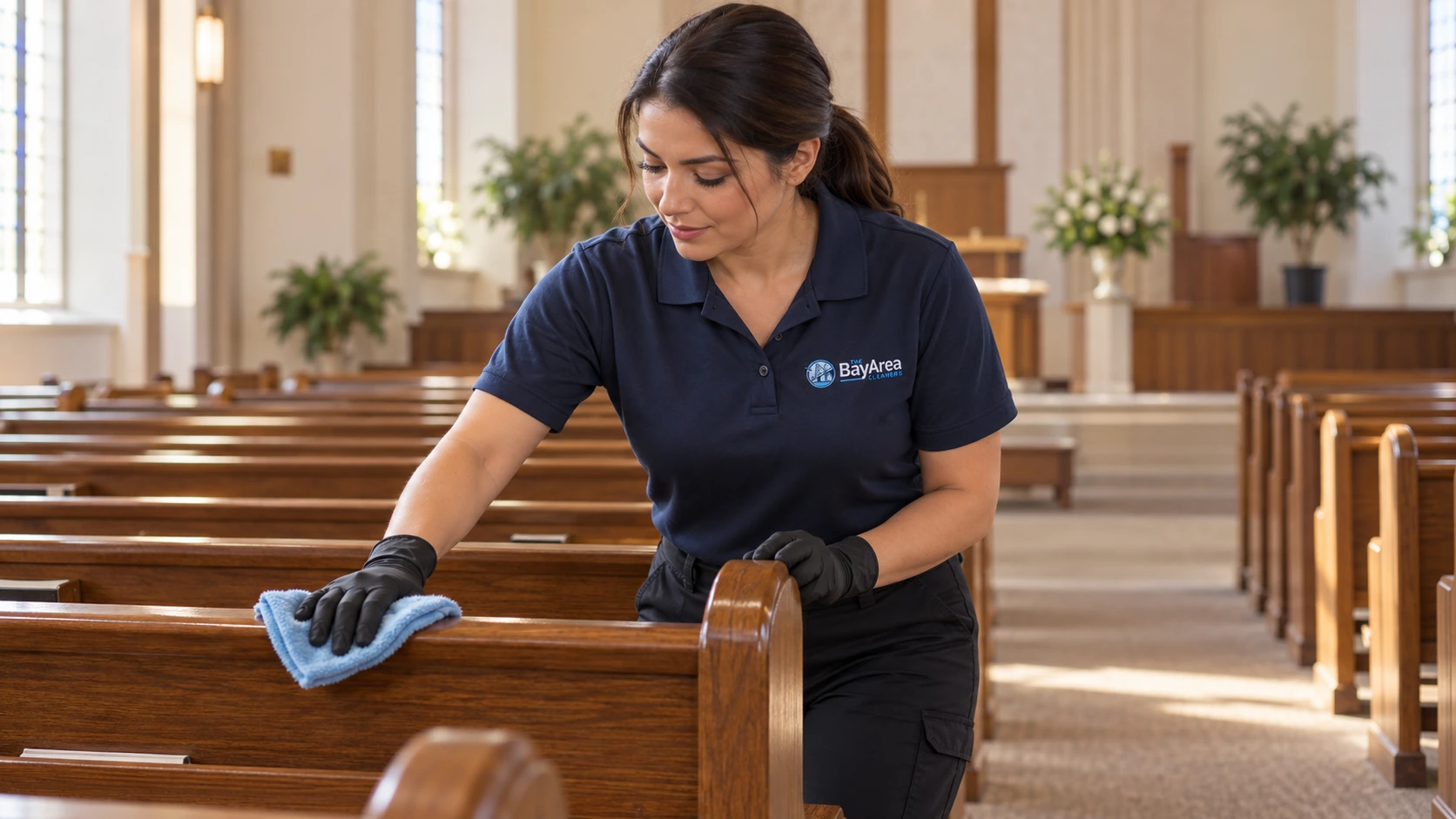
Your sanctuary gets the most attention and the least actual soil, since most congregations use it a handful of hours per week. What it needs is thoroughness on the days it runs, not daily attention.
Pews and seating
Most church cleaning services quote the sanctuary first, since it drives the rest of the proposal.
Pew backs, armrests, and seat surfaces collect hand contact from every person who sits, kneels, or passes an offering plate down the row. A wipe-down between services covers most of the exposure, if it focuses on the surfaces hands actually touch. Full pew cleaning, including undersides and hardware, belongs on a slower cycle, typically monthly.
Floors and carpet
Sanctuary carpet holds foot traffic concentrated into short windows, which is different from an office that sees steady wear all week. Vacuum after each service day. Reserve deep extraction for a quarterly or semiannual cycle, more often if the sanctuary hosts weddings or funerals.
Altars, Communion Items and Sacred Furnishings
These items deserve a note in your contract. Not since they need harsh cleaning, but the opposite. Wood altars, brass fixtures, and stained glass call for gentle, non-abrasive products. Many congregations also prefer a designated staff member over a rotating cleaning crew for these pieces. Write this boundary into your church cleaning services scope by name. It is the one area where a well-meaning vendor can cause damage that ordinary cleaning would not.
Sound and audio-visual surfaces
Microphones, tablets used for lyrics or scripture, and soundboard surfaces get touched by staff and volunteers throughout a service. They need a light wipe with an appropriate product, not a standard all-purpose cleaner that could damage electronics.
Takeaway: Sanctuary cleaning should be scheduled around service days, not calendar days. A sanctuary that meets Sunday and Wednesday needs a different rhythm than one that runs services daily.
You may also like: Commercial Restroom Cleaning: The One Room That Grades the Whole Building
Restrooms near the sanctuary see the same burst pattern as the worship space itself, which makes them a natural pairing on the same service visit.
Nurseries and Children’s Classrooms
This is the space where weak church cleaning services become visible fastest, and where the approach differs most from the rest of the building.
The CDC’s guidance on cleaning and disinfecting early care and education settings draws a clear line between three steps. Cleaning removes dirt and germs with soap, water, and scrubbing. Sanitizing reduces germs to a level considered safe, using a weaker solution. It applies to surfaces that come in contact with children’s mouths, such as toys and feeding items. Disinfecting uses stronger products to destroy remaining germs after cleaning, and is reserved for when someone is sick or at higher risk of getting sick. All three steps have their place. Cleaning always comes first. Dirt and residue make sanitizing or disinfecting products less effective.
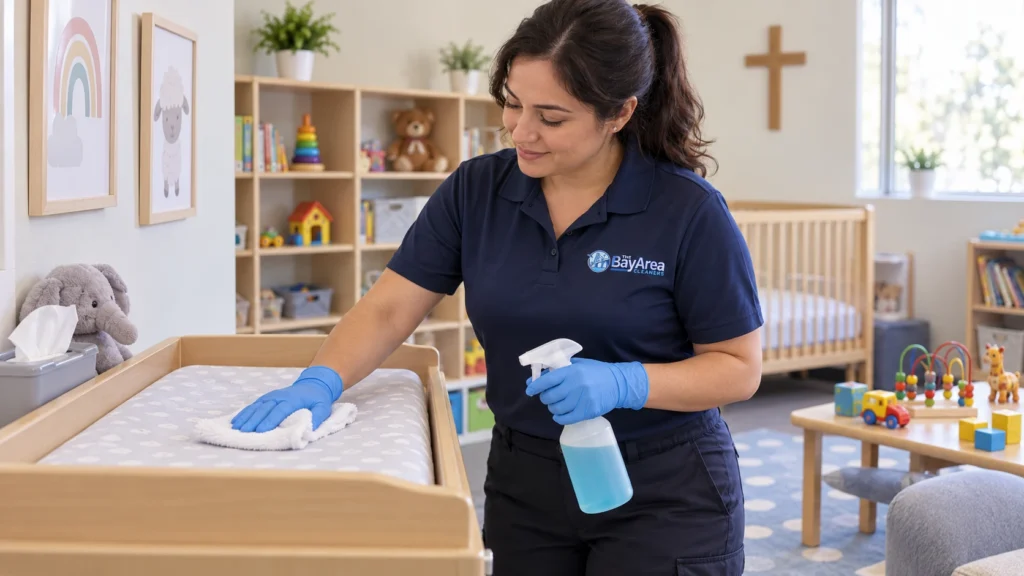
That distinction matters directly for a church nursery. A toy that goes into a toddler’s mouth needs sanitizing after use, every time, not just an occasional wipe-down. A changing table needs disinfecting after every diaper change. General classroom surfaces, tables, and door handles fall into a daily cleaning routine with sanitizing added for high-touch points.
Products matter here as much as method. EPA’s Safer Choice label identifies products where every ingredient has been reviewed for health and environmental safety. Safer Choice certified products are available for homes and for facilities such as schools. That makes the label a reasonable reference point for a nursery supply closet.
- Toys and feeding items: sanitize after each use
- Changing tables: disinfect after every diaper change
- Tables, chairs, and door handles: clean daily, sanitize high-touch points
- Floor mats and soft surfaces: launder or clean per manufacturer instructions on a set cycle
- Cribs and sleep surfaces: clean and sanitize between different children’s use
When you compare church cleaning services for this room, ask any vendor directly whether their crew has handled childcare or classroom spaces before. Ask what products they bring into the nursery. A general commercial cleaning crew without that background may not know the difference between cleaning, sanitizing, and disinfecting. In a nursery that difference is the entire point.
Takeaway: Nursery and classroom cleaning follows a different standard than the rest of the building. Confirm your vendor understands the difference between sanitizing and disinfecting before they ever touch a toy bin.
You may also like: Mold Remediation: What the EPA Thresholds Actually Mean for Your Building
Basement classrooms and nurseries are common in older church buildings. They are usually where moisture problems surface first.
Fellowship Halls and Kitchens
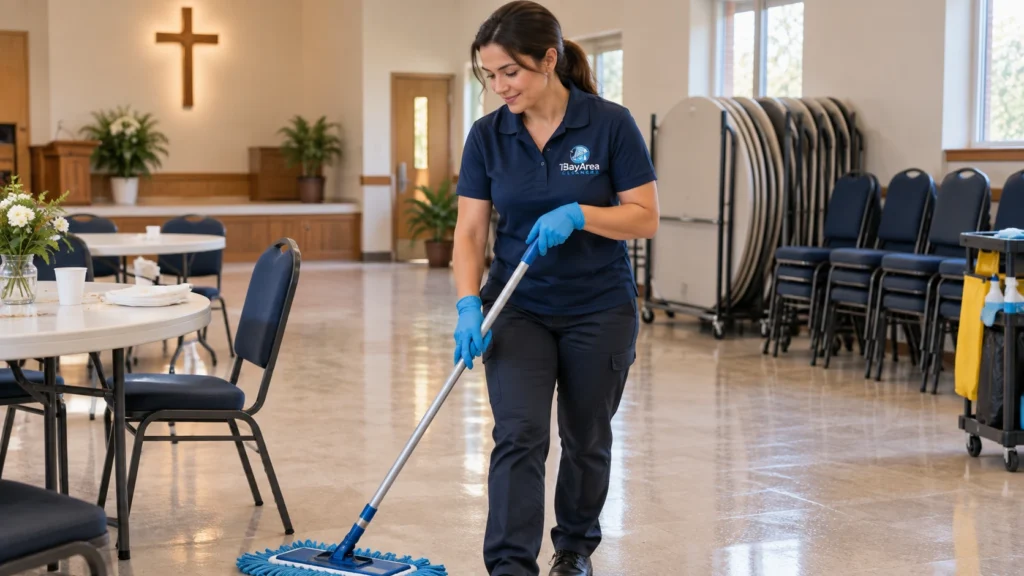
Fellowship halls do double duty as event space, overflow seating, and sometimes a gymnasium. Church cleaning services here have to match whatever happened in the room most recently, not a fixed weekly routine.
A potluck leaves different soil than a youth group movie night, and both differ from a wedding reception. Build the schedule around events rather than the calendar. Trigger cleaning off your event calendar. A same-day or next-day visit beats a fixed Tuesday slot that might land two days after Saturday’s banquet and four days before the next one.
Kitchen areas carry their own considerations, whether your church runs a full commercial kitchen or a simple warming kitchen. Food contact surfaces, refrigeration handles, and shared serving equipment need attention after every use, not on a weekly cycle. Church cleaning services with restaurant or catering experience bring more relevant background here. A crew whose experience is entirely office buildings does not. Ask about that background when you compare religious facility cleaning proposals.
Flooring in a fellowship hall usually takes more abuse than any other surface in the building, from folding chairs dragged across it to spilled punch and dropped food. A durable floor care routine, with spot response built into the contract rather than treated as an extra charge, saves money over time compared to letting damage accumulate between scheduled visits.
Takeaway: Tie fellowship hall cleaning to your event calendar, not to a fixed day of the week. A hall used twice this week and not at all the next does not fit a flat recurring schedule.
Offices, Classrooms and Administrative Space
Church staff offices, meeting rooms, and adult classrooms run on an entirely different rhythm than the worship and childcare spaces. This is where a standard office cleaning routine actually applies, with a few adjustments.
Weekday staff hours mean this space can follow a conventional office cadence, cleaned on weekday evenings or early mornings rather than tied to weekend service traffic. Trash, surface dusting, and floor care follow the same logic as any small office tenant.
The adjustment comes from volunteer and visitor traffic that a typical office does not see. Church offices often host walk-in visitors seeking assistance, committee meetings on weeknights, and volunteers coming and going outside normal business hours. Build a bit more flexibility into the access arrangement than a standard office contract would require.
Adult classrooms and meeting rooms used for Bible studies or small groups sit closer to the sanctuary’s usage pattern. They run busy on set days and quiet otherwise. Schedule them on that pattern rather than folding them into the daily office routine.
Takeaway: Administrative space can run on a standard office schedule. Do not let the rest of the building’s irregular rhythm push you into over-cleaning your offices or under-cleaning them. Separate the two.
You may also like: High Dusting: Why Your Clean Floors Do Not Stay Clean
Sanctuaries with high ceilings, exposed beams, and hanging light fixtures accumulate dust in places a standard cleaning pass never reaches, which eventually settles back onto pews and floors below.
Handling Weddings, Funerals and Holiday Services
Special events break every routine schedule a church has built. They deserve their own line in the church cleaning services contract, not an assumption that the regular crew will handle it.
Weddings and funerals both bring a spike in foot traffic, flowers that shed petals and pollen, and often an expectation of same-day turnaround. Church cleaning services that already handle event turnarounds regularly will have a standard answer for this. One that does not may improvise on the day it matters most. A funeral in the morning and a wedding rehearsal that evening leave almost no window for a full reset. Confirm with your vendor in advance how a short-notice event gets scheduled. Do this before the invitation goes out, not after.
Holiday services present a different challenge: volume rather than turnaround speed. Christmas Eve and Easter services can bring several times the normal attendance through the same restrooms, entryways, and sanctuary in a single day. That calls for additional service visits scheduled around the specific dates, not the standing weekly plan stretched to cover a much larger crowd.
- Confirm event notice requirements in the contract, ideally at least a week for weddings and funerals when they are scheduled in advance
- Ask how the vendor handles same-day requests for unplanned funerals
- Schedule extra restroom and entryway service for known high-attendance dates
- Decide who handles flower and decoration debris after weddings, since florists and cleaning crews sometimes assume the other will handle it
Takeaway: Put special events in writing as their own category, with a defined notice period and a defined response time. A contract that only covers routine weeks will not hold up on Christmas Eve.
Comparing Church Cleaning Companies Before You Sign
Once you understand what each space in your building actually needs, comparing church cleaning services gets much easier.
Ask about experience with religious facility cleaning, not just commercial buildings overall. Some vendors market themselves as church janitorial services, and that focus usually shows in how they answer this question. A vendor who has cleaned offices and retail stores but never a sanctuary or a nursery will need to learn your building’s quirks on your dime.
Ask how the vendor structures the contract around your actual schedule. Church cleaning services built around a fixed nightly window do not fit a building whose busiest day is Sunday morning. A typical office crew would not even be working then. A recurring janitorial arrangement built around weekend hours has usually solved this problem before you had to ask.
Confirm insurance and background checks for any crew member with building access, especially in the nursery and classroom areas. Many congregations restrict access to those spaces separately from the rest of the building, and your church cleaning services contract should say so in writing.
Ask for references from other congregations, ideally similar in size and schedule to yours. A vendor serving a downtown cathedral with daily services has a different rhythm than one serving a small suburban church that meets only on Sundays.
| What to compare | Strong answer | Warning sign |
| Religious facility experience | Named church or synagogue references | Only office and retail references |
| Nursery and classroom knowledge | Distinguishes sanitizing from disinfecting | Treats all rooms the same |
| Schedule fit | Builds around service and event calendar | One fixed nightly window |
| Special event handling | Defined notice period and response time | No mention of weddings or funerals |
| Access and screening | Background checks on assigned crew | No screening process offered |
Price should be the last comparison, not the first. Compare church cleaning services room type by room type, not as one number for the whole building.
Takeaway: Compare experience with religious facilities and schedule fit before price. A cheaper bid built around the wrong schedule creates more work than it saves.
You may also like: Elevator Cleaning: Why a Six-by-Six Room Gets Noticed More Than the Lobby
Multi-level churches with accessibility elevators should scope that space the way any commercial building would. It sees the same concentrated hand contact.
Frequently Asked Questions
What do church cleaning services typically include?
Most programs cover the sanctuary, restrooms, nursery and classrooms, fellowship hall, kitchen, and administrative offices. Each runs on its own schedule, tied to how you actually use that space. Church cleaning services usually separate routine weekly cleaning from event-driven cleaning around weddings, funerals, and holiday services. Those two categories need different response times and different pricing.
How often should a church be cleaned?
Frequency depends on which space you mean, not the building as a whole. The sanctuary typically needs thorough cleaning after each service day. The nursery needs daily cleaning with sanitizing throughout the day for high-touch items. Offices can follow a standard weekday office schedule. A single frequency for the entire building usually means some rooms are over-cleaned and others are under-cleaned.
What should a church look for in cleaning companies serving religious facilities?
Look for direct experience with religious facility cleaning, not just general commercial cleaning. Ask whether the company understands the difference between cleaning, sanitizing, and disinfecting for nursery and classroom spaces. Ask how it handles background checks for crew with building access. Ask whether its schedule can flex around your service calendar, instead of forcing your services around a fixed cleaning window.
Should churches use different products in the nursery than in the rest of the building?
Yes, in most cases. Items that go into children’s mouths need sanitizing after each use. Changing tables need disinfecting after every diaper change. That is a different standard than general office or sanctuary cleaning. Many congregations look for products carrying a label such as EPA’s Safer Choice mark. Children’s spaces carry different exposure considerations than an adult meeting room.
Conclusion
Your congregation is not one building with one cleaning need. It is several spaces under one roof, each with its own traffic pattern, its own vulnerable population, and its own products. Map your sanctuary, nursery, fellowship hall, kitchen, and offices separately. Write special events into the contract as their own category.
Compare church cleaning services on religious facility experience and schedule fit before price. If your congregation also needs work on general floor care or a scheduled deep clean before a major holiday, scope that separately from the standing weekly visit. Call 707-656-9339 to walk your building and build a schedule around how your congregation actually uses each room.