
A property manager finds a dark patch behind a water fountain. It is maybe the size of a dinner plate. The obvious questions come fast. Is this dangerous? Do we close the floor? Can maintenance handle it, or does this turn into a five-figure job with plastic sheeting and respirators? The answer turns on a number most building owners have never heard of. It is not about how bad the mold looks. It is about how many square feet it covers.
The quick version: Federal guidance sorts mold remediation by area, not by severity. The thresholds are numeric and easy to apply once you know them. Under ten square feet, trained staff can handle it with basic protection. Between ten and one hundred, you need containment. Above one hundred, the job needs full containment and outside pros. And the most common mistake, reaching for bleach, is something the EPA does not recommend as routine practice.
What Mold Remediation Actually Means

Mold remediation means removing mold from a building and fixing the moisture that let it grow. That second half is what separates it from cleaning.
Wiping a surface handles what you see. Remediation handles why it appeared. Without that, the same patch returns in the same spot within weeks.
The difference matters more than the words suggest. The EPA’s guidance for schools and commercial buildings puts it plainly: the key to mold control is moisture control.
A leaking pipe. A roof that fails in heavy rain. Condensation on a cold surface. Humidity that never drops. Any of these regrows a colony on a surface scrubbed clean the day before.
There is a second point in that guidance that surprises most people. The purpose of the work is to remove the mold, not merely to kill it.
Dead mold is still allergenic, and some dead molds remain potentially toxic. A product that kills a colony but leaves it in place has not solved the problem. It stopped the growth, but the material that triggers reactions stays exactly where it was.
You may also like: How to Clean Grout on Commercial Tile Floors
That is why a real plan has three parts rather than one. Fix the water problem. Remove the contaminated material. Verify the space is dry and stays dry.
Skip any of the three and the project becomes a recurring line item instead of a resolved issue.
One more thing to know before anyone quotes you. There are no federal standards for airborne mold levels. The EPA has not set limits for mold or mold spores.
So any vendor citing a spore count as a legal limit is describing their own standard, not a federal one. That is a useful question to ask a contractor early.
Takeaway: Remediation means removing the mold and fixing the moisture that caused it. Kill the colony without fixing the leak and you have scheduled the same job again.
The Square Footage Decides the Response

The framework that governs mold remediation in commercial buildings organizes everything around the size of the affected area. Not how black it looks. Not how bad it smells. Square feet.
That surprises people. The EPA is candid about why the numbers exist. They make it easier to pick the right technique, not because research shows a method becomes necessary at a specific size.
Limited containment means sealing the work area with one layer of six-mil fire-retardant polyethylene, with a slit entry and a flap on the outside. Supply vents, air returns, doors, chases, and risers inside that zone all get sealed.
The area is held under negative pressure, usually with a HEPA-filtered fan exhausting outdoors.
You may also like: How to Clean Walls: The Paint Finish Decides Everything
There is a field check for whether containment works, and it costs nothing. The sheeting should billow inward against every surface. If it flutters or pushes outward, containment has been lost and needs fixing before work continues.
A facility manager can check that with their own eyes. No equipment required.
Full containment adds a second layer of sheeting and a decontamination chamber for entry and exit. The chamber has to fit a waste container and let a worker put on and take off protective gear. Respirators stay on until the worker is fully outside it.
Size is a starting point, not a verdict. The EPA is direct that judgment overrides the table.
Heavy growth in a small area can release more spores than light growth across a large one. A small patch positioned to spread through occupied space may need full containment despite its size.
Four conditions push toward the cautious approach regardless of size: a toxic species identified or suspected, extensive hidden growth expected, a high chance of the material going airborne, or sensitive people in the building such as those with severe allergies or asthma.
| Affected area | Containment required | What that involves |
| Under 10 sq ft | None | Trained in-house staff, minimum N-95 respirator, gloves, eye protection |
| 10 to 100 sq ft | Limited | Single layer of 6-mil fire-retardant polyethylene, slit entry, area under negative pressure |
| Over 100 sq ft | Full | Double polyethylene layers, decontamination airlock, outside professionals |
Takeaway: Ten and one hundred square feet are the numbers that change the scope of the work. They are guidelines built for planning, not legal limits, and judgment can override them in either direction.
Why Bleach Is Not the Answer
Ask ten people how to deal with mold and most will say bleach. The federal guidance says something different, and it is worth stating accurately because it runs against decades of habit.
The use of a biocide such as chlorine bleach is not recommended as routine practice during mold remediation. Judgment may call for it in some cases, such as when immune-compromised people are present. But as a default, it is not what the guidance asks for.
The reasoning ties back to dead mold. Sterilizing an area is neither possible nor desirable in most cases. A background level of spores always stays in the air, roughly the same as or lower than outdoor levels, and those spores will not grow once the moisture problem is fixed.
Bleach attacks the visible symptom while leaving both the allergenic material and the underlying cause untouched.
Two safety points matter for any crew doing this work. Never mix bleach with cleaners or detergents containing ammonia, because the combination produces toxic fumes.
And if a biocide is used at all, ventilate the area. Sometimes that means bringing in outdoor air with fans, while taking care not to push spores into clean areas.
What the guidance recommends instead depends on the material. Nonporous hard surfaces can usually be cleaned by wiping or scrubbing with water, or water and detergent, then dried fast and fully.
Porous materials that are wet and growing mold often have to go. Mold works into porous substances and fills the crevices, which makes full removal difficult or impossible. Gypsum board, ceiling tile, and carpet padding fall into that category far more often than building owners expect.
HEPA vacuuming has a specific place in the sequence. Use it for final cleanup, after materials are dry and contaminated items are out, and for dust that settled outside the work area.
Filter seating matters, since air that bypasses the filter defeats the purpose. The filter and its contents go into well-sealed plastic bags.
One more practical rule that saves money: do not paint or caulk a moldy surface. Clean and dry it first. Paint applied over mold is likely to peel, which means paying twice for the same wall.
This comes up constantly in buildings finishing a renovation, where drywall that got wet during the build gets painted over on schedule rather than dried first. A post-construction cleaning pass before finishes go on is far cheaper than reopening a wall six months later.
Takeaway: Bleach is not the recommended default. Clean nonporous surfaces with detergent and water, discard porous materials that are contaminated, and finish with HEPA vacuuming.
The Mold You Cannot See
The patch behind the water fountain is the easy case, because someone found it. The harder problem is growth where nobody looks. That is how a small issue becomes a large one without anyone deciding anything.
The EPA guidance lists specific hiding places. Read them as a checklist, not a general warning.
Look at the back side of drywall, behind wallpaper, and behind paneling. Check the top of ceiling tiles and the underside of carpets and pads.
Then add the spots where conditions favor growth: pipe chases and utility tunnels with leaking pipes, walls behind furniture where condensation forms, condensate drain pans inside air handlers, porous liners inside ductwork, and roof materials above ceiling tiles.
You may also like: How to Clean Laminate Floors Without Warping the Seams
Some building materials make this worse by design. Drywall with vinyl wallpaper over it, or wood paneling, acts as a vapor barrier. It traps moisture underneath and creates exactly what mold needs.
The surface looks intact. The back of it is not.
Two signals point toward hidden growth. A building smells musty but nobody finds the source. Or there was known water damage and occupants report health problems. Either one is reason to look harder before assuming the visible area is all of it.
Investigating carries its own risk. Pulling wallpaper can release a huge quantity of spores from growth underneath. That is why disturbing a suspected site calls for protective gear, even during what feels like a look rather than a cleanup.
If hidden growth turns up, the plan has to be revised for the full area. That often pushes a job from one threshold into the next.
The HVAC system deserves its own mention, because it changes the scale of everything. Do not run the system if you know or suspect it is contaminated. Air handling equipment spreads spores through every zone it serves, turning a local problem into a building-wide one in hours. During remediation work, the guidance suggests upgrading filters, to a MERV 8 rating or better, since conventional filters are typically not effective at capturing particles the size of mold spores.
Takeaway: The visible patch is often not the full extent. Musty odor with no obvious source, or known water damage plus occupant complaints, means the affected area is probably larger than what you can point at.
Where Routine Cleaning Ends and This Work Begins
Here is the line that matters when deciding who to call. Routine commercial cleaning prevents the conditions that lead to mold and catches problems early. Mold remediation is a separate trade, often licensed at the state level, that handles contamination once it takes hold.
Prevention lives on the cleaning side, and it works. Water damage handled within twenty-four to forty-eight hours can avoid remediation entirely. That window is roughly how long it takes for growth to start on wet materials.
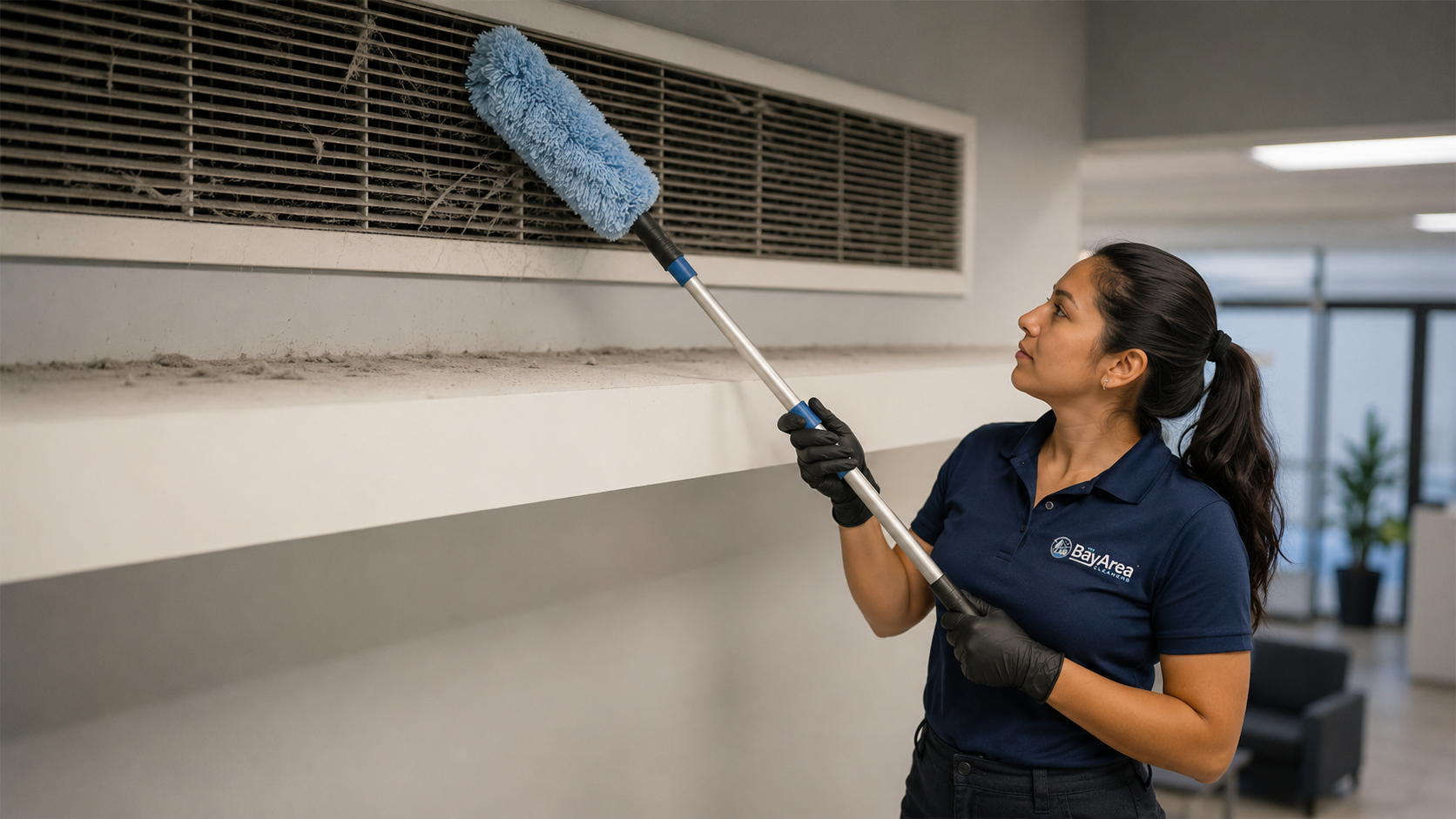
Drying an area fast and fully inside that window is the difference between a cleanup and a project. Our deep cleaning service covers the surface work and the moisture-prone areas where early detection happens, which is prevention rather than remediation.
Some environments create the conditions over and over, and those gain the most from a routine that watches for them.
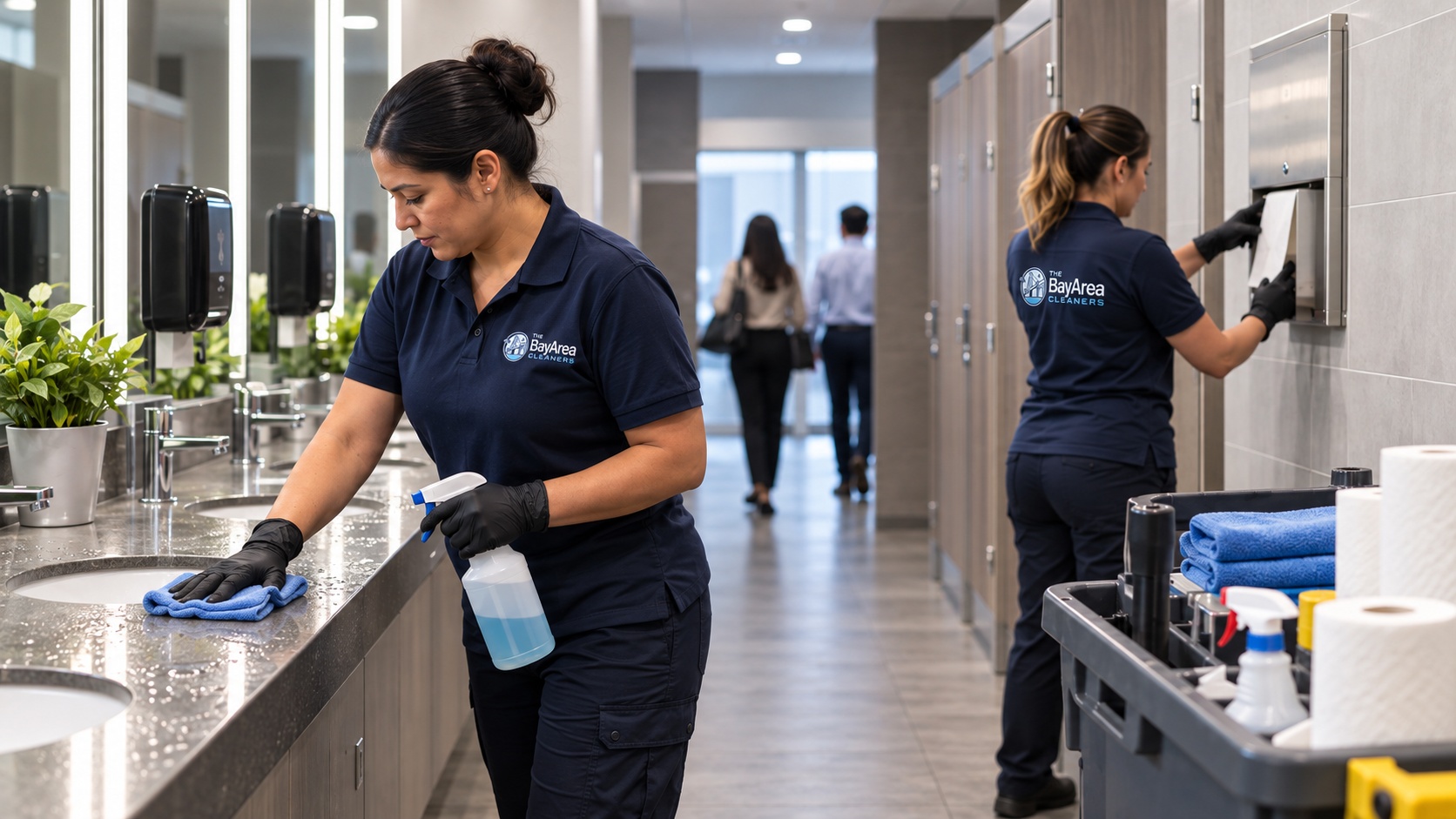
Restrooms combine constant moisture with weak ventilation. That is why restroom cleaning on a steady schedule catches early growth around fixtures and grout, before it reaches the wall cavity.
Buildings coming out of construction carry a related risk. Materials that got wet during the build hold moisture behind finished surfaces, and that is the point where the problem gets caught or missed.
What a cleaning provider should not do is take on a contamination problem that has crossed the thresholds. Above ten square feet the work needs containment, specific protective gear, and in several states a licensed remediator. A vendor offering to handle a large mold problem with the same crew that does nightly janitorial is describing a scope they are not equipped for. The building owner carries the consequences.
The handoff runs both ways. A cleaning crew that finds growth should document it, report size and location, and stop rather than disturb it. A remediation contractor finishing a job leaves a space that still needs the moisture watched, and that is where routine service picks back up.
Takeaway: Prevention and early detection sit with your cleaning provider. Contamination past ten square feet sits with a licensed remediator. Any vendor blurring that line is telling you something about their scope.
Frequently Asked Questions
When is mold remediation required instead of regular cleaning?
The federal guidance for commercial buildings uses ten square feet as the first threshold. Below that, trained in-house staff can generally handle cleanup with an N-95 respirator, gloves, and eye protection. Above it, containment becomes necessary, and above one hundred square feet the job calls for full containment and outside professionals. Several states add their own licensing requirements on top of the federal guidance, so local rules can require a licensed contractor sooner.
Does mold remediation include fixing the leak that caused it?
Fixing the moisture source is part of the process, not a separate project, though the physical repair is often done by a plumber or roofer rather than the remediation crew. The guidance is explicit that the water problem has to be corrected or the mold simply reappears. A remediation plan that does not identify and address the moisture source is incomplete, and that is a reasonable thing to ask about before signing anything.
How do you know when mold remediation is actually finished?
The moisture problem has to be completely fixed, visible mold and mold-damaged materials should be gone, and moldy odors should be absent. If sampling was done, indoor mold types and concentrations should resemble what is found outdoors. The site should be revisited shortly afterward with no signs of water damage or regrowth, and occupants should be able to use the space without health complaints. The EPA acknowledges this is a judgment call rather than a pass-fail test.
Is air sampling necessary before mold remediation?
In most cases where visible growth is present, sampling is unnecessary. It becomes useful in specific situations: litigation, an unclear contamination source, or ongoing health concerns. Air sampling captures only the moment it was taken, results require experience to interpret, and since no federal threshold limits exist for mold, sampling cannot verify compliance with any federal standard. Anyone conducting it should have specific experience in sampling protocols and interpretation.
Conclusion
Mold remediation is decided by measurements, not impressions. That is good news for anyone who needs to make a defensible call.
Measure the affected area first. Ten and one hundred square feet decide whether this is in-house work, a contained job, or a full professional project. Find the water source before touching the growth, because the colony returns without that step. And skip the bleach as a default, since the guidance calls for removing contaminated material rather than killing it in place.
The cheapest move a building owner can make sits earlier than any of that. Water damage handled within twenty-four to forty-eight hours usually stops growth before it starts. That makes routine cleaning and early detection far cheaper than mold remediation.
If you want the moisture-prone areas of your facility on a schedule that catches problems inside that window, The Bay Area Cleaners covers offices, schools, retail, and contractor projects from Vallejo to San Mateo. Call 707-656-9339 to talk through your building.