A cleaning scope can say “sanitize” for the break room and “disinfect” for the restroom. The two words sound close enough to swap. On a product label they aren’t. Sanitizing vs disinfecting comes down to the claim the maker was allowed to print, and each claim rests on a test the product passed.
This guide is for facility and property managers who sign off on cleaning scopes and product lists. It covers how federal rules sort cleaning vs sanitizing vs disinfecting products, the test behind each claim, and how one bottle can carry two claims. It then covers break room counters, the hospital claim, where the third word in sanitizing vs disinfecting vs sterilizing fits, and the California rules that apply.
The quick version: EPA regulates sanitizers and disinfectants as pesticides, and a cleaner falls under that rule only if it claims to kill germs. A sanitizer used away from food has to cut test bacteria by 99.9% in 5 minutes. A food-contact sanitizer has to reach 99.999% in 30 seconds. A hospital disinfectant has to pass a kill test against two named bacteria in 10 minutes. Sterilizing kills all microbial life and belongs to clinical and device work, not building surfaces. Many bottles carry a sanitizer claim and a disinfectant claim, each with its own directions. In California, the state registers these products too, and anyone using them at a public K-12 school or licensed child care center needs Healthy Schools Act training.
Both Claims Put a Product Under Pesticide Law
EPA has a short page on the difference between products that disinfect, sanitize and clean. It starts from a point most scopes skip. The agency treats sanitizers and disinfectants as antimicrobial pesticides. A cleaning product falls under that rule only if it claims to sanitize or disinfect.
You may also like: Church Cleaning Services: What Sanctuaries, Fellowship Halls and Nurseries Each Require
That’s the legal line in cleaning vs disinfecting products. A plain cleaner with no germ claim is sold like any soap. It can clean a counter well. It just can’t claim to kill germs.
Once the label says it kills germs, the product has to be registered with EPA and backed by test data. Look for a sanitizing or disinfecting claim on the label. Without one, the bottle is a cleaner.
EPA’s wording for the two claims is plain. Sanitizing kills bacteria on surfaces and “is not intended to kill viruses.” Disinfecting kills viruses and bacteria. So sanitizing vs disinfecting isn’t only about strength. It’s about which germs the label may name.
The same page says disinfectants face stricter tests than sanitizers. Hand sanitizers sit under FDA, not EPA. So the hand pump by your elevator and the spray bottle on the cart follow two rulebooks.
Takeaway: A product turns into a sanitizer or a disinfectant by making the claim and passing EPA’s test. A cleaner with no germ claim stays outside that system.
The Test Behind Each Claim
Each claim points to a test the product had to pass. EPA’s October 2024 interim guidance on virus claims lists the current standards in one table. Set side by side, the gap between the claims is easy to read.
| Label claim | EPA test standard | What it tells you |
| Sanitizer, away from food | At least 99.9% fewer test bacteria within 5 minutes | Fewer bacteria on surfaces that don’t touch food |
| Food-contact sanitizer | At least 99.999% fewer within 30 seconds for most products | Fit for food surfaces by the label’s food-contact directions |
| Hospital disinfectant | Passes EPA’s kill test against Staphylococcus aureus and Pseudomonas aeruginosa within 10 minutes | A tested kill claim you can check on the label |
Put numbers on the first two rows. Start with a million test bacteria on a surface. A 99.9% drop leaves 1,000 of them. A 99.999% drop leaves 10.
Food surfaces get the tighter test, and it’s the fastest one. That speed suits a counter that goes back into use a minute later. Both are real claims, and they aren’t the same claim.
Read the rows together and sanitizing vs disinfecting stops being vague. The sanitizer rows grade a percentage drop. The disinfectant row grades a kill test.
Takeaway: Sanitizers promise a percentage drop in a set time. Disinfectants promise to pass a kill test. The claim on the label tells you which promise you bought.
One Bottle Can Carry Two Claims
EPA’s page notes that many products are registered as both sanitizers and disinfectants. They passed both tests. That’s handy on a cart, but it means the bottle alone won’t tell you which claim your crew is using.
You may also like: Medical Office Cleaning: Where Routine Janitorial Work Needs More Control?
A dual-claim label prints a separate set of directions for each claim. Follow the sanitizer steps and you get a sanitizer result. That holds even when the front of the bottle says “disinfectant” in large print.
The front of a dual-claim bottle names the claim it wants you to see. The directions decide what you get. On that bottle, sanitizing vs disinfecting comes down to which directions the crew follows.
Every EPA label carries the same federal line. CDC’s summary of the rules for disinfectants and sterilants quotes it. “It is a violation of federal law to use this product in a manner inconsistent with its labeling.” Using a product off its label breaks that line.
So when your scope says “disinfect,” the product list should name a disinfectant claim, and the crew should work from those directions. When it says “sanitize,” the sanitizer directions apply.
Takeaway: A dual-claim bottle gives you whichever claim the crew follows. Tie each word in your scope to the matching directions on the label.
A Sanitizer Reaches Viruses Only When Its Label Says So
EPA’s page says sanitizing “is not intended to kill viruses.” Since October 2024, EPA lets a sanitizer add a virus claim if lab data back it. So a sanitizer pass on desks or tables reaches viruses only when the label prints a virus claim. Check the label. Don’t assume.
That matters when a building wants more germ control during flu season. If viruses are the goal, the scope needs a product with a virus claim on its label. A plain sanitizer claim won’t cover it.
So read the goal first, then the claim. Bacteria on a food counter call for a food-contact sanitizer. Viruses on shared surfaces call for a product with a virus claim. Plain soil calls for a cleaner, on the other side of the cleaning vs disinfecting line.
A scope settles sanitizing vs disinfecting when each word in it points to one of those goals. That makes the product choice easy to check.
Takeaway: A sanitizer reaches viruses only when its label carries a virus claim. When a scope’s goal includes viruses, name a product with that claim.
Break Room Counters Need a Food-Contact Claim
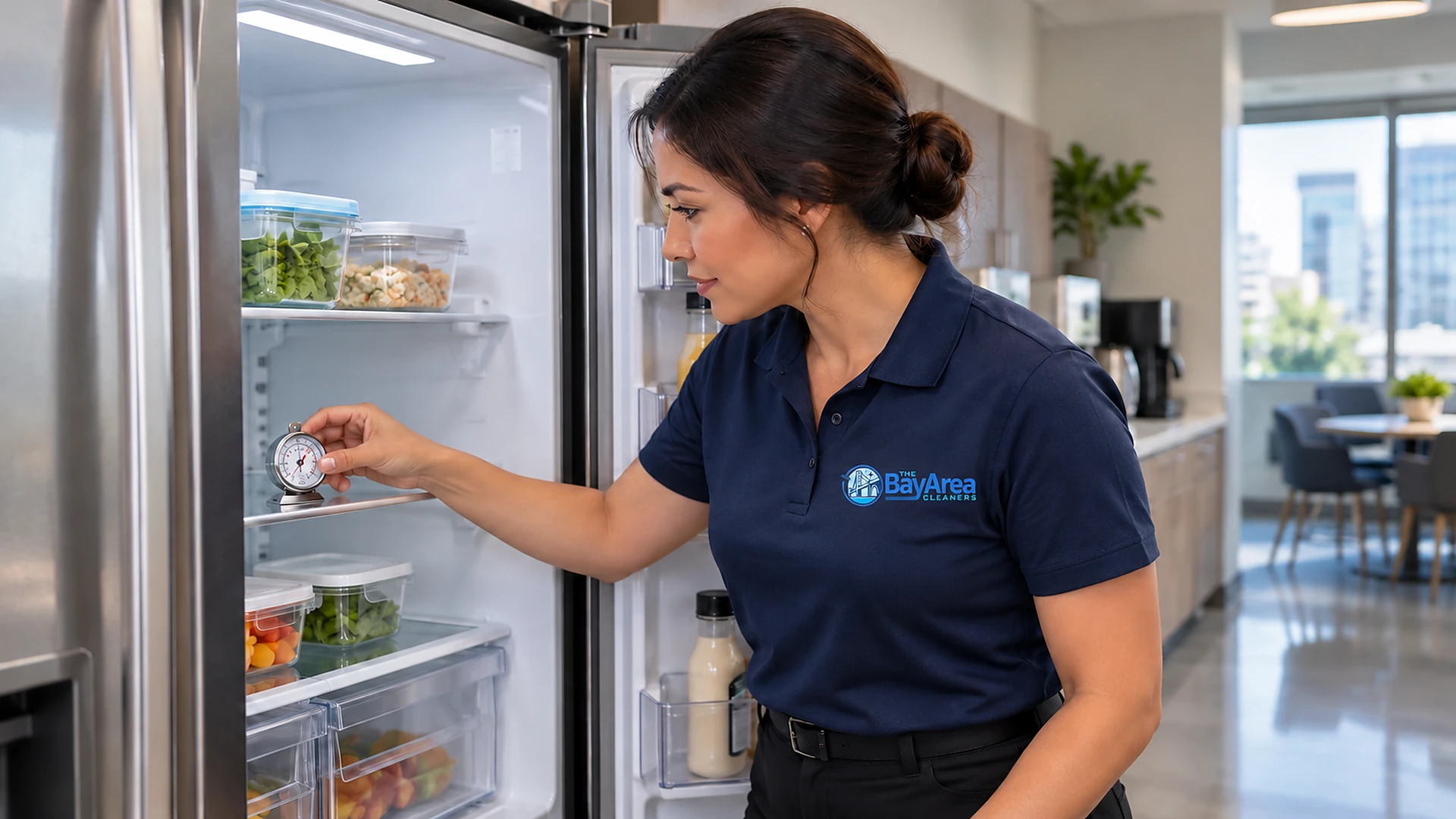
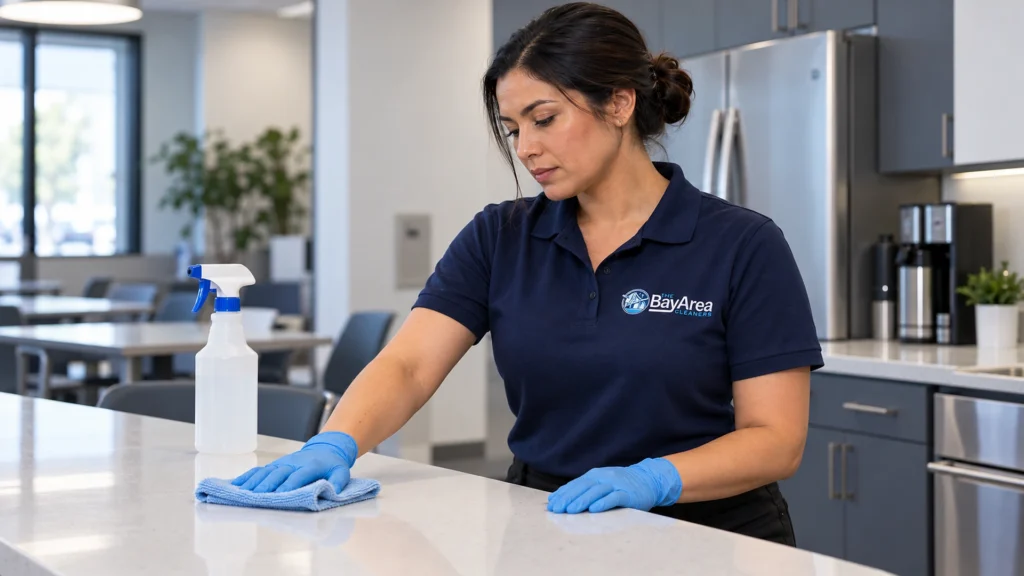
In an office, the break room is where the choice shows up most. The Bay Area Cleaners’ office cleaning page lists break room counters, sinks, appliance exteriors and tables as cleaned and sanitized. A sanitizer used on a counter where people set food should carry a food-contact claim.
That claim has its own block of directions on the label. It sets the mix for food surfaces and says whether a rinse follows. A sanitizer tested only away from food isn’t made for that job.
A disinfectant at its disinfecting strength isn’t a food-contact sanitizer either. If its label allows food surfaces at that strength, it calls for a potable-water rinse afterward.
Break rooms show why sanitizing vs disinfecting isn’t one choice per building. The counter takes a food-contact sanitizer. The outside of a shared microwave never touches food, so it doesn’t need the food-contact claim.
Tables where people eat sit in between. If food touches them, treat them like the counter.
Which break room surfaces get wiped, and how often, is a question for a checklist. This section covers only what the bottle has to say.
You may also like: Breakroom Cleaning Checklist for Hayward Offices
For your scope, one line per break room surface does the job. Name the claim the product carries and what the label says about rinsing. The answer is printed. It isn’t a judgment call.
That keeps sanitizing vs disinfecting from turning into a guess at the sink.
Takeaway: Break room counters that touch food take a sanitizer with a food-contact claim, used by those directions, including what the label says about rinsing.
What a Hospital Claim Adds on a Restroom Label
Restroom products often carry a hospital claim. EPA’s guidance table lists its test: a kill test against Staphylococcus aureus and Pseudomonas aeruginosa, within 10 minutes. That’s a clear promise you can check. When a restroom scope says “hospital-grade,” this is the claim behind it.
A hospital claim isn’t limited to hospitals. It names the test the product passed, not the building it’s used in.
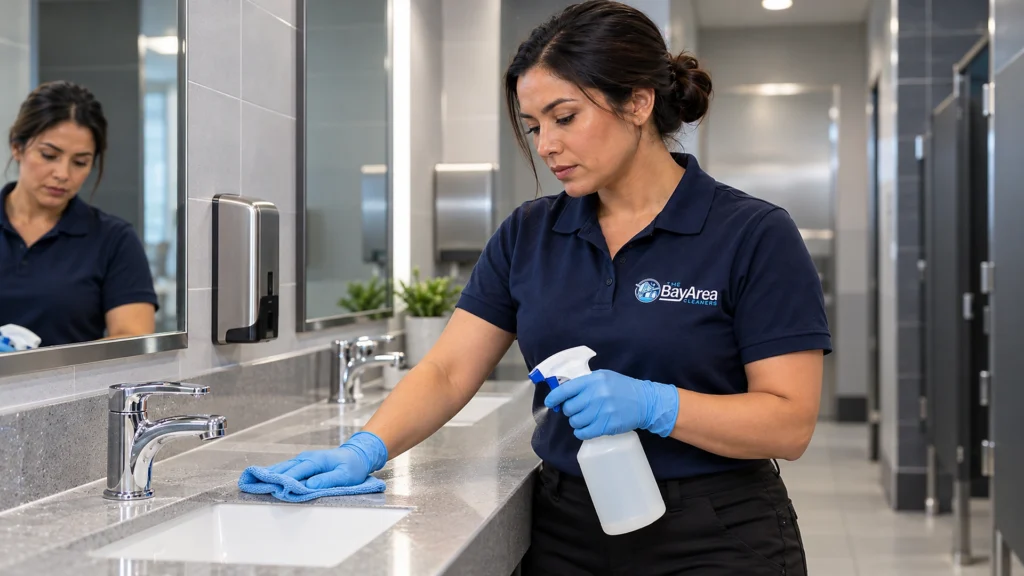
The Bay Area Cleaners’ restroom page describes a documented protocol with hospital-grade disinfection of toilets, urinals, sinks, partitions and high-touch surfaces. In label terms, that phrase points to a disinfectant claim printed on the bottle, not a sanitizer.
In restrooms, a disinfectant claim covers the disinfecting side of sanitizing vs disinfecting, and a hospital claim backs a scope that says hospital-grade. Ask to see the claim on the label your restroom crew uses. If the scope promises disinfection, the bottle should name a disinfectant claim, and the crew should follow its directions.
Takeaway: A hospital claim means the product passed EPA’s kill test against two named bacteria. Match your restroom scope’s “disinfect” to that claim on the label.
Put Sanitizing vs Disinfecting on the Product List
A scope names tasks, and a product list names bottles. The link between them is the claim. One short table per building ties each surface to the claim it needs and the directions the crew follows.
| Surface | Label claim to look for | Directions to follow |
| Break room counters and tables | Food-contact sanitizer | Food-contact directions, rinse or no rinse as the label says |
| Restroom fixtures and partitions | Disinfectant, with a hospital claim if the scope says hospital-grade | Disinfectant directions |
| Desks and shared equipment | Disinfectant | Disinfectant directions |
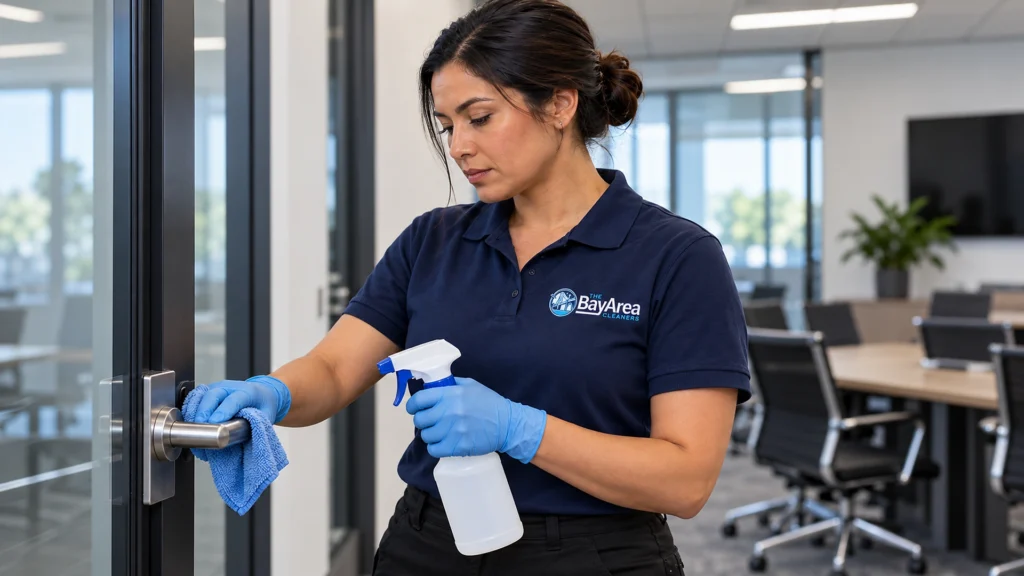
The Bay Area Cleaners’ recurring janitorial page lists door handles, light switches, elevator buttons and shared equipment disinfected routinely. On a product list, that line needs a disinfectant claim behind it. A sanitizer there gives a sanitizer result. The scope asked for more.
A table like this fits on one page. It takes minutes to check. It shows whether the bottle on the cart matches the word in the scope.
Keep the table with the scope, and update it when a product changes. A new bottle may carry a different claim, or the same claim with new directions. Your list shows whether the sanitizing vs disinfecting split still matches what the scope promised.
Takeaway: Tie each surface in the scope to one label claim and one set of directions. The product list is where the words become results.
Sterilizing Belongs to Clinical and Device Work
The third word in sanitizing vs disinfecting vs sterilizing belongs to a different field. CDC’s definitions for disinfection and sterilization give the gap in plain terms. Sterilization is “a process that destroys or eliminates all forms of microbial life.” Disinfection removes many or all of the germs that cause disease. It stops short of bacterial spores.
The agencies split this work by what gets treated. CDC’s rules summary says EPA regulates disinfectants used on surfaces that touch only intact skin, along with gaseous sterilants. FDA regulates the liquid chemical sterilants used to process medical devices that enter sterile tissue or touch mucous membranes or broken skin.
That keeps sterilizing out of a cleaning scope, even in a clinic. Floors, counters and fixtures get cleaned, sanitized or disinfected under EPA labels.
If a proposal promises to “sterilize” rooms or surfaces, ask which product and which label claim it means. A building’s surfaces run on sanitizer and disinfectant claims, and “sterilize” doesn’t belong in that scope.
Takeaway: Sterilizing kills all microbial life and belongs to clinical and device work. Building surfaces run on sanitizer and disinfectant claims under EPA.
California Registers These Products and Sets a School Training Rule
California adds its own layer. The Department of Pesticide Regulation, or DPR, registers pesticides for the state. Its page on how to register a pesticide says DPR “must register any pesticide before it can be sold or used in California.”
Its list of pesticide types includes antimicrobials. So a sanitizer or disinfectant on a Bay Area cart is a pesticide under state law too. DPR registers each product on its own, in most cases after EPA does.
Schools and child care centers carry one more rule. DPR’s disinfectants and surface sanitizers FAQ for schools and child care programs covers it. The Healthy Schools Act has a training rule for anyone applying pesticides, disinfectants and surface sanitizers included, at a public K-12 school or licensed child care center.
DPR’s guide to exempt uses lists antimicrobial pesticides as exempt from most of the Act’s steps. It still says everyone must take Healthy Schools Act training first. The FAQ adds that it’s illegal for children to use disinfectants and surface sanitizers, since they’re pesticides.
At those sites, the line in cleaning vs sanitizing vs disinfecting is simple. Soap and water need no training under the Act. A plain cleaner needs none either. The training rule starts the moment a sanitizer or disinfectant comes out.
If you manage a public school or a licensed child care center, ask whoever uses these products on site for proof of that training.
A Bay Area office isn’t a school, so the Healthy Schools Act doesn’t reach it. State registration does. Every sanitizer and disinfectant used there has to be a registered product, used by its label.
Ask which products are on the cart, and read their labels. That’s the same test for cleaning vs disinfecting that applies at the federal level.
Takeaway: In California, sanitizers and disinfectants are registered pesticides. Using them at public K-12 schools or licensed child care centers calls for Healthy Schools Act training.
Frequently Asked Questions
Can one bottle handle both sides of sanitizing vs disinfecting?
Yes, if it’s registered for both claims. EPA notes that many products pass both tests. Each claim has its own directions on the label, and the result depends on which directions the crew follows.
Where does sterilizing fit in sanitizing vs disinfecting vs sterilizing?
Outside a building’s cleaning scope. CDC defines sterilization as destroying all forms of microbial life. FDA regulates the liquid chemical sterilants used on medical devices that enter sterile tissue or touch mucous membranes or broken skin. Building surfaces use sanitizer and disinfectant claims under EPA.
Where does EPA draw the line in cleaning vs disinfecting products?
At the claim. A cleaning product falls under EPA’s rules only if it claims to sanitize or disinfect. Once it does, it has to be registered as an antimicrobial pesticide and pass the test for that claim.
Does California regulate cleaning vs sanitizing vs disinfecting products on its own?
Yes, for sanitizers and disinfectants. DPR registers them as pesticides before they can be sold or used in the state. Plain cleaners aren’t registered as pesticides. At public K-12 schools and licensed child care centers, anyone using sanitizers or disinfectants needs Healthy Schools Act training.
Conclusion
Sanitizing vs disinfecting is settled on the label, and the scope has to point to it. A sanitizer promises a tested percentage. A disinfectant promises to pass a kill test. A dual-claim bottle delivers whichever directions the crew follows.
In sanitizing vs disinfecting vs sterilizing, only the first two belong on a building’s surfaces. Match each word in your scope to a claim.
Use a food-contact sanitizer on break room counters. Use a disinfectant claim wherever the scope says disinfect. Leave sterilizing out of the cleaning scope. In California, add state registration and, at schools and child care centers, Healthy Schools Act training.
The Bay Area Cleaners sanitizes break room counters across the Bay Area and disinfects restrooms and shared equipment with commercial-grade disinfectants applied per manufacturer specifications. Call 707-656-9339 for a free estimate on your cleaning scope.