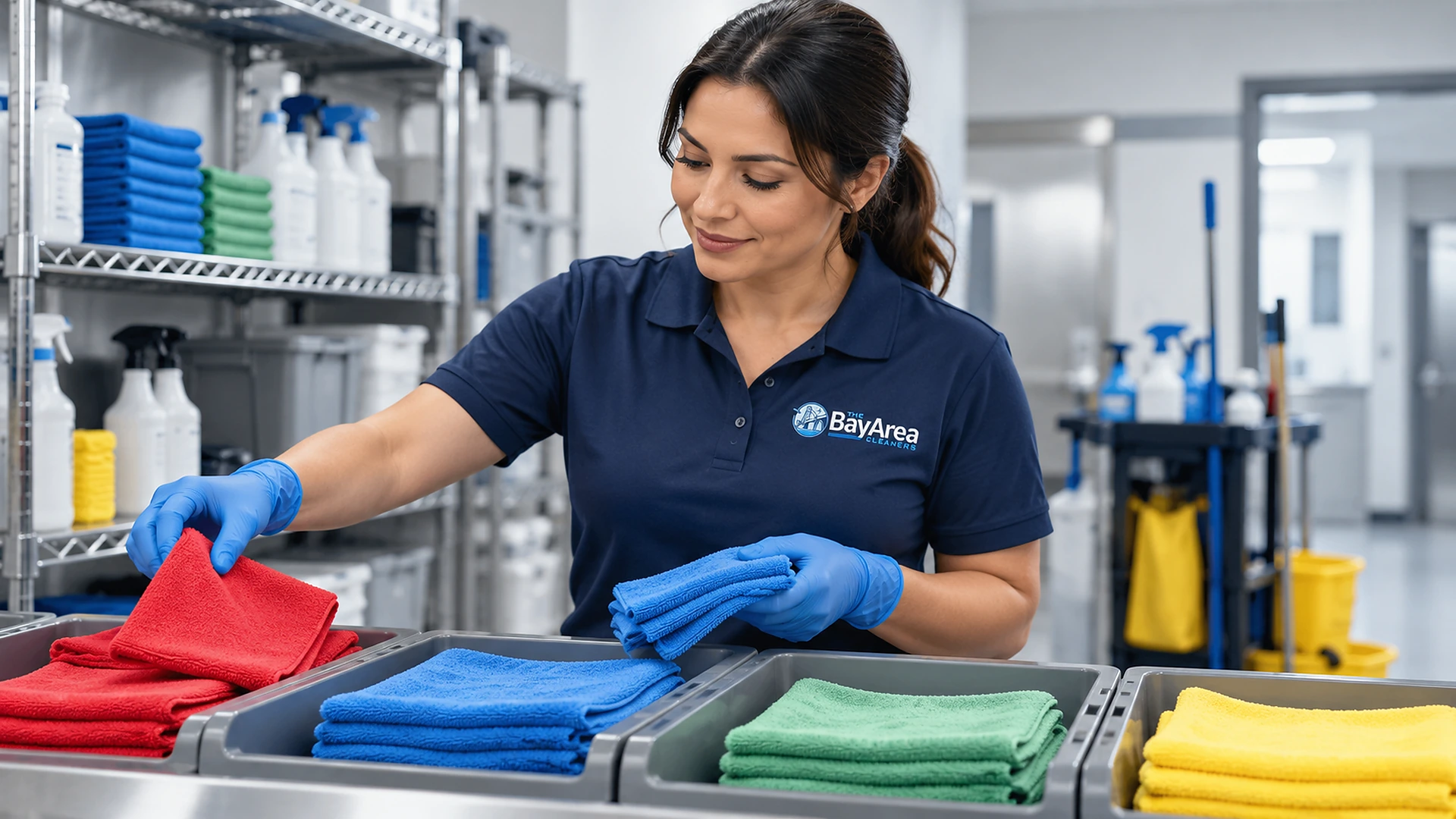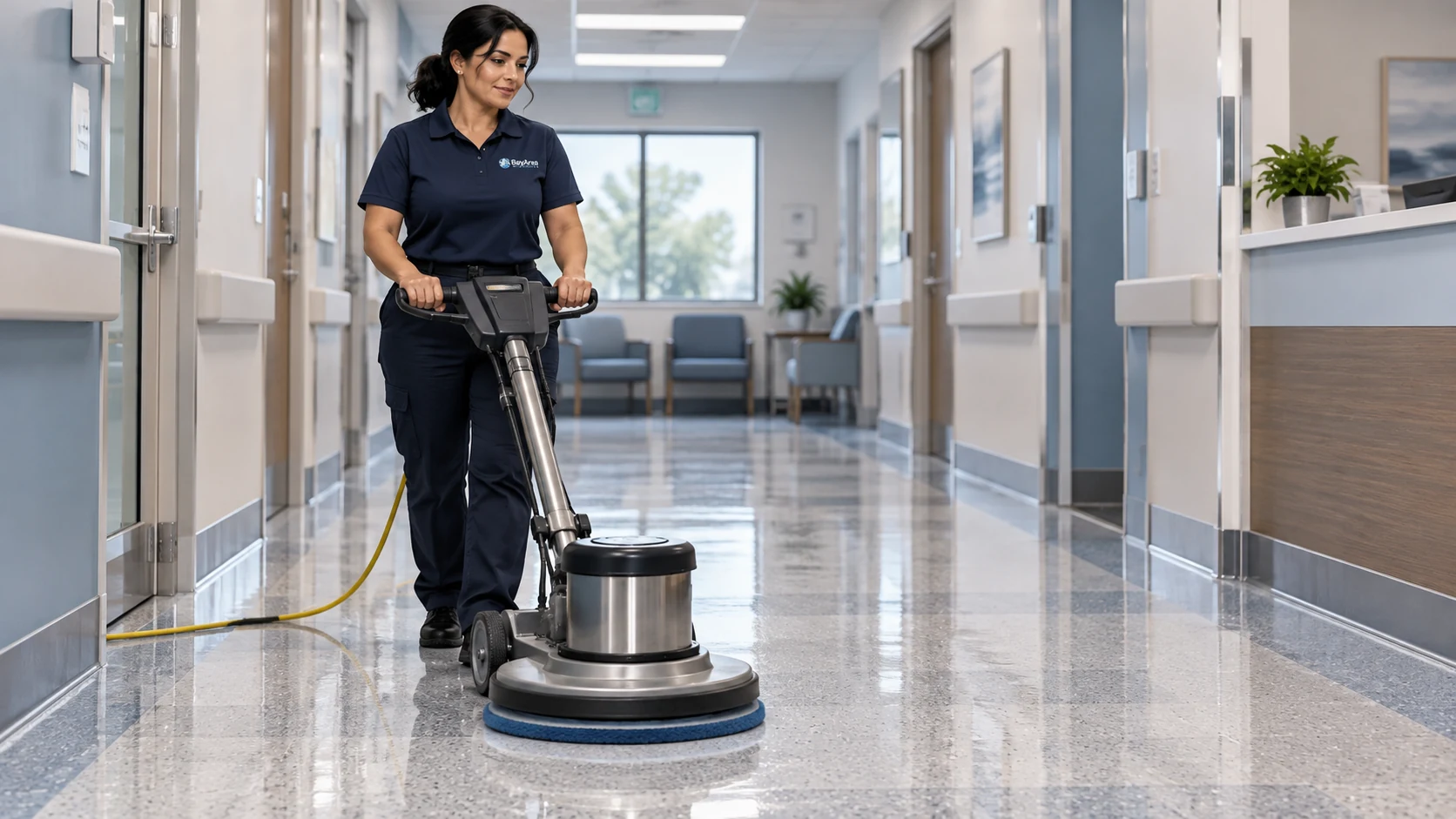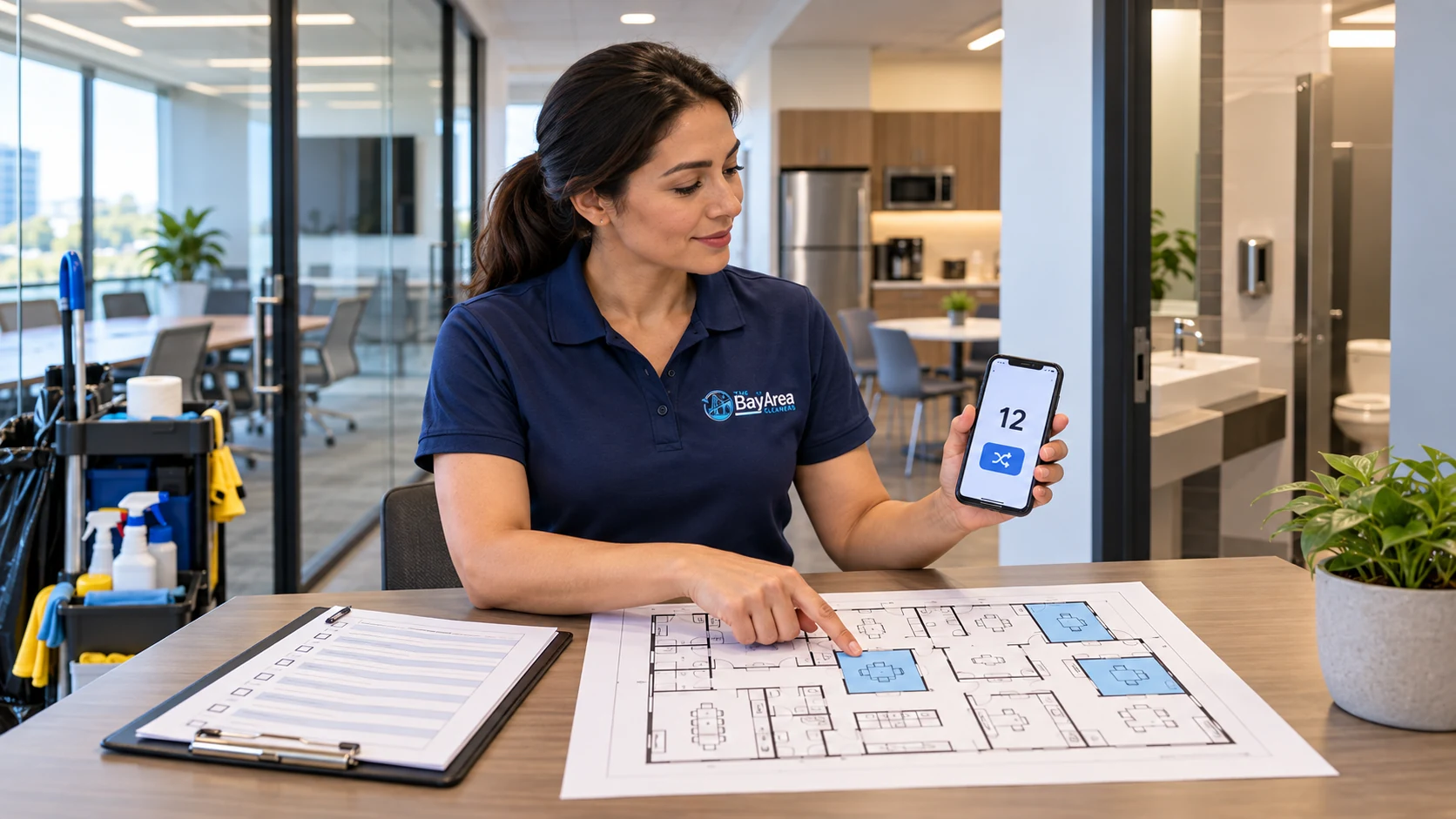
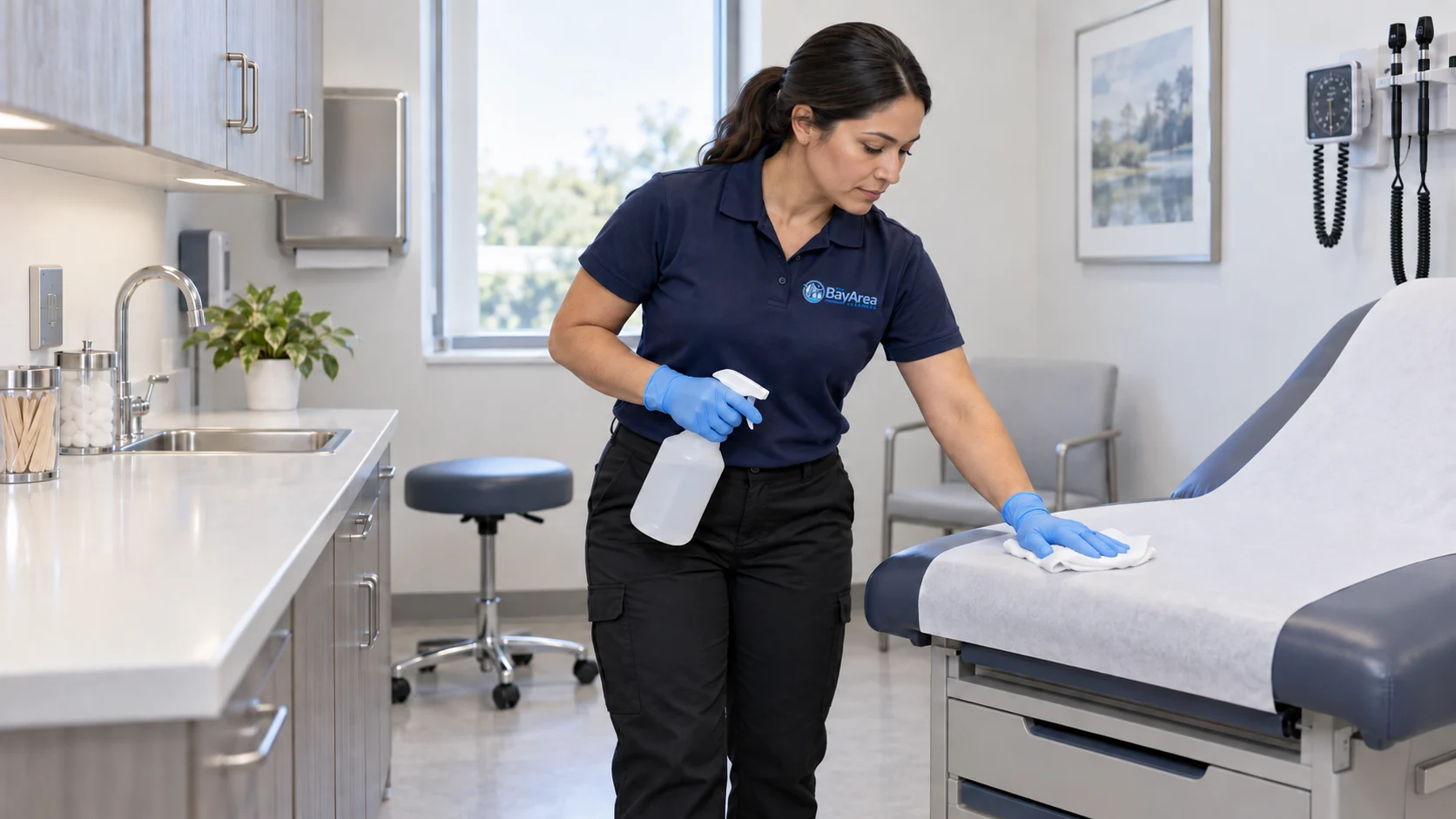
A cleaning crew can do everything right in an office building and still fall short in a clinic down the street. The difference is not effort and it is not equipment. It is that medical office cleaning runs on a written schedule, a documented method, and a sequence that someone can audit later.
Most practice managers inherit a contract written for general office space. You find the gap later, during an inspection, a staff complaint, or an exposure incident.
What changes in a medical office: your schedule has to be written down by area. Your disinfectant has to carry a label claim matching the pathogen. And the surface has to stay wet long enough for that claim to hold. Miss any of the three and the room looks clean without being decontaminated.
What Separates Medical Office Cleaning From Standard Janitorial Work?
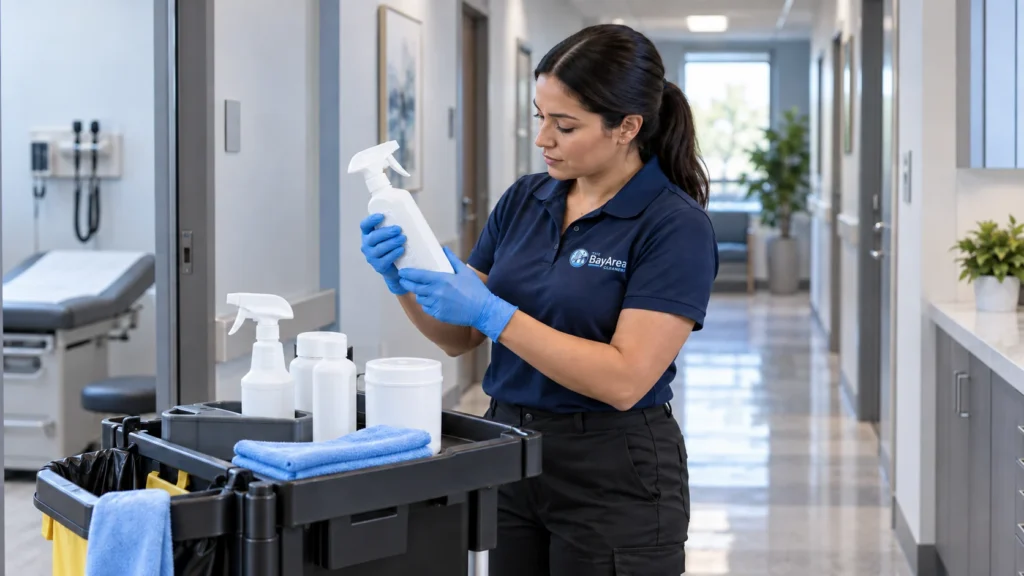
Standard janitorial work is judged by appearance. Medical office cleaning is judged by appearance plus paperwork. The paperwork half is where most contracts are thin.
The regulatory anchor is OSHA’s bloodborne pathogens standard. Under 29 CFR 1910.1030, an employer whose staff have occupational exposure has to determine and implement a written schedule for cleaning and a method of decontamination. The rule names four inputs for that schedule: the location within the facility, the type of surface being cleaned, the type of soil present, and the tasks performed in that area.
Read that list again, since it is the scoping instruction for the whole program. The standard does not say clean everything the same way. It says build the schedule around what happens in each room.
Three practical consequences follow:
- A single site-wide frequency does not satisfy the requirement, since the rule is written around location and task
- The schedule has to exist on paper, not in a supervisor’s head
- The method of decontamination belongs in the document alongside the frequency
That written-schedule rule is the clearest line between a medical office cleaning service and a plain janitorial contract. Office work rarely produces a document anyone asks to see. A medical office cleaning service should hand you one before the first visit.
Most practices already have part of this. The exposure control plan sits in a binder somewhere and the cleaning contract sits in another. They rarely reference each other. Pulling them into one document is usually a one-afternoon job, and it gives you something to hand an inspector.
Takeaway: Ask any vendor to show you the written cleaning and decontamination schedule they would produce for your practice. If the answer is a generic checklist, they are selling office cleaning.
You may also like: Commercial Restroom Cleaning: The One Room That Grades the Whole Building
Patient restrooms sit at the intersection of public traffic and clinical risk, which makes them the zone where a weak program becomes visible fastest.
Building Risk Tiers Instead of One Site-Wide Standard
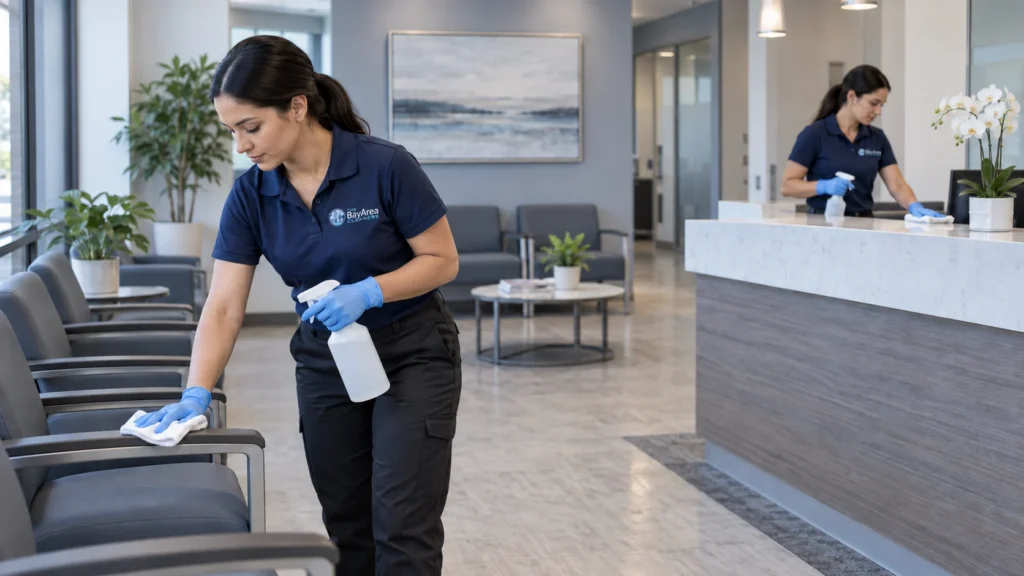
Once the schedule is organized by area, the next step is sorting those areas by risk rather than by square footage. Three tiers cover most outpatient settings.
| Area | Risk tier | Typical cleaning trigger | Who usually performs it |
| Exam rooms and procedure areas | High | Between patients, plus end of shift | Clinical staff between patients, vendor at end of day |
| Patient restrooms | High | Scheduled passes through the day | Vendor, with staff spot response |
| Waiting room and reception | Moderate | Daily, with high-touch passes | Vendor, with staff spot response |
| Hallways and patient circulation | Moderate | Daily | Vendor |
| Administrative offices and break rooms | Lower | Daily to several times weekly | Vendor |
| Storage and utility areas | Lower | Weekly to monthly | Vendor |
Waiting rooms and reception
Waiting rooms carry volume rather than clinical soil. The surfaces that matter are the ones hands reach without thinking. Chair arms. Check-in counters. Pens, clipboards, door pulls, kiosk screens, and any play surfaces you still keep.
Your reception counter deserves its own line. Staff eat there. Patients lean on it. Paperwork crosses it all day. A medical office cleaning service that treats reception as ordinary desk space misses a surface with more hand contact than most exam room furniture.
Exam rooms
Exam rooms split into two different jobs that should never be written as one line item.
Between patients, clinical staff wipe the table, the surfaces touched during the visit, and any equipment used. That work belongs to the practice, since it happens inside the patient flow and requires knowing what the visit involved.
At end of shift or end of day, the vendor performs the fuller reset: floors, low horizontal surfaces, waste removal, restocking, and the surfaces that accumulate across a full clinic day. The bloodborne pathogens standard supports that split directly. It calls for contaminated work surfaces to be decontaminated after procedures are completed. It calls for the same immediately or as soon as feasible after any spill. And it calls for it at the end of the work shift, if a surface may have become contaminated since the last cleaning.
Administrative and staff areas
Back-office space is where medical office cleaning programs over-serve or forget entirely. Billing offices, provider work rooms, and break rooms carry ordinary office soil. Treating them as clinical space wastes money that belongs in your high-tier zones.
One exception matters. Any administrative surface where specimens, lab paperwork, or used equipment transits should be scoped at the higher tier, no matter what the room is called on the floor plan.
Urgent care sites shift these tiers. Patient volume runs higher, visits are shorter, and rooms turn over faster than in a scheduled practice. If you run urgent care hours, the exam room tier needs more vendor passes during the day rather than one reset at close.
Takeaway: Write the tier next to each room on the floor plan before requesting a quote. Vendors price the rooms you name, at the tier you name.
Disinfectant Selection and Contact Time
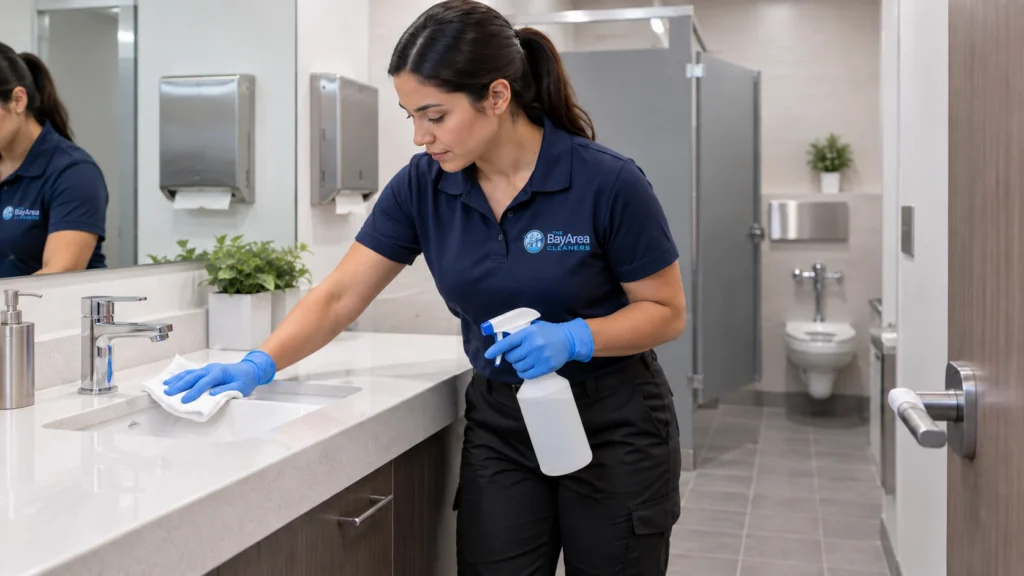
This is the most common failure point in the whole program, and it has nothing to do with how hard anyone scrubs.
A disinfectant only does what its label says it does. EPA registers antimicrobial products and approves the label language. Per the agency, if a product’s label does not include directions for a certain pathogen, EPA has not reviewed data on whether the product works that way.
Contact time is the part crews get wrong. EPA describes it as the time a product must stay on the surface to work. The surface has to stay visibly wet for that whole period. Spray and wipe in one motion does not meet it. The agency’s own example is direct. If the label lists a ten-minute contact time, the surface should stay visibly wet for at least ten minutes. If it has dried at the five-minute mark, more product goes on.
| Label element | What it tells you | Where programs fail |
| EPA registration number | The only reliable way to identify the product | Crews track brand names, which change |
| Pathogen list | Which claims the agency actually reviewed | Assuming one product covers everything |
| Contact time | How long the surface stays wet | Wiping dry immediately after spraying |
| Use sites | Which surfaces the product is approved for | Using a hard-surface product on upholstery |
| Dilution directions | The concentration the claim was tested at | Eyeballing the mix at the sink |
EPA also keeps pathogen-specific lists. One covers products effective against bloodborne pathogens such as HIV, hepatitis B, and hepatitis C. Per EPA, using listed products consistent with their labeling complies with OSHA’s bloodborne pathogens requirements. That is a useful bridge between the two rules your program has to satisfy.
One more product question belongs in the conversation. Ask which surfaces in your suite the manufacturer restricts. Exam table upholstery, touchscreen monitors, and certain equipment housings get damaged by products that work fine on a counter. A medical office cleaning service that has worked in clinical space will raise this before you do.
Takeaway: Put the disinfectant’s EPA registration number and its contact time in the written schedule. A product name alone tells you nothing about what was tested.
You may also like: High Dusting: Why Your Clean Floors Do Not Stay Clean
Overhead surfaces matter in clinical space for the same reason they matter anywhere: dust that sits on vents and ledges comes down onto surfaces someone just disinfected.
Drawing the Line Between Clinical Staff and Vendor Tasks
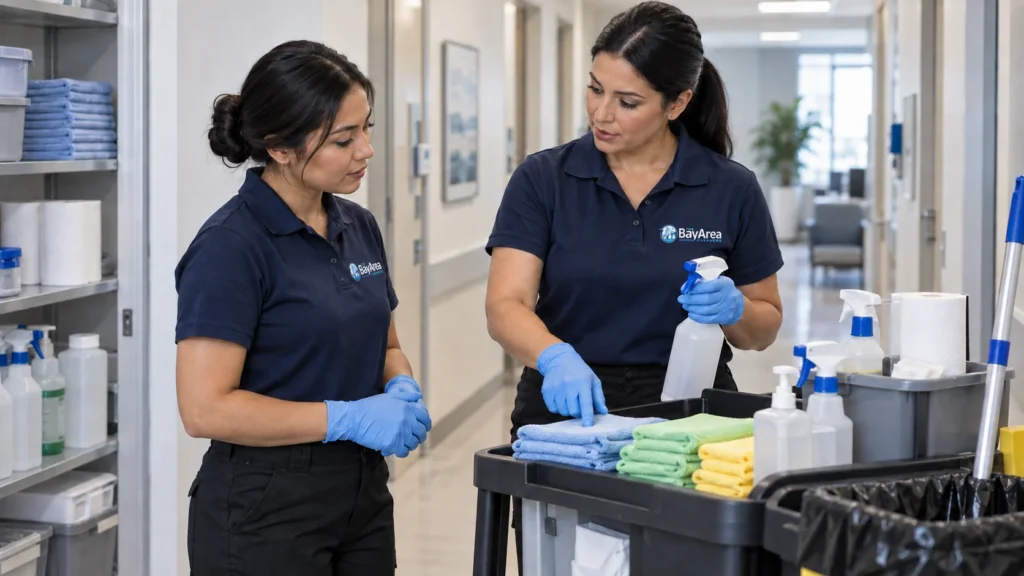
Medical office cleaning contracts break down at the handoff more often than at the task. Each side assumes the other owns something. Nobody finds out until the gap shows.
A few boundaries need a name in writing:
- Between-patient exam room wipe-downs, which almost always belong to clinical staff
- Blood and body fluid spill response, including who responds and with what product
- Sharps containers, which the practice manages, and the surrounding surfaces, which the vendor may clean
- Regulated waste handling and staging, which stays with the practice
- Specimen transport surfaces and lab bench areas
- Refrigerator interiors where specimens or vaccines are stored
- Equipment surfaces the manufacturer restricts to specific products
The standard sets a floor on some of these. Bins, pails, and cans with a reasonable likelihood of contamination have to be inspected and decontaminated on a regular schedule. They also get cleaned immediately, or as soon as feasible, once contamination is visible. It also prohibits picking up potentially contaminated broken glassware directly by hand, calling for mechanical means such as a brush and dust pan, tongs, or forceps.
Those are not preferences. They are requirements that should appear in the vendor’s own procedures, not just in the practice’s policy binder.
Revisit that list once a year. Your practice adds services, moves rooms, and changes staff, and a task list written three years ago quietly stops matching the building. An annual review also lines up with the schedule your medical office cleaning service should already be reviewing on its own.
Takeaway: Build a two-column task list, practice on one side and vendor on the other, and have both parties sign it. Verbal division of labor does not survive staff turnover.
You may also like: Elevator Cleaning: Why a Six-by-Six Room Gets Noticed More Than the Lobby
Medical office buildings with shared elevators add a zone that belongs to building management rather than to the practice, which is worth confirming before assuming it is covered.
Training, Products, and What Your Vendor’s Own Program Must Cover
Here is the part practice managers miss most. Your cleaning contractor is an employer too. If its workers have occupational exposure on your site, the same standard applies to that company.
Under 1910.1030, an employer with exposed employees maintains a written Exposure Control Plan, reviewed and updated at least annually. Training is required at initial assignment and at least annually after that. Gloves are required when an employee can reasonably anticipate hand contact with contaminated items or surfaces. Sharps containers, where they are in use, are kept upright, replaced routinely, and not allowed to overfill.
When you evaluate a medical office cleaning service, ask for that paperwork alongside the insurance certificate:
- The written Exposure Control Plan, with the date of the last annual review
- Bloodborne pathogens training records for the crew assigned to your site
- The hepatitis B vaccination offer policy for assigned staff
- Product list with EPA registration numbers and contact times
- Safety data sheets for every product coming into the building
- Spill response procedure, including who is trained to perform it
- Crew consistency policy, since rotating unfamiliar staff through clinical space raises the training burden every week
A vendor that produces those documents quickly has worked in healthcare space before. One that treats the request as unusual has not. Give them a week. That is a fair window for a company that already runs clinical accounts, and a revealing one for a company that does not.
Ask who covers a call-out, too. A crew of two with no backup means one sick employee turns into a skipped clinic night. That matters more in medical facility cleaning than in plain office work. A skipped night leaves clinical surfaces on a longer interval than your written schedule allows.
Takeaway: Request the vendor’s own Exposure Control Plan and training records. Their program is part of your risk picture, not a separate matter.
Comparing Medical Office Cleaning Companies Before You Sign
Once scope and paperwork are settled, the comparison gets easier. Weigh these in order.
Paperwork depth comes first. A vendor who arrives with a written schedule, a product list with registration numbers, and current training records has already answered what takes others weeks.
Scheduling fit comes second. This is where medical facility cleaning bids diverge most. Evening hours, Saturday clinics, and procedure days break a fixed nightly window. Ask how the vendor handles a schedule that shifts by day.
Supervision comes third. Ask who inspects the work and how often. Ask whether you get the inspection record. An unsupervised crew in clinical space is a different risk than one in a law office.
Scale matters for groups. If you run several locations, ask whether medical office cleaning companies can staff every site to the same written standard. The standard often drops quietly at the smallest office.
Price comes last. Compare it per tier, not per square foot. Two bids that look far apart often differ only in how many rooms each one put in the high tier. Ask each bidder to show the tier count. That single number explains most of the gap.
| What to compare | Strong answer | Warning sign |
| Written schedule | Drafted per area before pricing | Generic checklist reused across clients |
| Product documentation | Registration numbers and contact times listed | Brand names only |
| Training records | Current, dated, crew-specific | Company-wide claim with no records |
| Supervision | Named supervisor with inspection log | Supervisor exists but sends no reports |
| Schedule flexibility | Adjusts by clinic day | One fixed window, take it or leave it |
If your suite has recurring moisture, aging HVAC, or a water intrusion history, track that separately from routine cleaning. The two problems have different owners and different timelines.
Frequently Asked Questions
What does medical office cleaning include?
Medical office cleaning covers exam rooms, patient restrooms, waiting areas, reception, hallways, and administrative space, each on its own frequency and method. The work splits into recurring passes and between-patient tasks, and it runs against a written schedule built around the location, surface type, soil type, and procedures performed in each area. Routine office cleaning does not require that document, which is the clearest difference between the two.
What should a medical office cleaning service do between patients versus at end of day?
Between-patient work usually stays with clinical staff. It happens inside the patient flow and depends on what the visit involved. A medical office cleaning service typically handles the end-of-shift reset: floors, waste removal, restocking, low horizontal surfaces, and the surfaces that accumulate across a full clinic day. Write the split as two separate columns so neither side assumes the other covered a task.
How should a practice compare medical office cleaning companies?
Compare documentation before price. Ask each vendor for a written cleaning and decontamination schedule drafted for your floor plan, a product list showing EPA registration numbers and contact times, and current bloodborne pathogens training records for the assigned crew. Medical office cleaning companies that produce those quickly have run healthcare accounts before, and the ones that stall on the request are building the program on your site.
Is medical facility cleaning different for a larger outpatient building?
Medical facility cleaning in a larger outpatient building adds shared-space questions that a single-suite practice never faces. Lobbies, elevators, shared restrooms, and corridors often belong to building management rather than to the tenant, so the practice scope stops at the suite door. Confirm that boundary in writing, since medical facility cleaning gaps tend to appear exactly where the tenant contract and the building contract meet.
Conclusion
Medical office cleaning improves when the program stops being a frequency list and becomes a document. Sort your rooms into risk tiers, write the schedule by area rather than by building, record the EPA registration number and contact time for every product, and split the task list between clinical staff and the vendor in writing. A practice that needs supporting work on general office space or restroom care should scope those on their own terms rather than folding them into the clinical tier. Call 707-656-9339 to walk your suite and build the written schedule before the pricing conversation starts.