

Industrial cleaning services get priced wrong far more often than they get performed wrong. Two contractors walk the same plant on the same afternoon. One comes back forty percent under the other. That gap is rarely about crew speed. It is about what each one assumed on three points: scope, who supplies the equipment, and when their people can physically reach the work.
None of those three assumptions appear on a one-page proposal. All three decide what you end up paying.
Short answer: scope industrial cleaning services by production zone, not by square footage. Put in writing which equipment the contractor brings and which your plant supplies. Settle site access before anyone quotes a number. Access rules set the labor hours more than the soil does.
What Is Industrial Cleaning, and Where Does It Stop Being Janitorial Work?

For industrial cleaning services, the useful line is not the type of building. It is whether the work touches production equipment, production residue, or spaces a general janitorial crew is not cleared to enter.
Janitorial work covers offices, restrooms, break rooms, and circulation space inside a plant. Industrial cleaning services cover the process side. That means machine frames and guarding, dust collection housings, overhead structure above live lines, pits, sumps, tanks, and floors carrying oil, swarf, or product residue rather than foot traffic.
Most plants need both, and most buy them as one contract without separating the line items. That is where the pricing confusion starts.
- Janitorial scope: offices, restrooms, locker rooms, cafeterias, entry mats, aisles outside production
- Industrial scope: equipment exteriors, guarding, conveyor structure, dust collectors, pits and sumps, process floors, overhead steel
- Contested middle: mezzanines, maintenance shops, tool cribs, QA labs, dock interiors, chemical storage rooms
That contested middle is worth naming zone by zone in the contract. A plant manager who leaves it undefined finds out during the first walkthrough that nobody quoted the maintenance shop.
One more boundary is worth drawing early. Industrial cleaning services are usually scoped as a program, with recurring passes and periodic events on different cycles. Emergency response after a spill or an equipment failure is a separate industrial cleaning service, priced by call-out rather than by the month. Plants that never separate the two end up treating every incident as a change order.
Takeaway: Split janitorial and industrial cleaning services into separate line items on the same contract. One blended number gives you nothing to compare against a second bid.
You may also like: Warehouse Cleaning: What a Professional Program Should Include
Warehouse work sits closer to the janitorial end of that spectrum in most facilities, since racking, aisles, and dock floors rarely involve production equipment. Treat a distribution building and a manufacturing plant as two different scoping problems.
Scope Boundaries: Mapping Zones Before Anyone Quotes a Number
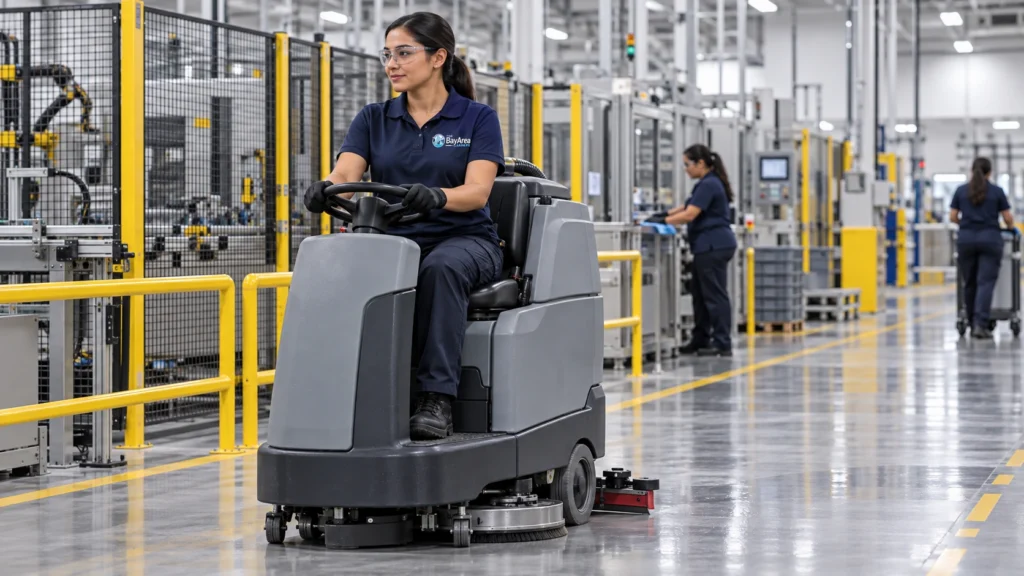
A plant walk produces a better industrial cleaning services scope than a floor plan does. Walk it with the contractor and your maintenance lead at the same time, so equipment questions get answered on the spot rather than by email three weeks later.
| Zone | Who usually owns it | Where the scope argument starts |
| Process floors under live lines | Contractor, on a scheduled pass | Whether cleaning happens during production or only at shutdown |
| Machine exteriors and guarding | Split, and often unstated | Whether guards get removed, and by whom |
| Dust collectors and ductwork | Specialty contractor, not general janitorial | Whether it is in the base contract or quoted per event |
| Pits, sumps and trenches | Specialty, permit-dependent | Whether entry is required or the work is done from grade |
| Maintenance shop and tool crib | Plant staff, usually by default | Almost never quoted, since nobody names it |
| Overhead steel and light fixtures | Contractor, on a periodic cycle | Access equipment and whether lines must stop below |
Zone mapping tells you which work is recurring and which is event-driven. A dust collector cleanout scheduled twice a year is not the same commercial arrangement as a nightly floor pass, and bundling them hides the cost of both.
Bring the zone map back to the same two people once it is written. Your maintenance lead will catch the equipment that cannot be cleaned the way the contractor assumed, and the contractor will flag the zones that need access you have not offered. An hour of that review saves the first three change orders.
Takeaway: Walk the plant with the contractor and your maintenance lead together. A scope written from a floor plan misses the contested middle every time.
Equipment: What the Crew Brings and What Your Plant Supplies
Equipment is the second place industrial cleaning services quotes diverge. One contractor prices a ride-on scrubber and a vacuum rated for combustible dust. Another assumes your plant lends them a forklift and a shop vac. Both look like the same scope on paper.
| Equipment class | What it handles | What to confirm before signing |
| Ride-on and walk-behind scrubbers | Large process floors, oil and product film | Machine width against your narrowest aisle, and who charges the batteries |
| Industrial vacuums | Fine dust, metal chips, wet recovery | Whether the unit is rated for the dust in your plant, not just for shop use |
| Aerial lifts and scaffolding | Overhead steel, fixtures, ductwork | Whether the contractor supplies and certifies operators, or rents from you |
| Pressure and steam equipment | Baked-on residue, equipment frames | Water supply point, containment, and where the runoff goes |
| Containment and filtration | Work adjacent to running production | Whether adjacent lines keep running during the work |
The runoff question catches more plants than any other item on that list. Cleaning water that carries process residue is not the same as mop water, and the discharge path needs to be settled before a crew ever turns on a hose.
Ask for the equipment list as an attachment to the proposal. A contractor who cannot produce one in writing is planning to borrow from you. Ask early. A serious industrial cleaning service will have the list ready.
Storage is the quiet companion question on industrial cleaning services. An industrial cleaning service running a ride-on scrubber needs somewhere to park and charge it, and that space has to exist inside your building. Plants that skip this conversation discover the machine living in a fire lane. Settle the footprint, the electrical drop, and the water fill point when you settle the equipment list. Ask where the industrial cleaning service will stage supplies too.
Takeaway: Get the equipment list in writing as a proposal attachment. Anything not on that list is something your plant is quietly expected to supply.
You may also like: Commercial Restroom Cleaning: The One Room That Grades the Whole Building
Restrooms inside a plant sit on the janitorial side of the line, but they get judged by the same visitors and auditors who walk the production floor. Do not let that zone slide just since the rest of the scope is industrial.
Site Access: Shutdown Windows, Lockout and Confined Spaces

Access changes the labor hours on industrial cleaning services more than anything else. It is also the item buyers scope last. Three constraints do most of the damage to a schedule.
Production windows
A crew that can only work between 2:00 a.m. and 5:00 a.m. on Sundays is not doing the same job as a crew with an eight-hour shutdown. Say which one you are buying before you compare prices. Put the window in the bid packet. The same scope across a narrow window costs more, since it takes more visits and more mobilizations to finish.
Lockout and tagout
This one has a specific regulatory shape worth knowing, since it changes who is allowed to touch what.
OSHA’s control of hazardous energy standard (29 CFR 1910.147) defines servicing and maintenance to include cleaning of machines or equipment where a worker could be exposed to unexpected startup or the release of stored energy. Cleaning is named in the text of the definition, not implied by it.
The standard speaks directly to contractors. Under 1910.147(f)(2), outside servicing personnel trigger a two-way duty. The on-site employer and the outside employer are required to inform each other of their lockout or tagout procedures. The on-site employer must then see that its own staff comply with the restrictions of the contractor’s energy control program.
In plain terms, a crew working inside machine guarding is not a vendor you simply schedule. The exchange of energy control procedures runs in both directions. A plant that has never had that conversation with its cleaning contractor has a gap worth closing before the next visit.
Confined spaces
Pits, sumps, tanks, silos, and hoppers often meet OSHA’s definition of a confined space. The test is simple: large enough to bodily enter, with limited means of entry or exit, and not built for continuous occupancy. The permit-required confined spaces standard (29 CFR 1910.146) adds a second test. A space becomes permit-required when it can hold a hazardous atmosphere, holds material that could engulf an entrant, has walls that converge inward or a floor sloping to a smaller cross-section, or carries any other recognized serious hazard.
The contractor provisions matter here too. Under 1910.146(c)(8), a host employer who brings in a contractor for permit space entry carries five duties. Tell the contractor the workplace contains permit spaces. Apprise them of the hazards and of the host’s own experience with the space. Share the precautions already in place. Coordinate entry when both crews work in or near the space. Debrief the contractor afterward. The contractor, under 1910.146(c)(9), has to obtain that information, coordinate, and tell the host which permit space program it will follow. Neither exchange is optional. Neither happens by accident on a first visit.
Badging, escorts and orientation
The fourth access constraint is administrative and it is the one most often left out of a schedule. Contractor badging, site safety orientation, and escort requirements all consume crew hours that nobody quoted. A plant that requires a two-hour orientation for every new crew member pays a real cost for contractor turnover. That cost belongs in the conversation before the award, not after it.
Ask how the industrial cleaning service handles crew consistency. A provider rotating new faces through your plant every week burns part of each visit getting oriented instead of cleaning.
Takeaway: Settle the access window, the lockout exchange, and the confined space question before requesting pricing. All three change the hours, and hours are what you are actually buying.
How to Read an Industrial Cleaning Proposal
Once scope, equipment, and access are on the table, industrial cleaning services proposals become comparable. Read it in this order.
- Frequency per zone, not a single site-wide frequency
- Recurring work and event-driven work as separate figures
- The equipment attachment, and any line that says “client-supplied”
- The assumed access window, stated in hours and days
- Who holds the confined space program if entry is in scope
- Crew size and supervision, since an unsupervised crew in a plant is a different risk than an unsupervised crew in an office
- What happens when production runs long and the window shrinks
That last item is the one worth pressing on. Plants run long. A proposal that has no answer for a shortened window is a proposal that will produce a change order in month two.
Watch the unit of measure too. Industrial cleaning services priced per square foot assume the soil is spread evenly, which it almost never is in a plant. Pricing by zone and frequency holds up better. It lets you add a dust collector cycle or drop a mezzanine pass without reopening the whole agreement.
You may also like: High Dusting: Why Your Clean Floors Do Not Stay Clean
Overhead work follows the same sequencing logic in a plant as in an office. Clean high before low, or the floor pass gets undone by the next vibration cycle.
A short scoring sheet helps when three industrial cleaning services bids land the same week. Score each industrial cleaning service on scope clarity, equipment ownership, access realism, and documentation speed. Look at price last. The cheapest bid on that grid is often the one that scored lowest on access realism, which is the same bid that renegotiates in month two.
Takeaway: Compare proposals line by line on frequency, equipment, and access assumptions. Comparing bottom-line numbers across different assumptions tells you nothing.
Contractor Qualification: What to Request Before the First Visit
Scope and price are the visible half of an industrial cleaning service decision. Qualification is the half that shows up only when something goes wrong.
- Certificate of insurance with limits that match your plant’s contract requirements, not generic janitorial limits
- Written energy control procedures, since 1910.147(f)(2) contemplates an exchange of them
- Confined space program and entry permits, when tanks, pits, or hoppers are in scope
- Safety data sheets for every chemical the crew brings on site
- Training records for aerial lift and powered equipment operators
- A named site supervisor, with the escalation path in writing
- Reference contacts at facilities with a comparable process, not just a comparable size
A contractor who can produce those documents inside a week has run this kind of account before. One who needs a month to assemble them is building the program on your site.
References deserve a specific question rather than a general one. Ask what the provider does when a scheduled window gets cancelled at the last minute, and ask the reference the same thing. Plants cancel. It happens to every site. A steady industrial cleaning service reschedules without a fee fight. How an industrial cleaning service absorbs a cancelled Sunday night tells you more about the next two years than any line in the proposal.
You may also like: Mold Remediation: What the EPA Thresholds Actually Mean for Your Building
Plants with washdown areas, cooling systems, or chronic condensation should track moisture findings separately from soil removal. The two problems have different owners and different timelines.
Insurance deserves one extra look. An industrial cleaning service carrying standard janitorial limits may not be covered for work inside machine guarding or inside a permit space, and that mismatch surfaces at the worst possible moment. Have your risk contact read the certificate against the actual scope rather than against a template.
Takeaway: Request the qualification packet before the site visit, not after the award. What arrives, and how fast, tells you more than the proposal does.
Frequently Asked Questions
What do industrial cleaning services typically include?
Industrial cleaning services cover the process side of a plant. That means equipment exteriors and guarding, conveyor structure, dust collection housings, pits and sumps, overhead steel, and floors carrying oil or product residue. Most industrial cleaning services are bought alongside a janitorial scope for offices and restrooms. Keep the two on separate line items so each can be priced and compared on its own.
What is industrial cleaning compared with regular commercial cleaning?
For industrial cleaning services, the dividing line is the production environment, not the building type. Regular commercial cleaning handles occupied space on a predictable schedule. Industrial cleaning handles equipment, process residue, and areas where access depends on shutdown windows and energy control procedures. That access dependency is what changes the pricing structure, since the work is scheduled around production rather than around occupancy.
How do you choose an industrial cleaning service for a manufacturing plant?
Compare three things before price: whether the scope is written zone by zone, whether the equipment list is attached in writing, and whether the contractor can produce energy control and confined space documentation. An industrial cleaning service that treats a plant like a large office will underprice the job and then renegotiate it once the access reality becomes clear.
How often should a plant schedule industrial cleaning?
Industrial cleaning services frequency depends on process type, soil load, and how much shutdown time the schedule allows, so any provider quoting a universal interval is guessing. Set frequency per zone instead of per site. Floors under a live line and a dust collector housing rarely belong on the same cycle, and treating them as one schedule over-serves one and under-serves the other.
Conclusion
Scope, equipment, and access are the three variables that separate two industrial cleaning services quotes on the same plant. Nothing else moves the number as much. Map the zones with your maintenance lead present, get the equipment list attached in writing, and settle the access window and the energy control exchange before anyone prices the work. A facility that needs industrial floor care or a scheduled deep cleaning pass should scope those separately rather than folding them into a nightly rate. Judge each industrial cleaning service on documentation speed and access realism before you judge it on price. Call 707-656-9339 to walk your site and build the scope before the pricing conversation starts.