
A busy retail entrance may look presentable at opening and collect tracked-in dirt before lunch. An office restroom may need attention sooner than a quiet meeting room. If you manage either property, asking what does a commercial cleaner do is a practical way to define the work you expect, instead of paying for an unclear promise to keep everything clean. For Oakland workplace managers, the answer changes with foot traffic, materials, access, and operating hours. This guide explains the tasks, boundaries, and inspection questions that belong in a useful cleaning scope.
The quick version: A commercial cleaner maintains agreed areas of a business property through routine surface cleaning, waste removal, restroom attention, and floor upkeep. The exact work depends on the contract and the building, not on a universal list. Some facilities need service after closing, and others need attention during occupied hours. Deep floor restoration, regulated healthcare cleaning, and specialized industrial work may need separate arrangements. Review task descriptions, frequencies, exclusions, and quality checks before comparing bids.
What Does a Commercial Cleaner Do During a Routine Visit?
The everyday answer to what does a commercial cleaner do is straightforward: the worker completes the cleaning tasks listed in the property’s agreed scope, using methods suited to each surface. A normal visit may include shared areas, restrooms, rubbish collection, and accessible floors. It does not mean every item in every room receives the same treatment.
To answer what does a commercial cleaner do, start with the places used by most occupants. Entrance glass, lobby counters, door handles, breakroom tables, and shared seating collect different soil. The cleaning plan should reflect those constraints rather than assuming one shift fits all properties.
A practical first-pass inspection looks for the following conditions:
- Entry areas have visible soil, tracked-in debris, or smudged glass that calls for attention.
- Shared counters and tables contain crumbs, stains, fingerprints, or items that restrict access.
- Waste containers are approaching capacity, and recycling needs to remain separated where required.
- Restroom fixtures, floors, and dispensers need cleaning or replenishment under the written agreement.
- Walkways contain dirt or spills that should be reported through the property’s established process.
Cleaning is not the same as disinfecting
For ordinary offices and other community settings, the CDC’s facility guidance recommends regular cleaning of high-touch surfaces and cleaning other surfaces when visibly dirty. The CDC describes additional disinfection in certain circumstances, including visible illness. Its guidance explicitly excludes healthcare facilities and settings with separate requirements.
The EPA explains the difference between cleaning, sanitizing, and disinfecting. These are different activities with different claims. If disinfection is part of a contract, the responsible provider must follow the applicable product label and surface instructions. A vague phrase such as “fully sanitized” is not enough to describe an observable task.
When someone asks what does a commercial cleaner do at each visit, the better follow-up is which surfaces are included, how completion is checked, and what happens when a room cannot be accessed.
Takeaway: Walk the property with a room-by-room task list. Separate ordinary cleaning from any disinfection request, and define access restrictions before the first scheduled visit.
How Do Cleaning Tasks Change Across Oakland Workplaces?
What does a commercial cleaner do in a retail store compared with an administrative office? The common tasks remain recognizable, but their priorities change. A retail operator may focus on customer entrances and display areas. An office manager may focus on breakrooms, meeting rooms, and shared workstations.
The table compares commercial-cleaning priorities by property and use.
| Workplace type | Typical routine priorities | Access or operating constraint | Clarify before hiring |
| Office suite | Shared desks, meeting rooms, bins, restrooms | Devices, records, occupied desks | Which workstations may be touched? |
| Retail location | Entrances, customer floors, fitting areas, glass | Opening hours and merchandise | Which customer areas need interim attention? |
| Community facility | Corridors, gathering rooms, washrooms | Events and irregular occupancy | Who reports a schedule change? |
| Multifamily common areas | Lobby, stair rails, mailroom, shared corridors | Residents and delivery traffic | Which areas are common, not private homes? |
Consider an Oakland office where employees rotate between desks. The manager may authorize wiping cleared shared desks but prohibit moving personal equipment. In a small store, staff may handle displays themselves, leaving the contractor responsible for the adjacent floor and entry glass.
Keep specialized facilities distinct
Restaurants, production areas, and clinical environments may involve requirements beyond a standard office-oriented scope. The CDC says its community-facility cleaning guidance does not replace sector-specific practices for healthcare and certain food settings. An article about general commercial cleaning cannot establish a provider’s qualifications for those areas.
A well-built commercial cleaning checklist should name the property type, allowed work, restricted zones, and people who can authorize changes. The recurring janitorial service provides related service context.
A manager can document those distinctions in a short operating brief:
- Identify the rooms open to contracted cleaners and the areas requiring an escort.
- Mark hours when customer traffic or meetings make cleaning impractical.
- Specify who removes confidential documents and personal items before the visit.
- Set a contact method for unexpected closures, events, or construction work.
What does a commercial cleaner do when a location changes its operating pattern? The appropriate response is to review the scope and scheduling assumptions. A contract written for an empty evening office may not cover daytime visitor traffic without a documented adjustment.
Takeaway: Assign work by facility use, not industry label alone. A brief access and activity map makes proposed cleaning schedules easier to compare and manage.
Which Floor and Restroom Tasks Need a Separate Scope?
What does a commercial cleaner do for floors and restrooms? In most agreements, routine upkeep means removing ordinary soil and keeping agreed surfaces usable. More involved restoration or specialized cleaning should be described separately, with surface compatibility and service boundaries made clear.
Floors require material-specific decisions
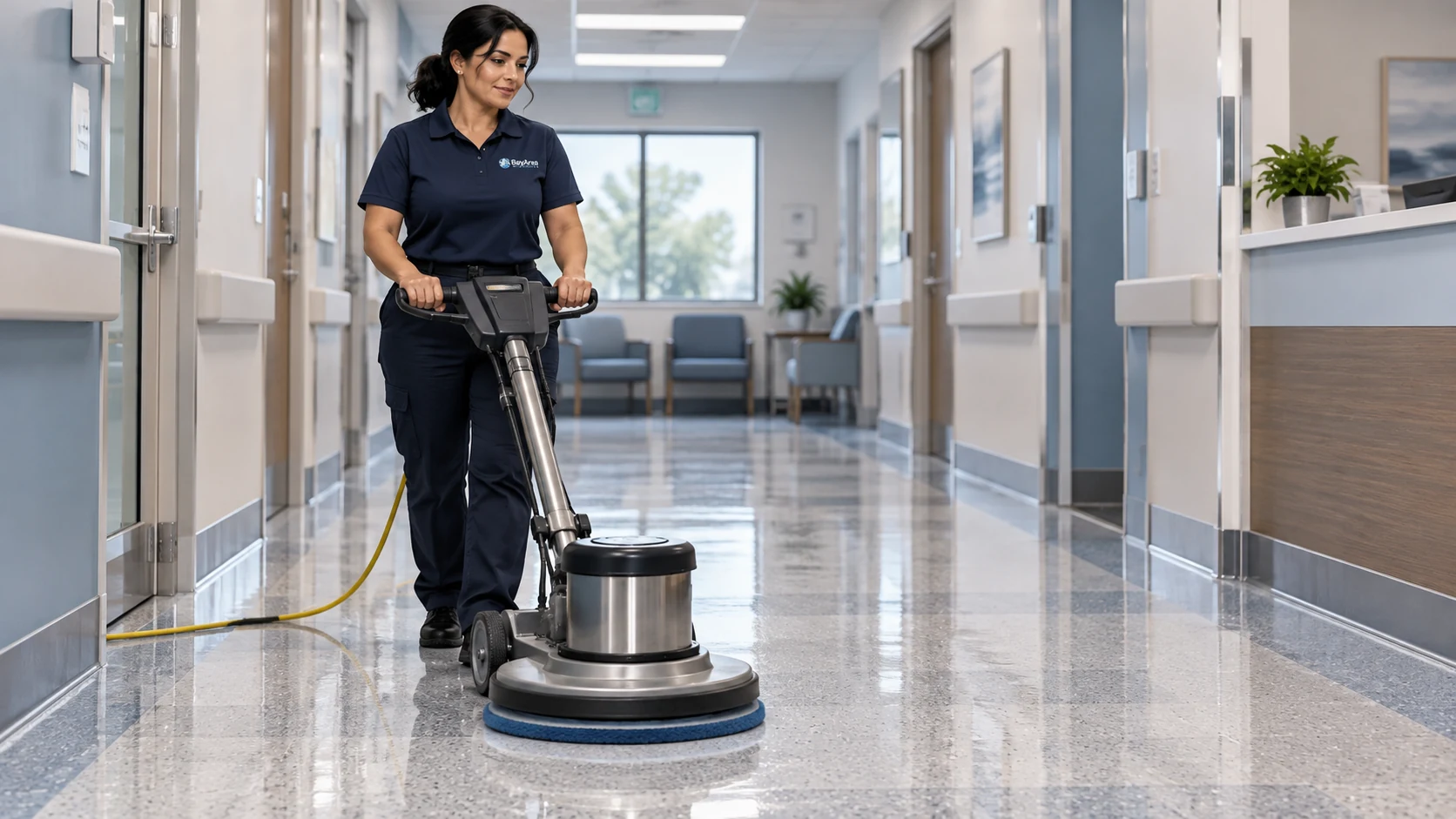
Commercial floor cleaning may mean vacuuming accessible carpet, removing loose debris from resilient floors, or addressing tracked-in dirt near entrances. It does not automatically include carpet extraction, stripping coatings, refinishing, or moving heavy fixtures. Those tasks need explicit approval and suitable equipment.
The Bay Area Cleaners has a dedicated commercial floor care service listing carpet care, tile and grout, and hard-floor maintenance. The existence of that page supports a related service link, but a manager should verify which tasks are included in a specific proposal. Do not infer that intensive work is bundled with routine janitorial visits.
A useful commercial floor cleaning decision begins with the manufacturer or facility maintenance instructions. Ask whether the floor has a protective finish, which cleaning method is permitted, and who will address a recurring problem such as tracked-in grit. The goal is to avoid treatments that damage a surface or remove a finish unnecessarily.
Restrooms need a defined inspection standard
Commercial restroom cleaning requires more detail than “clean bathrooms.” A scope can name toilets, sinks, partitions, touchpoints, mirrors, floors, bins, and supply dispensers. It should say who supplies consumables and who reports a leak or damaged fixture. An odor complaint may need a maintenance assessment rather than repeated cleaning alone.
The restroom cleaning service page describes the type of work offered by TBAC. For a deeper look at recurring odor and touchpoint problems, see the published article Commercial Restroom Cleaning: The One Room That Grades the Whole Building.
This second table answers what belongs in recurring care and what may require separate approval.
| Area or task | Routine scope example | Potential separate work | Verification question |
| Entry floors | Remove surface grit and visible marks | Finish restoration | Is the surface condition improving? |
| Carpet | Vacuum accessible traffic areas | Extraction or stain treatment | Is the requested method approved? |
| Restroom fixtures | Clean listed surfaces and check supplies | Repair of leaks or broken fittings | Who logs maintenance defects? |
| Interior glass | Remove ordinary accessible smudges | High or difficult access cleaning | Which panes are included? |
A commercial floor cleaning plan and a commercial restroom cleaning plan may appear in the same agreement, but each needs separate acceptance criteria. A manager should be able to tell whether a complaint concerns unfinished work, an excluded service, or a maintenance fault.
Takeaway: Put flooring materials, restroom fixtures, supplies, and exclusions into the scope. Route repairs and restoration requests to the right service rather than treating every issue as routine cleaning.
How Should a Commercial Cleaning Checklist Be Written?
A commercial cleaning checklist translates a general promise into observable actions. It identifies the work, location, frequency, access rules, and method of confirming completion. The checklist becomes useful only when both the facility manager and the cleaner can interpret it the same way.
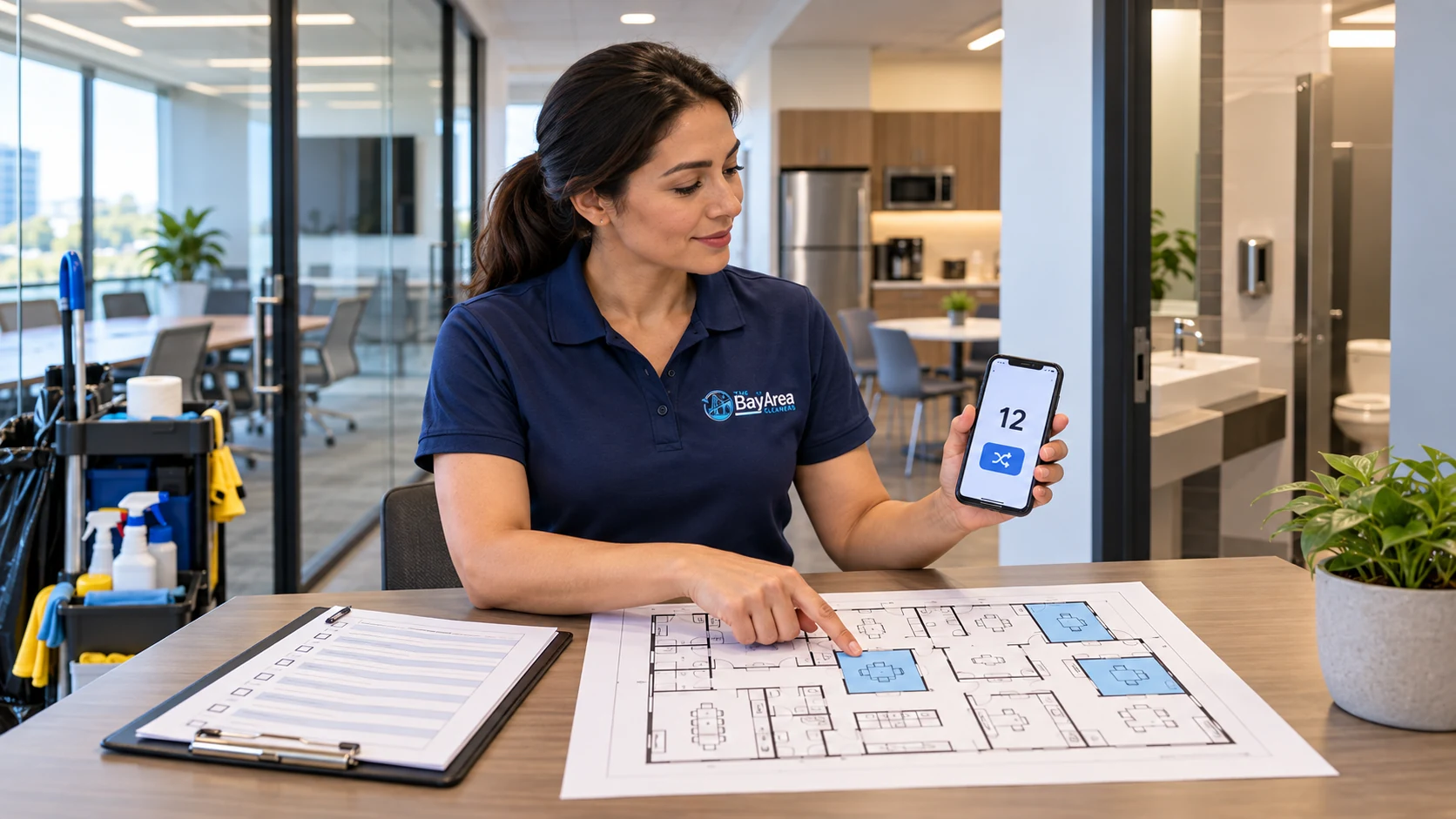
For an Oakland office, a sensible approach is to build the document from the layout rather than copy a generic template. Start at the entrance, walk through occupied areas, and end in restrooms and service corridors. Note what building staff already handles so two teams do not assume the other is responsible.
A simple development sequence is:
- List rooms and shared areas, distinguishing ordinary access from restricted areas.
- Record visible conditions and touchpoints that need regular attention.
- Match each task to a suitable frequency based on traffic and operating hours.
- Mark exclusions, additional services, supplies, and who authorizes exceptions.
- Agree on how the team records completed work and reports inaccessible rooms.
- Review the first visits and revise unclear wording before it becomes a recurring dispute.
A commercial cleaning checklist should use verbs such as “empty,” “wipe,” “vacuum,” “inspect,” and “report.” Phrases like “maintain excellence” sound positive but do not tell either party what to check. A clear list consistently describes visible outcomes without promising an unrealistic health or productivity result.
Design the checklist around decisions
The most useful documents distinguish a missed task from a new request. Suppose an office relocates desks into a meeting room. The room’s traffic rises, and the original schedule may no longer fit. The manager should record that change and ask the contractor to revise the scope rather than expecting undocumented extra work.
You may also like: High Dusting: Why Your Clean Floors Do Not Stay Clean.
Upper ledges and vents are a useful example of work that occupants may notice only after dust settles below. Their inclusion should depend on access, safety, and the agreed cleaning scope, not assumptions made from a short proposal. What does a commercial cleaner do about an inaccessible high surface? Report it and follow the documented escalation process.
Takeaway: Build the checklist from real rooms, traffic, and access limits. Use specific actions and a documented change process.
How Can Managers Check Cleaning Quality Without Constant Supervision?
What does a commercial cleaner do well enough to justify a recurring contract? The best answer comes from checking agreed outcomes, not from watching every movement. A short inspection routine can identify missed tasks, unclear instructions, and maintenance issues without creating unnecessary interruptions.
To answer what does a commercial cleaner do, inspect after a representative visit and compare results with the checklist. Do not judge specialized disinfection performance by appearance alone. Follow product and facility requirements where such work is contracted.
Use a compact inspection list to record the outcome:
- Check the same representative areas at consistent points in the operating schedule.
- Note specific defects, locations, and dates rather than broad judgments about cleanliness.
- Separate a missed agreed task from damage, wear, or a condition requiring repair.
- Report inaccessible areas and confirm who may grant access for future visits.
- Review recurring patterns with the service contact and update the scope if necessary.
A commercial cleaning checklist can serve as the inspection record, but it should not become an excessive reporting burden. Avoid capturing employee records, patient details, customer information, or security-sensitive material.
Managers sometimes ask what does a commercial cleaner do when a task cannot be completed. A professional process should identify the limitation and request direction rather than quietly marking the item finished. The agreement can specify how complaints are logged, when a response is expected, and who closes a documented issue. Those details should be negotiated, not invented in an article.
A facility can assess commercial restroom cleaning through supplies, surface condition, and recurring service reports. It can assess commercial floor cleaning through visible debris, safe access, and the state of the specified finish. Neither check justifies a guaranteed absence of germs or an automatic claim about business revenue.
Takeaway: Inspect a few agreed areas consistently, document specific exceptions, and use the results to refine the scope. Quality checks should clarify responsibility, not create unsupported performance promises.
When Does Routine Cleaning Stop and Specialized Work Begin?
What does a commercial cleaner do when a request goes beyond the agreed routine? The cleaner or supervisor should identify the new requirement and refer it for appropriate assessment. The scope may exclude high access, construction residue, hazardous materials, restorative floor work, and regulated environments.
Routine cleaning is usually predictable: accessible surfaces, visible soil, bins, common areas, and scheduled restroom care. Specialized assignments can involve different equipment, risks, authorizations, or professional qualifications. A manager should never assume the presence of cleaning supplies proves a team is authorized for every type of job.
The OSHA cleaning-industry guidance points employers to hazards involving cleaning chemicals, falls, electrical equipment, and protective equipment. This article is a decision aid, not a substitute for workplace safety requirements.
Before adding a new service, ask:
- Is the task included in the signed description, or does it need a separate quotation?
- Are the surface, equipment, and access conditions suitable for the proposed method?
- Who is responsible for evaluating unusual hazards or regulated areas?
- How will the manager inspect the completed work without entering restricted zones?
- Does the proposed vendor actually serve the address and have evidence for the required capabilities?
The answer varies by industry and does not prove that one company serves every Oakland property. TBAC’s public materials describe commercial services across the Greater Bay Area. The exact Oakland address and any specialized work should be confirmed directly before making an appointment or describing a service as available.
For ordinary offices seeking recurring support, review office cleaning and recurring janitorial services as separate service options. Their functions overlap in places, so compare the actual scope rather than assuming their names mean the same tasks.
Takeaway: Treat unusual access, regulated spaces, and restorative work as separate decisions. Confirm geographic coverage and written capability before asking a provider to add them to a contract.
Frequently Asked Questions
What does a commercial cleaner do in a small office?
A commercial cleaner may empty agreed bins, clean shared counters and meeting rooms, attend to restrooms, and remove ordinary dirt from accessible floors. What does a commercial cleaner do in your office depends on its layout, hours, and written scope. Confirm whether occupied desks, electronics, interior glass, and supplies are included rather than assuming every surface is covered.
What belongs on a commercial cleaning checklist?
A commercial cleaning checklist should identify rooms, assigned tasks, frequency, supplies, access restrictions, exclusions, and a way to record completion. Use observable wording such as “wipe reception counter” or “check restroom soap.” When an area is locked or a task changes, the process should say who records the issue and approves any new work.
Is commercial floor cleaning included in janitorial service?
Commercial floor cleaning often includes routine removal of dirt from agreed, accessible surfaces, but the contract determines the exact work. Carpet extraction, stripping, refinishing, or special stain treatment may be separate. Ask which floor materials are present, what methods are approved, how often the work is scheduled, and who responds when restoration is needed.
What should commercial restroom cleaning include?
Commercial restroom cleaning may cover listed fixtures, touchpoints, mirrors, floors, waste bins, and supply dispensers. The contract should identify who provides soap and paper products and how damage or leaks are reported. Disinfection, when required, must follow applicable product labeling. Inspect completion against a room-specific checklist rather than relying on broad descriptions such as “spotless bathrooms.”
How do managers compare cleaning proposals in Oakland?
Compare proposals against the same building map and task list. Ask each provider to clarify frequency, accessible areas, supplies, reporting, exclusions, and any specialized work. Check service coverage for the specific Oakland address instead of relying on regional descriptions alone. A lower quote is not comparable when it excludes work included in another provider’s scope.
Conclusion
What does a commercial cleaner do for your building? The answer should be a clear set of tasks, sensible service boundaries, and an inspection method that your team can use. Oakland offices, stores, and shared buildings need different priorities, yet each benefits from a written agreement that names the work rather than relying on broad claims. If you manage a commercial property in the Greater Bay Area, review The Bay Area Cleaners’ recurring janitorial options and ask whether your exact address and requirements are covered. Call 707-656-9339 to discuss the scope before requesting a proposal.