
Take a quote of $1,400 a month to clean a 12,000-square-foot office five nights a week. If the bidder plans 86.7 labor hours a month, the pace of a crew covering 3,000 square feet an hour, the quote pays $16.15 per labor hour. California’s minimum wage in 2026 is $16.90. That $16.15 would have to cover payroll tax, insurance and supplies on top of the crew’s pay.
Every commercial office cleaning cost quote, whether it’s written per square foot, per hour or per month, rests on the same arithmetic. This guide walks through it, shows how to restate a quote in another unit, and ends with the state registration check that protects the buyer.
The quick version: Commercial office cleaning cost comes down to four numbers: cleanable square feet, the square feet a crew cleans per labor hour, visits per month, and the billed rate per labor hour. Divide any quote by the labor hours the bidder plans and you get the hourly rate inside it. Compare that rate with California’s $16.90 minimum wage, or the local minimum where it’s higher. Before hiring, look the provider up in the Labor Commissioner’s janitorial registration search.
A Commercial Cleaning Cost Calculator You Can Check by Hand

A spreadsheet with four inputs works as a commercial cleaning cost calculator, and you control every number in it. Cleanable square feet divided by the crew’s production rate gives labor hours per visit. Multiply by visits per month for monthly hours, then by the billed rate for the commercial office cleaning cost of that month.
The production rate and billed rate in this example are sample inputs, not a quote from us or anyone else. Swap in the figures each bidder gives you.
| Input | Example | Result |
|---|---|---|
| Cleanable square feet | 12,000 | 12,000 sq ft |
| Production rate (sq ft cleaned per labor hour) | 3,000 | 4 labor hours per visit |
| Visits per month | 5 nights × 52 weeks ÷ 12 = 21.67 | 86.7 labor hours per month |
| Billed labor rate | $40 per hour | $3,467 per month |
| Result | Annual total and unit cost | $41,600 a year, about $0.29 per sq ft per month |
Our office cleaning crews handle workstations, meeting rooms, restrooms and breakrooms, and each of those rooms adds minutes to the hours in the formula. The visits input comes from your cleaning schedule, and our Fremont guide sets out common schedules by headcount.
You may also like: How Fremont Businesses Can Choose the Right Office Cleaning Program?
Four labor hours per visit can mean one cleaner for four hours or two cleaners for two. The formula doesn’t care how the hours are split, only how many there are.
Now change one input at a time. Add $2 to the billed rate and the year costs $2,080 more. Drop the production rate from 3,000 to 2,500 square feet an hour and the same schedule needs 104 labor hours a month, which comes to $4,160 at $40 an hour. That’s a 20 percent higher commercial office cleaning cost for the same floor.
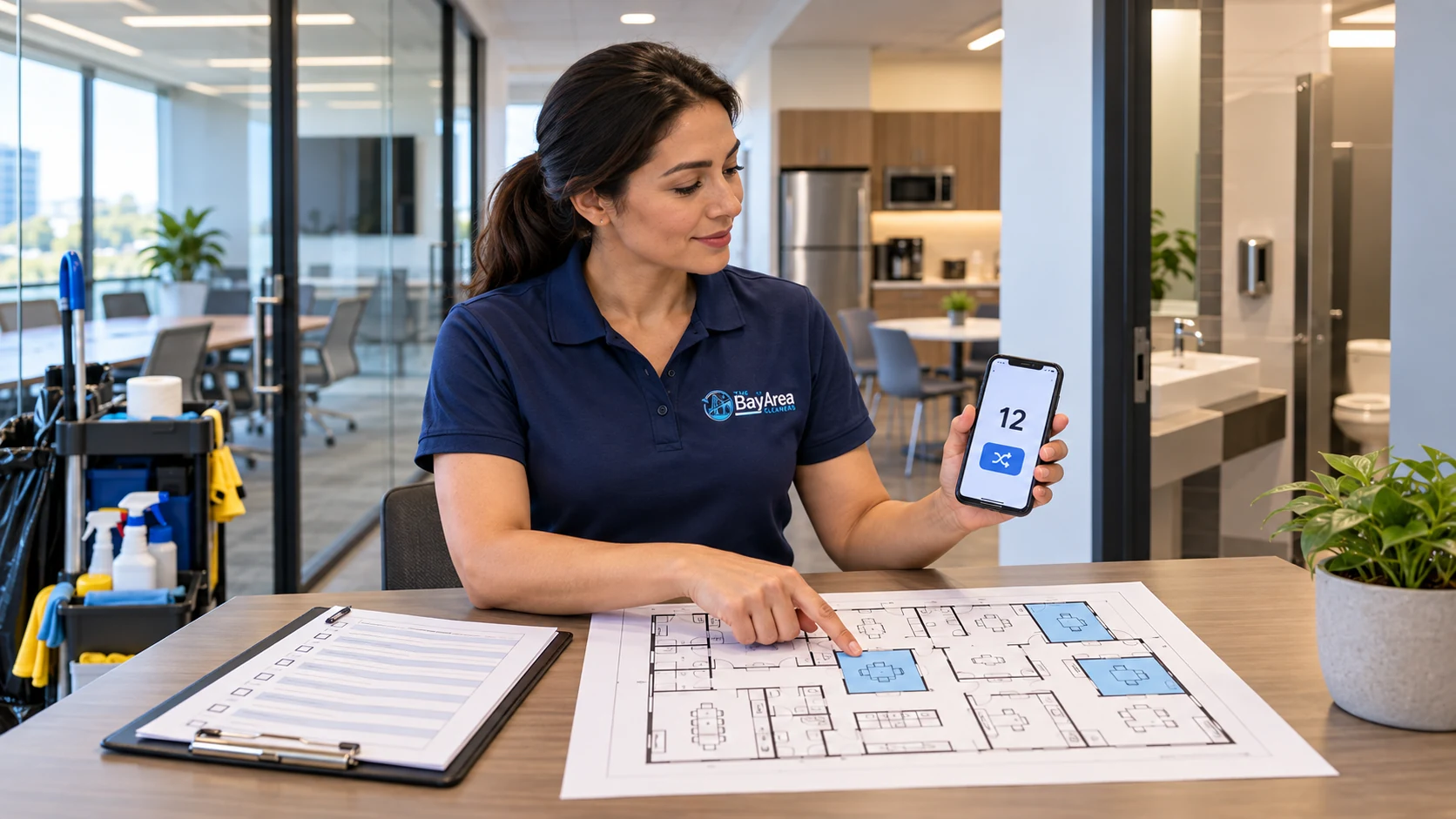
Square footage comes from a floor plan and visits come from a calendar. The production rate comes from the bidder’s own staffing plan. If a bidder won’t state it, divide cleanable square feet times visits per month by the planned monthly hours.
Read the year in labor hours
Multiply the monthly hours by 12 and the sample office comes to about 1,040 labor hours a year. A full-time schedule of 40 hours a week for 52 weeks is 2,080 hours, so this office takes about half of one full-time cleaner’s year. That’s a quick way to picture what a commercial office cleaning cost is paying for.
If a quote implies far fewer hours than that for a similar floor, ask the bidder to walk you through its production rate before comparing prices.
Takeaway: Four inputs rebuild any office cleaning price. A small change to the production rate or the billed rate moves the annual total by thousands of dollars.
What a Billed Labor Hour Pays For
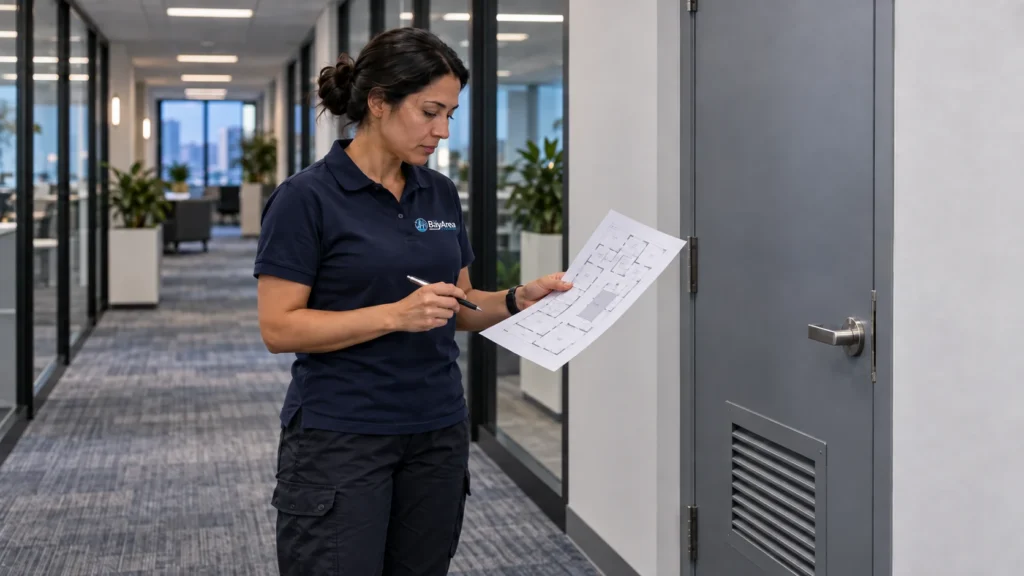
The billed rate on a quote isn’t what the cleaner earns. It covers the cleaner’s wage plus payroll taxes, workers’ compensation insurance, supplies, supervision and the company’s margin. Inside any commercial office cleaning cost, the wage is the one part with a floor set by law.
Payroll taxes and workers’ compensation premiums are figured on pay, so they rise when the wage rises. Supplies, supervision and margin don’t follow the wage the same way, and that difference matters when a price increase arrives.
The 2026 wage floor
California’s statewide minimum wage is $16.90 an hour in 2026, up from $16.50 in 2025. Where a city or county sets a higher minimum, the higher rate applies. Check your office’s city before running any of the tests in this guide, and use whichever rate is higher. No billed rate can sit below that floor and still pay a legal crew, and a rate barely above it leaves nothing for the rest of the bill.
What the federal wage data shows
Data from the U.S. Bureau of Labor Statistics puts the mean wage for building and grounds cleaning and maintenance work in the San Francisco-Oakland-Fremont area at $25.46 an hour in May 2025, against $19.66 nationwide. That’s about 30 percent higher. The group covers more than janitors, so treat it as a sign of local pay levels, not a cleaner’s exact wage.
Here’s what that means for a billed rate. If a crew earned that $25.46 area mean, a $40 billed hour would leave $14.54 for payroll taxes, workers’ compensation, supplies, supervision and profit. At $30 billed, $4.54 would be left.
Takeaway: A billed rate has to clear the local minimum wage first, then pay for everything a crew needs to show up. A rate that barely clears the floor can’t cover the rest.
Find the Hourly Rate in a Commercial Office Cleaning Cost Quote
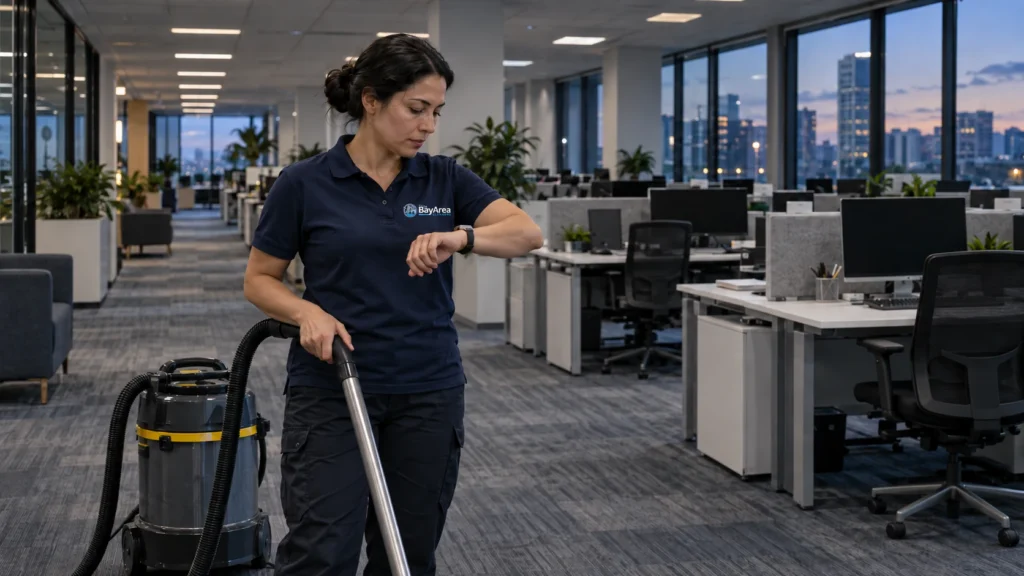
Per-foot and flat quotes don’t state a billed rate. You can find it with one division: the monthly price divided by the labor hours the bidder plans to spend each month. The result is the implied hourly rate, and it works the same for any commercial office cleaning cost, whatever unit the quote uses.
You may also like: How to Choose a Janitorial Service for Your Business: 7 Questions to Ask First
That’s how the $1,400 quote came out at $16.15 an hour. The same division works on a per-foot price once you turn it into a monthly total: $0.30 a square foot on 12,000 feet is $3,600 a month, and $3,600 over 88 planned hours is $40.91 an hour. A commercial office cleaning cost that low can’t staff 86.7 hours a month with a legal crew.
Now take a $3,300 flat quote that plans 88 labor hours a month. It works out to $37.50 an hour, which clears the floor with room for taxes, insurance, supplies and margin. The open question for that quote is whether 88 hours covers your floor, and the production rate you back out from it answers that.
If a bidder talks in crew size instead of hours, convert it. Two cleaners working two hours a night, five nights a week, come to about 86.7 labor hours a month (2 × 2 × 21.67). Run the result against the minimum wage in your office’s city, since a local rate can sit above the state’s.
Keep the planned hours in writing with the quote. If the crew later works fewer hours than planned, the commercial office cleaning cost you agreed to is buying less labor than the quote described.
Takeaway: An implied rate at or under the local minimum wage means the quote can’t pay a legal crew for the hours it names. Ask every bidder for planned monthly hours so the division is possible.
Convert a Quote Between Per-Foot, Hourly and Monthly Terms
Converting takes two figures: the cleanable square footage and the planned monthly labor hours. With both on hand, you can restate any commercial office cleaning cost in the other two units. Each example in this section assumes 12,000 cleanable square feet and 88 planned hours.
Cleanable square feet versus rentable
Your lease lists rentable square feet, which usually folds in a share of the building’s lobbies, corridors and mechanical rooms. Your own crew cleans the offices, work areas, restrooms, breakrooms and conference rooms on your floor. A commercial cleaning cost per square foot applied to rentable area charges you for space your crew doesn’t clean.
Say the lease shows 13,800 rentable square feet for the same floor that has 12,000 cleanable feet. At $0.30 a foot, the rentable figure produces a $4,140 monthly bill against $3,600 on the cleanable area. That’s $540 a month, or $6,480 a year, for lobbies and mechanical rooms your crew never touches. Ask each bidder which figure it used, and where the number came from.
Three quote formats, converted
| Quote as written | Monthly total | Per sq ft per month | Per planned labor hour | Annual total |
|---|---|---|---|---|
| $0.30 per sq ft per month | $3,600 | $0.30 | $40.91 | $43,200 |
| $42 per labor hour, 88 hours | $3,696 | about $0.31 | $42.00 | $44,352 |
| $3,300 flat per month | $3,300 | about $0.28 | $37.50 | $39,600 |
Per-visit quotes
Some quotes arrive as a price per visit. Multiply it by the visits in a month to get the monthly figure: $160 a visit on a five-night schedule comes to about $3,467 a month, the same commercial office cleaning cost as the sample calculator. From there, divide by the planned hours for the hourly rate or by the cleanable feet for the per-foot rate.
Every hourly figure in the three-format conversion can go straight into the implied-rate test. All three clear the state floor comfortably, so the next check for each is the production rate behind its 88 hours.
Takeaway: Get the cleanable square footage and the planned hours behind every quote. With those two figures, each price reads in all three units.
What Happens to Each Pricing Unit When Something Changes
A quote gets set once, but the calendar and the office keep changing. The pricing unit decides who pays when they do, and that choice shapes the commercial office cleaning cost you see over a full year.
| Change | Per square foot | Hourly | Flat monthly |
|---|---|---|---|
| A 23-weeknight month instead of 20 | Same bill | Bill follows hours worked | Same bill |
| Your office adds a suite | Bill rises with the added cleanable feet | Hours rise with the added space | Needs a new quote |
| The office closes for a holiday | Billed unless the contract credits it | No hours worked, no charge | Billed unless the contract credits it |
When the office grows or shrinks
When your space changes, a per-foot price tells you the new bill before the crew starts: the rate times the new cleanable feet, measured the same way as the original ones. A flat price has to be quoted again, and an hourly bill shows the change only after the new hours reach an invoice.
Giving space back works the same way in reverse. If you sublet a wing, the per-foot bill drops by the feet you hand over. A flat commercial office cleaning cost stays where it is until someone asks for a new number.
Short months and holidays
A five-night recurring janitorial schedule averages 21.67 visits a month, but real months run anywhere from 20 to 23 weeknights. In 2026, February has 20 and July has 23. A flat or per-foot bill charges the same for a short February as for a long July, and that evens out over a year. Holidays don’t even out, so ask whether nights the office is closed get credited or are already priced out.
The January wage adjustment
California adjusts its minimum wage each January using the national consumer price index for urban wage earners and clerical workers (CPI-W), with no one-year raise above 3.5 percent. The 2026 step, from $16.50 to $16.90, came to 2.4 percent. A raise pegged to that change lifts the wage portion of a billed rate by about 2.4 percent and the whole rate by less, since supplies and margin don’t move with the wage floor.
Here’s the math on the 2026 step. A crew paid $16.50 in 2025 got 40 cents more an hour. Inside a $40 billed rate, that’s about 1 percent of the rate plus the payroll taxes on 40 cents, not a 2.4 percent jump in the whole commercial office cleaning cost.
Takeaway: The pricing unit decides who pays for short months, added space and holidays. Check any January increase against the published change in the state minimum wage.
Look Up the Provider’s State Registration
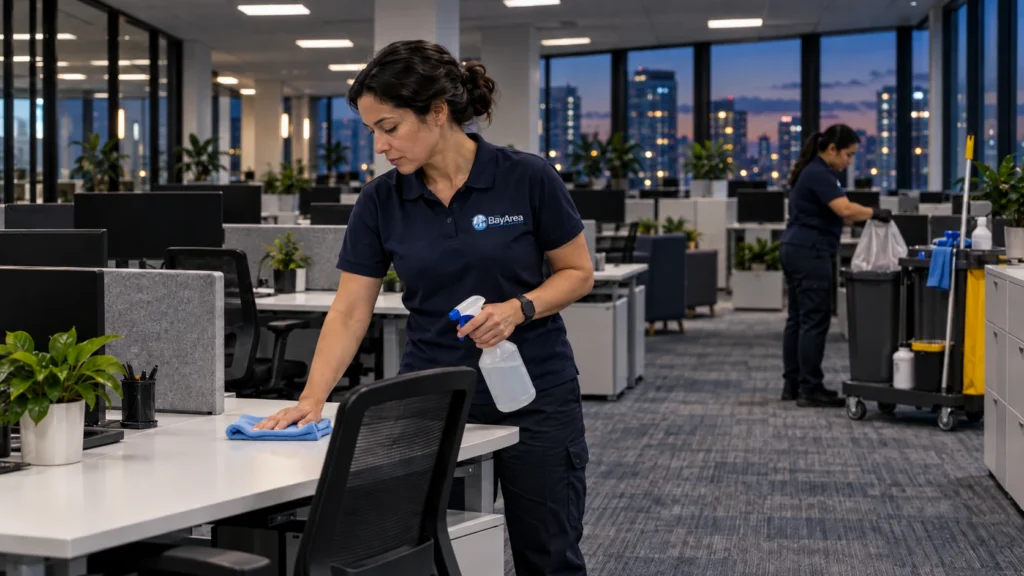
California requires janitorial employers to register with the Labor Commissioner and renew that registration every year. According to the Labor Commissioner’s Office, an employer that fails to register is subject to a civil fine of $100 for each calendar day it goes unregistered, up to $10,000.
The rule reaches the buyer too. Any person or entity that contracts for janitorial services with an employer that isn’t registered when the contract is signed, extended, renewed or modified is subject to a civil fine of $2,000 to $10,000 for a first violation, and $10,000 to $25,000 for a later one. That fine lands on top of whatever commercial office cleaning cost the contract carries.
Ask each bidder for its registration details and look the company up in the Labor Commissioner’s janitorial registration search before the contract is signed. Save the search result with the contract file, next to the quote and the planned hours.
A registration is valid for one year from the date it was issued. The provider’s registration can lapse partway through your agreement, so run the search again whenever the contract is extended, renewed or modified.
Takeaway: A janitorial contract with an unregistered provider exposes the buyer to state fines. Confirm the registration each time a contract is signed, extended, renewed or modified.
Frequently Asked Questions
Is commercial office cleaning cost higher in the Bay Area than in other markets?
Usually, yes. Federal data puts mean pay for building and grounds cleaning and maintenance work in the San Francisco-Oakland-Fremont area about 30 percent above the national mean. National price ranges work as a rough reference only, so compare a local commercial office cleaning cost with other local bids.
Why does commercial cleaning cost go up every January?
The state minimum wage adjusts each January 1 with CPI-W, capped at 3.5 percent a year. For a provider paying at or near that floor, January is when payroll rises, so it’s when a commercial cleaning cost increase makes sense to request. A fair increase moves the wage share of the rate by the published percentage, not the whole rate.
Should commercial cleaning cost per square foot use rentable or cleanable space?
Cleanable space, since that’s the area your crew actually works. Rentable area on a lease adds a share of lobbies, corridors and mechanical rooms that the building’s own staff looks after. Multiply a commercial cleaning cost per square foot by the cleanable feet to get the monthly total. Then divide that total by the planned monthly hours to see the hourly rate inside the price.
Can a commercial cleaning cost calculator flag a bid that’s too low?
Yes, once you have the bidder’s planned monthly hours. Divide the monthly price by those hours and compare the result with the minimum wage in your office’s city, or the state’s $16.90 where no local rate applies. A commercial cleaning cost calculator that shows an implied rate at or near the minimum wage has found a bid that can’t cover payroll taxes, insurance and supplies.
Conclusion
Commercial office cleaning cost comes from square footage, crew speed, visits and a billed rate. Put every quote in monthly, per-foot and hourly terms, run the implied-rate test against the local wage floor, and confirm the provider’s state registration. A quote that holds up on all three is one worth a second meeting. One that fails any of them tells you what to ask next: more hours, a different rate, or proof of registration.
Call The Bay Area Cleaners at 707-656-9339 to request a written, itemized estimate for your office.