One office floor with 45 private offices, two conference rooms, three restrooms and a breakroom holds 51 rooms. At four minutes a room, inspecting all of them takes more than three hours, every week.
Eight rooms drawn at random, plus the three restrooms and the breakroom, take about 48 minutes. This commercial cleaning checklist is built for that shorter walk: a weekly sample, a pass-or-fail mark on each line, a score, and a set routine for anything that fails. You end up with a number you can track from week to week, and your cleaning provider knows the standard before the first walk.
The quick version: Inspect every restroom and the breakroom each week, and draw the rest of the rooms at random. Mark each line of a commercial cleaning checklist pass or fail, and score the week as lines passed out of lines inspected. A week passes when it clears a threshold you picked in advance and no must-pass line has failed. Recheck failed lines the next business day, and double the random draw after a failed week until two weeks in a row pass.
Borrow the Method From Federal Service Contracts
For performance-based service contracts, the Federal Acquisition Regulation requires measurable performance standards and a method of assessing the contractor’s performance against them. The same regulation says the plan for checking a service contract should specify the work that needs surveillance and the method used to check it.
The State Department’s handbook for its contracting officer’s representatives adds a third piece: when work falls short, the government can require the contractor to correct the deficiency and send the work back for inspection. Put the three together and a weekly commercial cleaning checklist inspection needs:
- A standard for each line.
- A method: which rooms, how often, and who inspects.
- A routine for anything that fails.
This guide builds all three for an ordinary office floor, starting with the lines themselves. One example floor runs through every section, so each number can be checked against the others.
Takeaway: Standards, a checking method and a failure routine make a checklist something you can inspect against. The federal rules name the first two, and the failure routine completes the set.
The Commercial Cleaning Checklist Template

Every line in this commercial cleaning checklist template passes one test: two people inspecting the same room on the same morning would mark it the same way. The lines cover the rooms our office cleaning crews work in, grouped into three kinds of space. Lines marked must-pass cover a slip risk or a missing supply.
| Space | Line | Pass if |
|---|---|---|
| Workspace (office, conference room or pod) | Surfaces | No crumbs, rings or spills on desks or tables |
| Workspace | Waste bin | Empty, fresh liner, no liquid at the bottom |
| Workspace | Floor | No paper or debris larger than a U.S. quarter |
| Restroom | Fixtures | No visible residue in toilets, urinals or sinks |
| Restroom | Floor (must-pass) | Dry, with no paper on it |
| Restroom | Supplies (must-pass) | Every dispenser has product and the spare roll is in place |
| Breakroom | Counter and sink | No food in the basin, no sticky spots on the counter |
| Breakroom | Tables | Wiped, with no crumbs left |
| Breakroom | Floor (must-pass) | Dry, with no food or spills under the tables |
The quarter in the workspace floor line gives everyone the same size to judge by. A few specks near a chair leg don’t fail the line, and a torn sticky note does.
The three restroom lines are scoring checks for the weekly walk, not a restroom cleaning scope. What a restroom crew should work through on every visit is a separate subject.
You may also like: Commercial Restroom Cleaning: The One Room That Grades the Whole Building
That’s nine lines in all. Each sampled workspace gets the three workspace lines, each restroom gets the three restroom lines, and the breakroom gets its three. On the example floor, a normal week adds up to 36 lines: 24 from eight workspaces, nine from three restrooms and three from the breakroom.
The same nine lines work on every floor of a building, and each floor gets its own numbered room list. Identical lines keep scores comparable across the whole property.
Takeaway: Nine lines, three kinds of space, and three must-pass lines. If two inspectors could mark a line differently, reword it before the first walk.
How to Pick the Rooms for a Fair Sample

The State Department’s Contracting Officer’s Representative Handbook says 100 percent inspection may be warranted where safety and health are an issue, and that random sampling lets a limited number of parts stand in for the entire lot. The handbook talks about parts and lots, not rooms. Applied to a commercial cleaning checklist for an office floor, it points to two rules:
- Inspect every restroom and the breakroom every week.
- Draw the offices, conference rooms and open-plan areas at random.
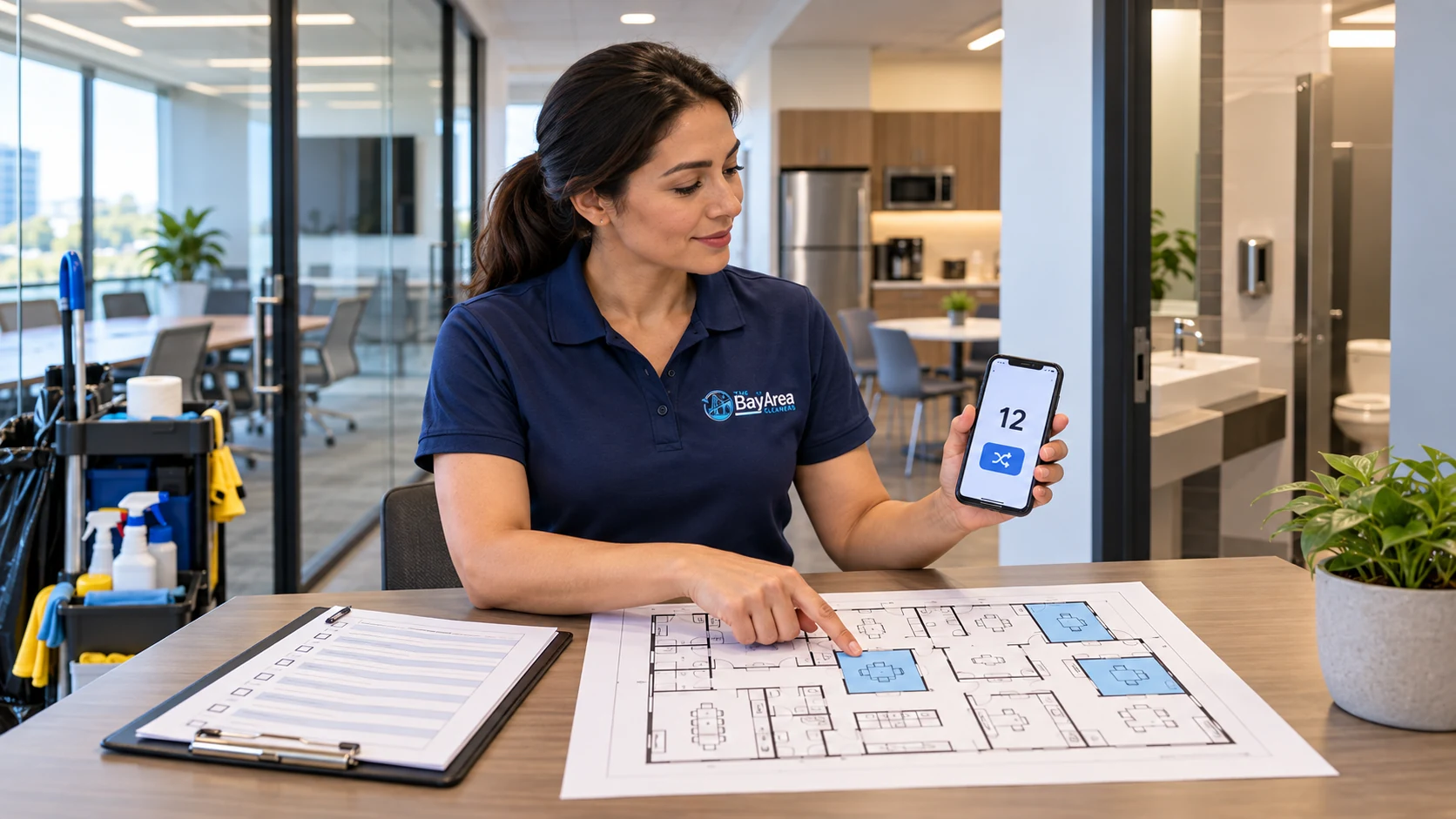
Number every sampled room on a floor plan. Each week, have a phone’s random number generator pick 12 numbers. Inspect the first eight and keep the other four as spares for rooms you can’t enter.
On a doubled week, pick 20 numbers: 16 to inspect and four spares. Don’t choose rooms by feel, and don’t share the list with the crew ahead of time.
Open-plan areas have no doors to number, so split the floor into pods of about eight desks and number each pod like a room. A drawn pod gets the same three workspace lines, marked across the whole pod.
Random draws spread the inspection across the whole floor over time. On the example floor, eight draws a week from 47 workspaces reach about three in four of them within eight weeks, and no one on the crew can guess which desks come next. Larger or smaller floors can keep the same pace by drawing roughly one in six workspaces each week, with a minimum of five.
Takeaway: Health rooms get inspected in full, and workspaces get drawn at random with spares. A hand-picked sample measures the rooms you already worry about.
Running the Weekly Office Cleaning Checklist

Hold the weekly office cleaning checklist walk on the same weekday, in the first hour of the business day, with the same inspector. Morning timing means the rooms still show the night crew’s work rather than the day’s traffic. Changing the inspector or the hour can move the score without any change in the cleaning.
Mid-afternoon supply levels fall outside this walk and belong to daytime coverage.
You may also like: Day Porter Services: What They Are and When Your Building Needs One?
In each room, read the lines in order and mark pass or fail. Beside each fail, write what you saw and where: “coffee ring, left side of desk” is enough.
If a drawn room is locked or in use, move to the next spare and note the swap. Don’t wait and come back at 2 p.m. By then the room no longer reflects the night’s work.
Leave everything as you found it. Wiping away a fail during the walk removes the evidence the provider needs to see.
Four minutes a room is plenty for three lines. When a room regularly takes longer, its lines are probably too vague, and they’re due for rewording at the next joint walk.
If the regular inspector is out, skip the week instead of sending someone who hasn’t walked it before, and mark the gap in the log. A skipped week doesn’t count toward two passing weeks in a row, and the next walk covers the health rooms as usual.
Once a month, bring the provider’s supervisor on the weekly office cleaning checklist walk. Each of you marks the same rooms separately, and you compare sheets at the end. Our recurring janitorial programs include periodic supervisor walkthroughs, and a shared sheet gives that visit a fixed agenda.
Takeaway: Same day, same hour, same inspector, and no cleaning during the walk. A monthly walk with the provider’s supervisor shows whether both of you read the lines alike.
How to Score Each Week
Each line on the commercial cleaning checklist scores 1 for pass and 0 for fail. The week’s score is lines passed divided by lines inspected. On a normal 36-line week, a single fail moves the score by about 3 points.
Pick the threshold before the first walk and agree on it with the provider. A threshold set after the first bad week looks like a moving target, even when it isn’t. The example uses 90 percent, plus one more condition: a week fails outright if any must-pass line fails, whatever the percentage says. Four weeks on the example floor might read like this:
| Week | Draws | Lines inspected | Lines failed | Must-pass fails | Score | Result |
|---|---|---|---|---|---|---|
| 1 | 8 | 36 | 3 | 0 | 91.7% | Pass |
| 2 | 8 | 36 | 5 | 0 | 86.1% | Fail |
| 3 | 16 | 60 | 1 | 1 | 98.3% | Fail |
| 4 | 16 | 60 | 2 | 0 | 96.7% | Pass |
Weeks 3 and 4 inspect 16 workspaces: week 3 follows the failed week 2, and week 4 follows the failed week 3. Week 3 shows why must-pass lines sit outside the percentage: 98.3 percent still fails when the one missed line was an empty soap dispenser.
Takeaway: Score lines, not rooms, and let any must-pass fail decide the week. Fix the threshold with the provider before the first walk.
What Happens After a Room Fails
On this commercial cleaning checklist, a room fails when any of its lines fails, and every failed line gets its own recheck. The State Department handbook describes the loop for its own contracts: the deficiency gets corrected and the work goes back for inspection. For an office floor, that loop looks like this:
- Recheck each failed line on the next business day, in the same room. The recheck confirms the fix, and the week’s score doesn’t change.
- After a failed week, double the draw to 16 workspaces the following week.
- Return to eight draws after two passing weeks in a row.
You may also like: How to Choose a Janitorial Service for Your Business: 7 Questions to Ask First
The larger draw adds eight rooms, about 32 minutes of walking on the example floor, and it answers one question fast: was the failed week a slip, or the start of a pattern? On the example, week 4 passed, so week 5 stays at 16 draws, and week 6 can drop back to eight if week 5 passes too.
A recheck that fails again gets logged as a repeat fail. Repeat fails don’t change the week’s score, but they belong in the trend, and a line that keeps failing after rechecks says more than any single week.
When the provider disputes a fail, the wording of the line decides it. If the line could fairly be read both ways, the fail still counts for that week, and the line gets reworded at the next joint walk.
Takeaway: Recheck failed lines the next business day and widen the draw after a failed week. Two passing weeks in a row bring the normal draw back.
Read the Trend, Not One Week
A single week says little, and twelve weeks of commercial cleaning checklist results say a lot. Keep one row per commercial cleaning checklist walk in a spreadsheet: date, inspector, workspaces drawn, lines inspected, lines failed, must-pass fails, score, and the names of the failed lines.
After 12 weeks, sort the fails two ways.
If the same line fails across many rooms, look at method or training first. The crew may be doing that task the same wrong way everywhere. If one restroom or the breakroom fails on different lines week after week, look at time first. The route may be running short before the crew gets there.
A plain line chart of weekly scores, with the threshold drawn across it, shows the direction at a glance. Three weeks drifting toward the line tell you more than one week that dipped and recovered. Split the trend by space as well: workspaces, restrooms and the breakroom. A healthy overall score can hide a restroom fixtures line or a breakroom counter line that failed three weeks running.
Share the chart with the provider every month, whether or not a week failed, so a slow drift gets attention before it crosses the threshold.
Takeaway: Log every week and sort fails by line and by health room. The pattern tells you whether to look at method or at time.
Keep the Checklist Steady When the Office Changes
Walls move, desks get added and storage rooms become meeting rooms. A commercial cleaning checklist only stays useful through those changes if its lines hold still as the room list moves. When the layout changes, renumber the floor plan and draw from the new list the following week. The nine lines stay the same, so scores before and after the move still measure the same thing.
A renovated area rejoins the draw once its construction cleanup is finished and the space is back in daily use.
Reword a line only at the monthly joint walk, and record the date of every change in the trend log. The log then splits cleanly into stretches with identical wording, and the scores inside each stretch compare fairly with each other.
Takeaway: Renumber rooms when the layout changes, and reword lines only at the joint walk, with the date logged. Stable wording keeps a year of scores comparable.
A Commercial Cleaning Checklist Printable on One Page
Keep the commercial cleaning checklist printable on a single sheet, turned sideways. One page holds a full normal week, and the weekly office cleaning checklist walk moves faster with nothing to flip. Before printing, fill in:
- The date and the inspector’s name.
- The eight workspace numbers drawn for the week, the four spares, and the health rooms.
- A grid with the drawn rooms down the side and their three lines across the top, with a pass box and a fail box in every cell.
- A short comment space beside each room for fails.
- A score box at the bottom.
On a doubled week, print a second page for the extra workspaces. Print every sheet from the same master file, so the wording on the page always matches the wording in the log.
Takeaway: One sheet per normal week, room numbers filled in, and one master file. The printed wording and the logged wording should never differ.
Frequently Asked Questions
How many rooms should a commercial cleaning checklist inspection cover each week?
Every restroom and breakroom on the floor, plus about one in six workspaces drawn at random, with at least five. On a 47-workspace floor, that works out to eight draws a week. After any failed week, double the draw until two weeks in a row pass.
Can one commercial cleaning checklist template work for every floor in a building?
Yes. A single commercial cleaning checklist template lets you compare one floor’s score with another’s. A floor with a room type the others lack, such as a lab, can carry one extra line, logged with the date it was added and set aside when you compare floors.
Who should run the weekly office cleaning checklist?
The facility or office manager runs the weekly office cleaning checklist, or names one person to run it. Keeping the same inspector matters more than who it is. A backup inspector should do a few walks alongside the regular one before taking over.
Is a commercial cleaning checklist printable on one page enough, or do you need an app?
A commercial cleaning checklist printable on one page is enough for the walk itself, and it works in a basement restroom with no signal. An app makes the trend log easier to keep. Paper during the walk and a spreadsheet row afterward works well, as long as the wording is identical in both.
Conclusion
A commercial cleaning checklist earns its keep when two inspectors would mark it the same way and the results feed a routine everyone knows in advance. Inspect the health rooms in full, draw workspaces at random, score lines against a set threshold, recheck fails the next day, and widen the draw after a bad week. Twelve weeks of that gives you a record of the building’s cleaning that both sides can read the same way.
Call The Bay Area Cleaners at 707-656-9339 to set up a recurring program with periodic supervisor walkthroughs you can run this checklist against.