Vinyl composition tile, or VCT, is the square-tile floor under a coat of polish in many clinics, stores, hotels and offices. Good VCT floor care starts with what the tile is made of and which rules cover it. In California, Cal/OSHA’s general industry asbestos rule, Title 8 §5208, treats vinyl flooring installed in 1980 or earlier as asbestos-containing. It puts firm limits on sanding, stripping and burnishing on that tile.
This guide is for facility and property managers who oversee VCT in commercial buildings. It covers the tile’s makeup, how to tell it from linoleum and sheet vinyl, and what the 1980 cutoff means for your floor. It then walks through the limits on older tile, the damage that changes the job, and the first days on a new floor.
The quick version: What is VCT floor tile? It’s mostly limestone bound with vinyl. Armstrong’s through-pattern tile carries its color through the full 1/8-inch thickness, and Armstrong calls for polish on top. Asphalt and vinyl flooring installed in 1980 or earlier must be treated as asbestos-containing until an industrial hygienist finds otherwise. VCT floor care on that tile runs under three limits: sanding is banned, VCT floor stripping needs low-abrasion pads under 300 rpm and wet methods, and burnishing needs enough finish that the pad never touches the tile. Cracked, chipped or missing tile leaves an edge with no finish, so burnishing stays off that spot. New VCT waits five days before any wet wash, machine scrub or strip.
Vinyl Composition Tile Is Mostly Limestone
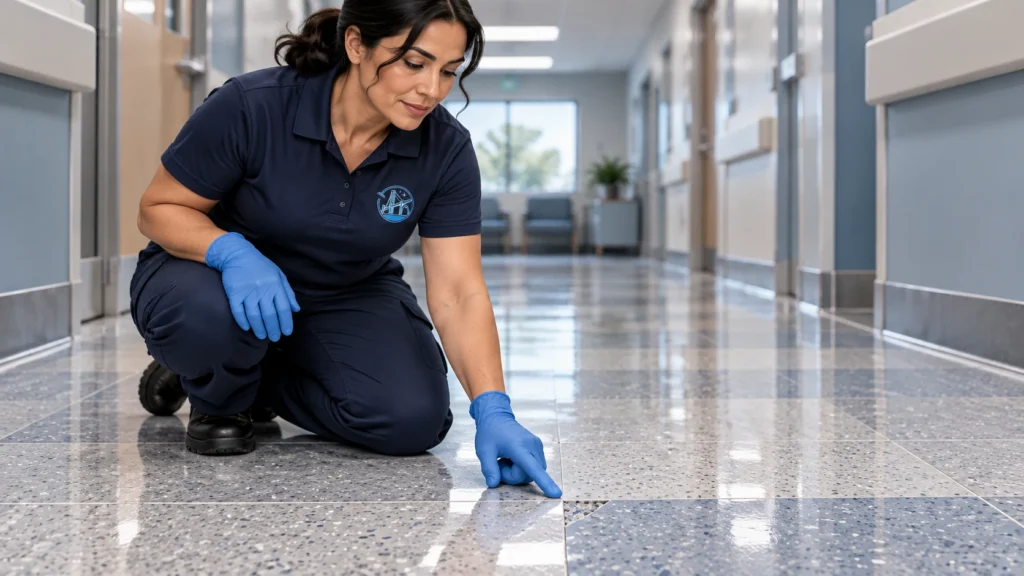
What is VCT floor tile? Armstrong Flooring, one of its makers, says the main ingredient in its vinyl composition tile is 85% limestone. A binder of vinyl resin and plasticizer holds that filler in a hard tile, which is where the “vinyl” in the name comes from. Armstrong sells it in 12-by-12-inch squares and in long strips, 1/8 inch thick.
Armstrong’s VCT is through-pattern, meaning the color and chips run through the full thickness of the tile. A worn tile still shows its pattern, and a chipped corner shows the same color underneath. That construction sets Armstrong’s VCT apart from floors with a printed design on top.
Not every VCT is built this way. ASTM F1066, the standard for vinyl composition tile, covers solid-color, through-pattern and surface-pattern tile. If your floor comes from another maker, its data sheet names the class you have.
The tile isn’t meant to stay bare. Armstrong’s care instructions call for coats of commercial floor polish on new tile, so VCT floor care is mostly care of that polish.
The Bay Area Cleaners lists VCT among the floors it handles, and its floor-care page says VCT needs periodic stripping, refinishing and regular burnishing to keep its shine. On tile laid through 1980, the asbestos rules put limits on each of those steps.
Takeaway: VCT is mostly limestone bound with vinyl, and Armstrong’s through-pattern tile carries its color all the way through. Armstrong calls for polish on new tile.
VCT Floor Care Next to Linoleum and Sheet Vinyl
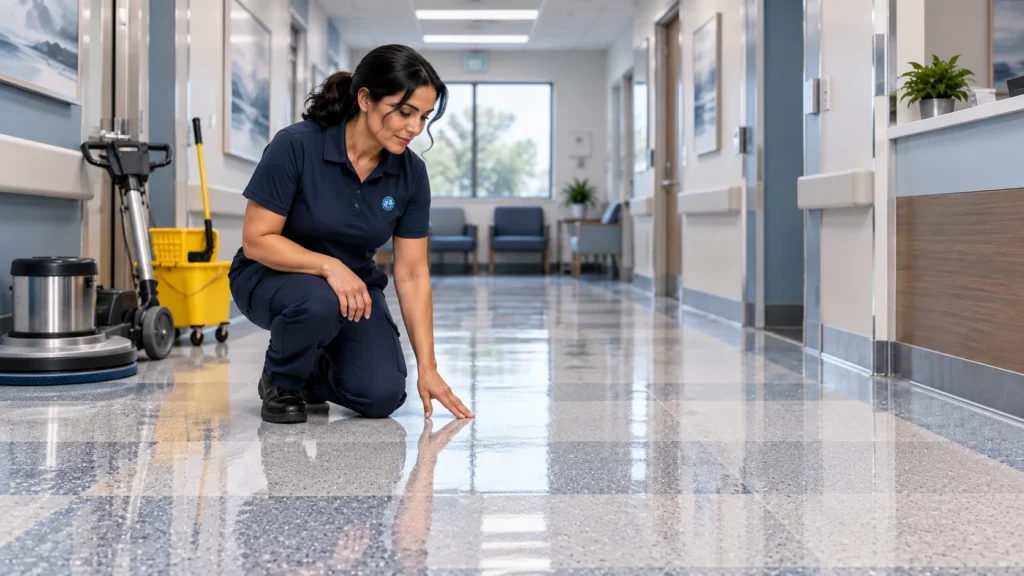
Several resilient floors can share one building, and each takes different chemistry. VCT floor care assumes a tile that can take a polish, a strip and fresh coats many times over. Linoleum and sheet vinyl don’t always fit that plan.
You may also like: How to Clean Laminate Floors Without Warping the Seams
VCT shows a seam at every tile edge, or long strips laid in a pattern. On through-pattern VCT, a chip at a corner or doorway shows the same color below the surface. Sheet vinyl comes off a roll, so its seams run long and far apart. Luxury vinyl tile and plank carry a printed design, so a chip there shows a different layer under the print.
Sheet vinyl doesn’t escape the 1980 cutoff. The cutoff covers vinyl flooring, not tile alone, so an old sheet floor in a break room counts the same as old VCT.
Linoleum is the one to watch. It’s made with linseed oil, and from across a room it can pass for VCT. Forbo’s care guide for Marmoleum with Topshield2 says the factory finish shouldn’t be removed, and it warns that traditional wet stripping can damage the floor.
So a VCT strip-and-recoat program run on Marmoleum with Topshield2 can damage the floor it was meant to protect. If your VCT meets linoleum at a doorway, the strip on the VCT side stops short of the linoleum edge.
Takeaway: Confirm a floor is VCT before any strip goes on it. Forbo warns that traditional wet stripping can damage Marmoleum with Topshield2.
Vinyl Flooring Laid Through 1980 Is Treated as Asbestos-Containing

Paragraph (j)(2) of Title 8 §5208 says asphalt and vinyl flooring material installed no later than 1980 must be treated as asbestos-containing, and 29 CFR 1910.1001 uses the same wording under the same number. The date that counts is the flooring’s install date, which can differ from the building’s.
You may also like: High Dusting: Why Your Clean Floors Do Not Stay Clean
Take a clinic that put new VCT in its lobby in 2012 and kept its original 1976 tile in the back hall. The lobby tile falls outside the 1980 cutoff and follows its maker’s guide. The back hall tile is treated as asbestos-containing. One night of VCT floor care in that building can cross both kinds of floor.
That treatment can be lifted. Paragraph (j)(8) lets an owner or employer show that flooring, with its mastic and backing, isn’t asbestos-containing. The proof is an industrial hygienist’s determination based on accepted analytical techniques. Until that determination exists, VCT floor care on that tile runs under the asbestos limits.
Owners carry duties under paragraph (j)(3) as well. They have to determine where asbestos-containing material sits in the building and keep records of it, and those records pass to the next owner if the property sells. The third duty is to tell employers whose employees do housekeeping where that material is, if the crew may contact it. Floor care falls under the standard’s housekeeping paragraph, so the company that mops and scrubs your VCT is one of those employers.
If you manage an older property, your asbestos survey may already show which floors contain asbestos and which were cleared. Your notice to the cleaning company can cover three things:
- The install year of each vinyl or asphalt floor, or the remodel that put it in
- Any industrial hygienist’s determination that cleared an area
- The survey pages that show where asbestos-containing floors sit
With those three items in hand, VCT floor care in each room starts from the right limits.
Public and nonprofit K-12 schools keep this information in a set place. Under 40 CFR 763.93, each local education agency keeps an asbestos management plan for each school. The plan has to be available to workers, without cost or restriction, before work begins in any area of a school building.
Takeaway: Vinyl flooring installed in 1980 or earlier counts as asbestos-containing until an industrial hygienist’s determination clears it, and the owner has to tell the cleaning employer where it is.
VCT Floor Stripping Limits on Tile Laid Through 1980
Paragraph (k)(7) covers the care of asbestos-containing flooring. In the federal standard, its three parts are (k)(7)(i) through (iii), and §5208 lists the same three as (k)(7)(A) through (C). There’s one each for sanding, stripping and burnishing.
| Task | What paragraph (k)(7) says | What it rules out |
| Sanding | Sanding of asbestos-containing floor material is prohibited | Any sanding of the tile, for any reason |
| Stripping finish | Low-abrasion pads, speeds lower than 300 rpm and wet methods | Aggressive pads, fast machines and dry stripping |
| Burnishing or dry buffing | Allowed only where the finish is thick enough that the pad can’t contact the flooring | Burnishing spots worn down to the tile |
VCT floor stripping on older tile has one goal: take the finish off and leave the tile’s surface alone. Low-abrasion pads, slow machines and a wet floor all serve that goal. The rule doesn’t replace the usual stripping steps. It sets the pads, speed and water those steps run with.
Wet methods keep the pad working on a wet floor, never a dry one, so loosened finish stays wet instead of turning to dust. A dry strip on your older tile skips that protection, which is why (k)(7) leaves no room for it.
Armstrong’s instructions for its own VCT use the same number. They call for machine scrubbing and stripping at 300 rpm or less, and they warn against the most abrasive pads and stiff brushes. On tile treated as asbestos, the rule’s wording is the one to follow: lower than 300 rpm, not equal to it.
A plan for VCT floor stripping on tile laid in 1980 or earlier fits (k)(7) only if it leaves out sanding, dry stripping and aggressive pads, and keeps the machine under 300 rpm.
Takeaway: On tile treated as asbestos, sanding is out, and stripping runs with low-abrasion pads under 300 rpm on a wet floor.
Floor Burnishing on Older Tile Stops Where the Finish Stops
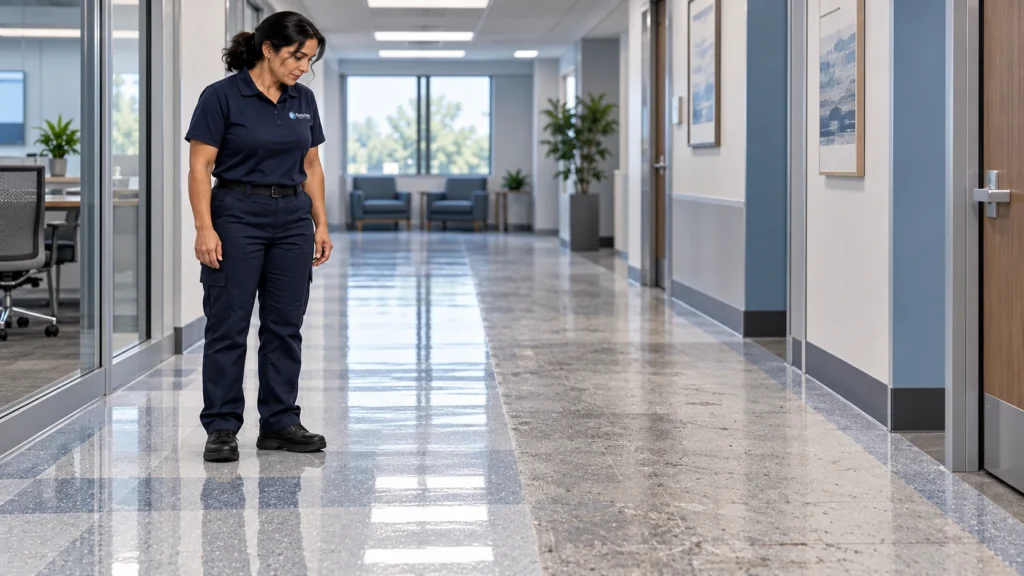
The third limit in (k)(7) covers floor burnishing and dry buffing. The rule allows both on asbestos-containing flooring only when there’s enough finish that the pad can’t contact the tile. It sets no speed for burnishing. The limit is the layer of finish between the pad and your floor.
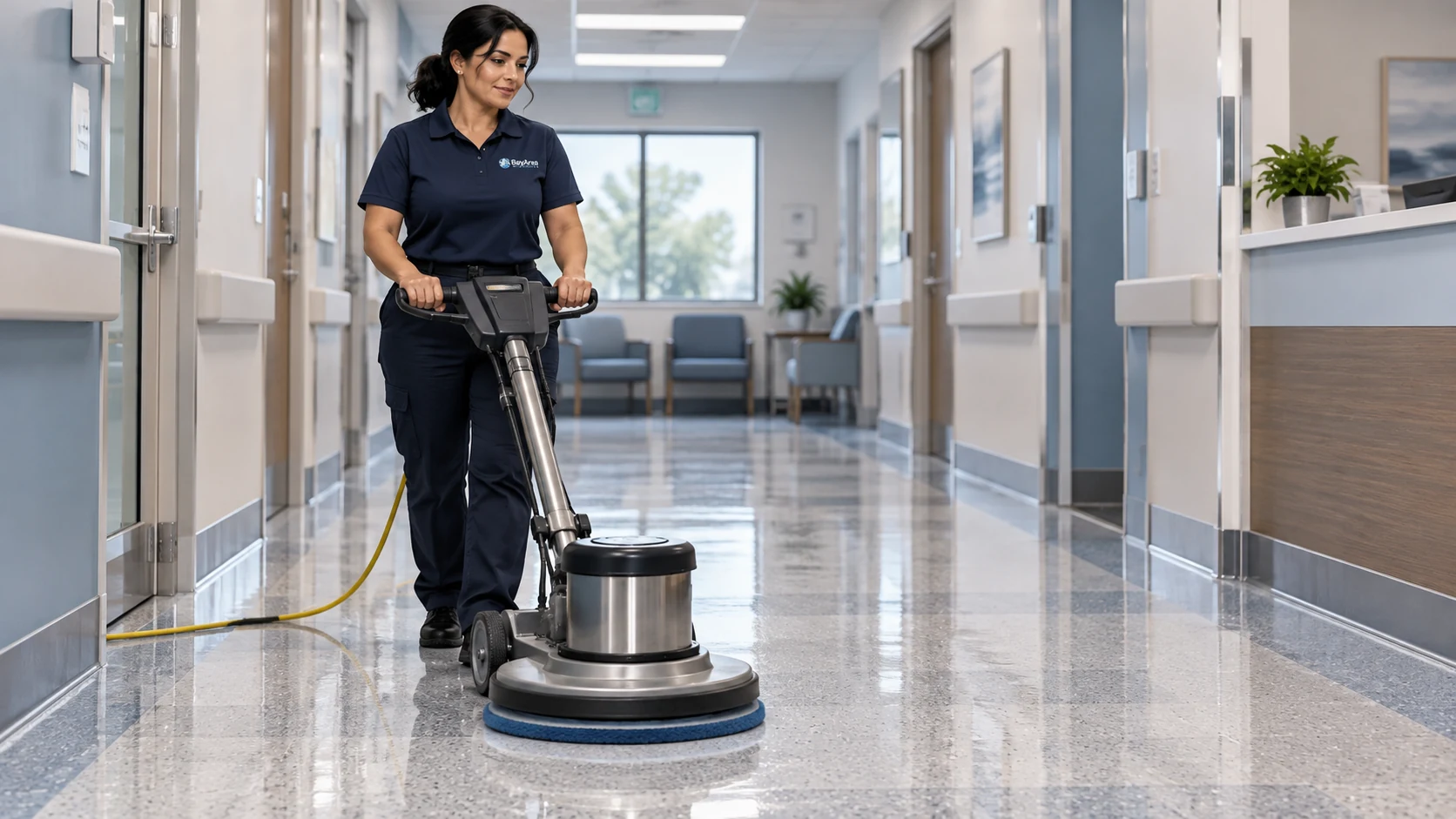
This is the limit your crew meets most often in VCT floor care on older tile, since burnishing is the regular visit and stripping the periodic one.
EPA’s asbestos FAQ makes a related point for schools. It says machine-cleaning can be part of a good maintenance program for asbestos-containing floor tile, as long as the machine is run properly and the tiles aren’t in poor condition. It adds that undamaged, well-maintained floor tiles present little risk to students, teachers and school staff.
On older VCT, the risk sits in the bare spots. Where traffic has worn the finish down to the tile, the burnisher has no layer to ride on, and the rule keeps it off that spot until fresh coats go down. VCT floor care that keeps the finish whole leaves every square open to the burnisher.
Takeaway: Floor burnishing on older VCT needs finish between the pad and the tile. Where the finish is gone, the burnisher stays off until the floor is recoated.
A Crack in Older Tile Leaves an Edge Without Finish
Damaged VCT is easy to spot. A crack runs across a tile or along its edge. A curled tile lifts at a corner, and a loose one rocks underfoot. A gap shows the adhesive or subfloor where a piece broke away.
You may also like: Mold Remediation: What the EPA Thresholds Actually Mean for Your Building
On tile treated as asbestos, those spots carry more weight. At a break, a burnishing pad reaches tile with no finish over it, which (k)(7) rules out, and a pad or brush that catches a broken edge can snap off more of it. Loose pieces fall under the standard’s housekeeping paragraph: HEPA-filtered vacuums, no compressed air, no dry sweeping where vacuuming or wet cleaning is feasible, and sealed, impermeable bags or other closed, impermeable containers. Who collects those pieces is the owner’s call.
The notice in (j)(3) covers where the flooring sits, not its condition. Naming known cracked or loose tile in the same notice lets the crew keep the burnisher clear of it.
Taking up the old tile falls under a different standard. The federal construction rule, 29 CFR 1926.1101, lists the removal of asbestos-containing floor tile as Class II asbestos work, and California’s construction rule, Title 8 §1529, defines Class II the same way, floor tile included. That’s flooring work for you to arrange as the owner or manager, apart from nightly VCT floor care.
Takeaway: On tile treated as asbestos, a crack or gap is bare tile the burnisher stays off, loose pieces follow the standard’s housekeeping rules, and removal is Class II work the owner arranges.
The First Five Days on a New VCT Floor
New VCT laid today falls outside the 1980 cutoff, so its VCT floor care runs on the maker’s instructions from the start. Armstrong’s VCT maintenance instructions, updated in August 2025, set limits for a new floor. They say to keep rolling loads off it for at least 72 hours, and not to wet wash, machine scrub or strip it for at least five days after installation.
Their list for a newly installed floor is short. Remove any adhesive residue with a clean cloth dampened with denatured alcohol, then sweep, dust mop or vacuum. Damp mop with a properly diluted cleaner, and apply at least two coats of commercial floor polish to protect the tile until regular maintenance begins.
After the five days, Armstrong’s next step readies the floor for commercial traffic: a machine scrub at 300 rpm or less, a clean-water rinse and more coats of polish.
The five-day wait matters most at the end of a build-out. The Bay Area Cleaners’ post-construction service includes floor finishing prep, where floors are scrubbed, polished or extracted so new flooring presents the way it was specified. If your VCT went in three days before that visit, the machine scrub waits, and the adhesive and dust removal come first.
One more line in the same instructions shapes the next two years of VCT floor care. Armstrong doesn’t recommend aggressive strippers, such as mop-on/mop-off, no-scrub and no-rinse types, on tile floors less than two years old. Give your contractor the install date, and the stripper choice can follow it.
Takeaway: New VCT gets no wet wash, machine scrub or strip for five days, starts with at least two coats of polish, and skips aggressive strippers for its first two years.
Frequently Asked Questions
What lifts the asbestos limits on VCT floor care for older tile?
An industrial hygienist’s determination. Vinyl flooring installed in 1980 or earlier stays under the limits until one shows that the flooring, mastic and backing aren’t asbestos-containing. The building owner holds that record and the install dates. If neither turns up, plan VCT floor care as if the limits apply.
What is VCT floor tile made of?
Mostly limestone. Armstrong puts limestone at 85% of its VCT, bound with vinyl resin and colored through the full thickness. That’s why a worn or chipped Armstrong tile keeps its pattern. Surface-pattern VCT, another class in ASTM F1066, carries its design in the top layer instead.
What does the asbestos standard say about VCT floor stripping?
On asbestos-containing flooring, stripping of finishes has to use low-abrasion pads at speeds lower than 300 rpm, with wet methods. Sanding the floor is prohibited. California’s Title 8 §5208 uses the same limits, so VCT floor care on your tile from 1980 or earlier follows them until an industrial hygienist’s determination clears the floor.
Does floor burnishing have a speed limit on older VCT?
No. Title 8 §5208 and the federal standard set no speed for floor burnishing on asbestos-containing flooring. They allow it only when the finish is thick enough that the pad can’t contact the tile. Keeping the finish intact is the part of VCT floor care that keeps burnishing allowed on your older tile.
Conclusion
So what is VCT floor tile? Limestone and vinyl sold to wear a coat of polish, with VCT floor care set by its maker and, on floors laid through 1980, by the asbestos limits.
On vinyl flooring installed in 1980 or earlier, the asbestos limits apply until an industrial hygienist’s determination clears the floor. That means no sanding, slow and wet stripping with low-abrasion pads, and burnishing only over intact finish. Newer tile follows its maker, starting with five days before the first wet wash or machine scrub.
The Bay Area Cleaners handles VCT, LVT, tile, sealed concrete, hardwood and commercial carpet, with strip-and-wax work scheduled over nights or weekends. Call 707-656-9339 for a floor assessment and a maintenance calendar built around your traffic and flooring types, and have your floor install dates on hand for the call.