Look into the mop bucket at the end of a night shift on a vinyl plank floor. The water that started out clear has turned gray, and the last rooms on the route got mopped with it. That gray water dries on the planks as a thin, even film, so your floor looks dull the next morning. Knowing how to clean vinyl plank floors starts with keeping that water out of the last rooms.
This guide is for facility and property managers with luxury vinyl plank in offices, lobbies, stores, schools and apartment common areas. It shows you where the film comes from and how to clean vinyl plank floors with a fresh pad in every room. It then covers what commercial makers’ care guides say and the damage no cleaning can undo: heat, rubber mat backings, furniture and sun.
The quick version: Most of the film on a freshly mopped vinyl plank floor is soil the mop laid back down. Keep the cleaning solution and the rinse water in separate buckets or a dual-chamber bucket, change both at set points on the route, and give each room its own mop pad. On large floors, a scrubber that lays down fresh solution and vacuums it back up does the same job faster. Can you steam clean vinyl plank floors? No. J+J Flooring rules out steam mops on its commercial vinyl, and three makers warn against rubber-backed mats. For most crews, the answer to how to clean vinyl plank floors without a film is clean solution on every pass.
The Film Is Soil the Mop Put Back
Mop water can’t soak into the coated surface of a vinyl plank, so whatever the water carries dries on top. Many commercial planks are embossed with a wood grain as well. Soil settles into those shallow grooves, and a mop head slides over them.
You may also like: How to Clean Laminate Floors Without Warping the Seams
As a shift goes on, the solution in a single bucket picks up soil from every room it touches. By the last rooms, the mop is spreading thinned-out dirt, and it dries as an even gray layer that reads as film. String mops make it worse, since a heavy cotton head holds a lot of water and a lot of what it picked up.
A school cleaning guide from the California Department of Public Health (CDPH) reports that custodians at UC Davis Medical Center used 95 percent less water and chemicals with microfiber mops than with cotton string mops. Less water on the floor means less dirty water left behind to dry. If you’re working out how to clean vinyl plank floors on a nightly route, retire the string mops first.
You can check whether the bucket is your problem. Walk the route in the morning in the order the crew mopped it. If the film gets heavier from the first rooms to the last ones, the mop water is carrying it. If it’s even from first room to last, look for another cause.
Takeaway: The dull film on a freshly mopped vinyl plank floor is usually soil carried in the mop water from earlier rooms on the same route.
How to Clean Vinyl Plank Floors With a Fresh Pad in Every Room?
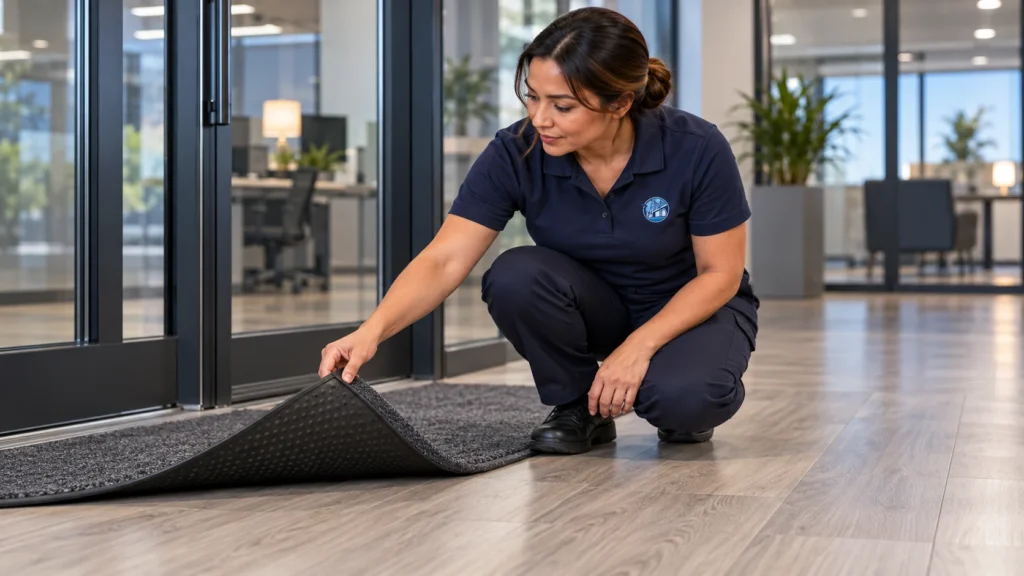
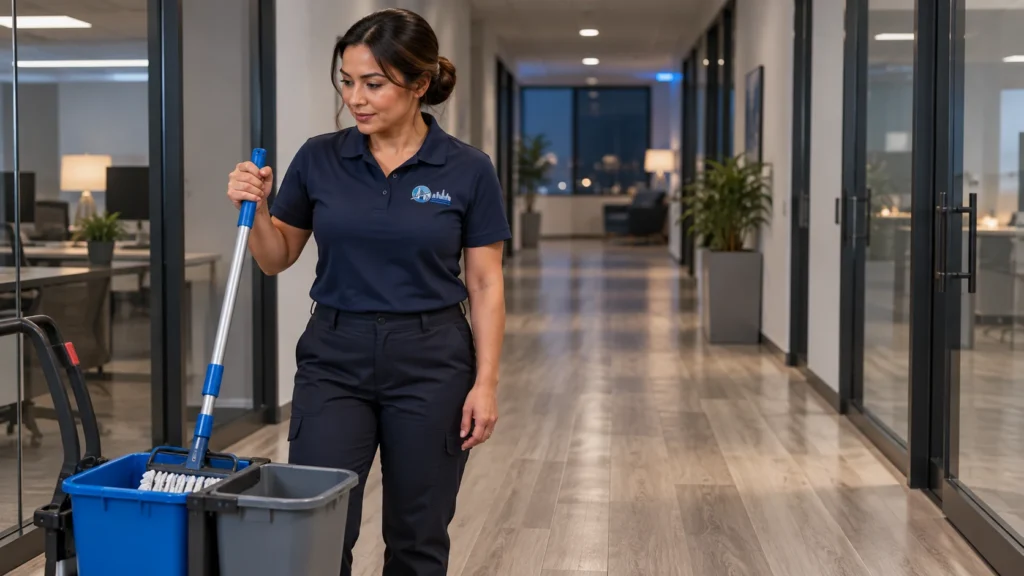
The fix is to keep the cleaning solution and the rinse water apart for the whole route. Interface, a commercial flooring maker, tells crews in its LVT maintenance guidelines to rinse the mop often with clean water during mopping. Here’s how to clean vinyl plank floors so your last room gets solution as clean as the first:
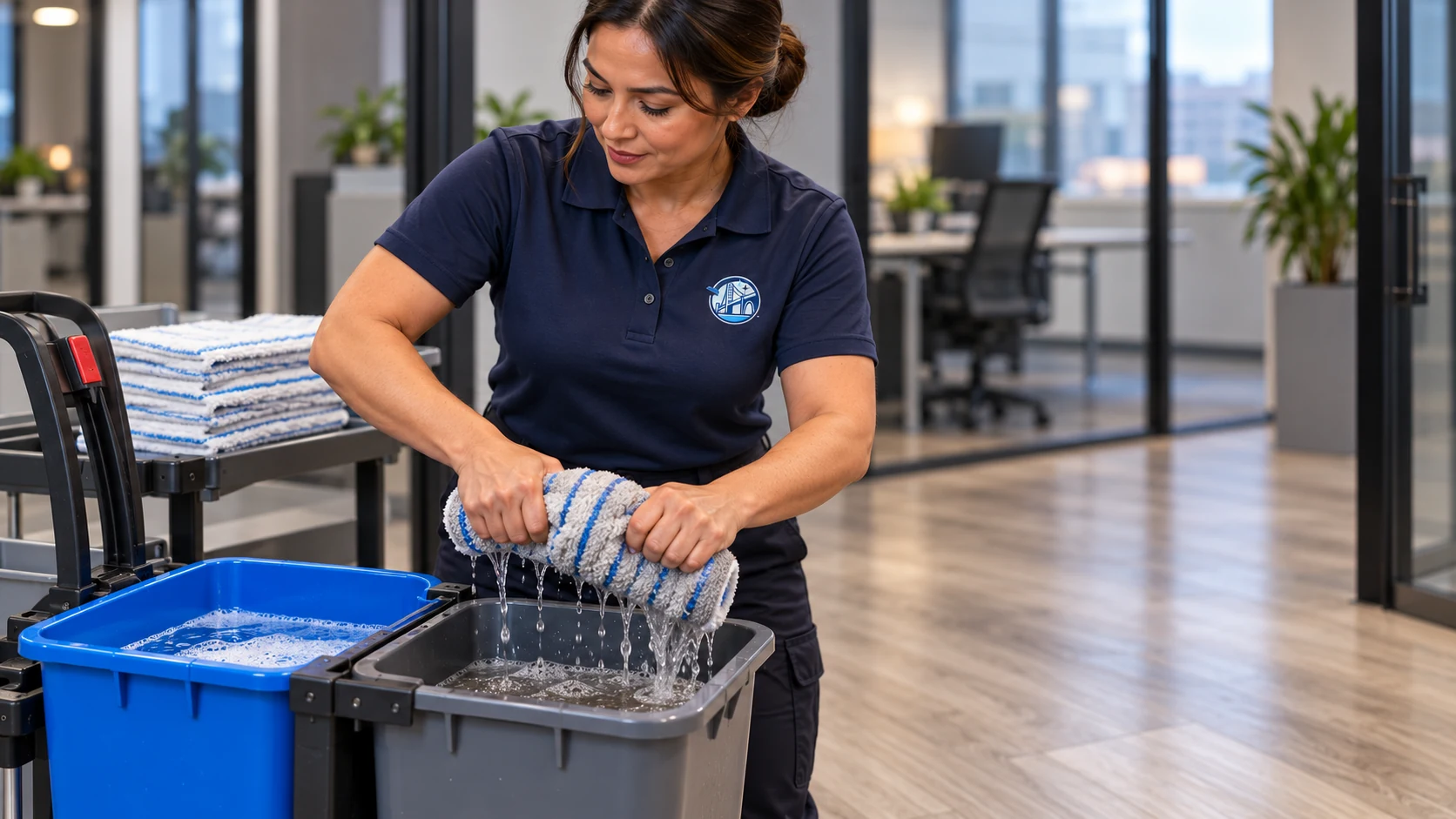
- Use two buckets, or one bucket with two chambers: cleaning solution on one side, rinse water on the other. Wring the mop into the rinse side before it goes back into the solution.
- Change both at set points, such as after each breakroom or entry, and any time the rinse water turns gray.
- With flat mops, give each room its own pad. A used pad goes into a laundry bag, never back into the solution.
- Mop the dirtiest areas last, so soil from an entry or a breakroom doesn’t ride the mop into clean offices.
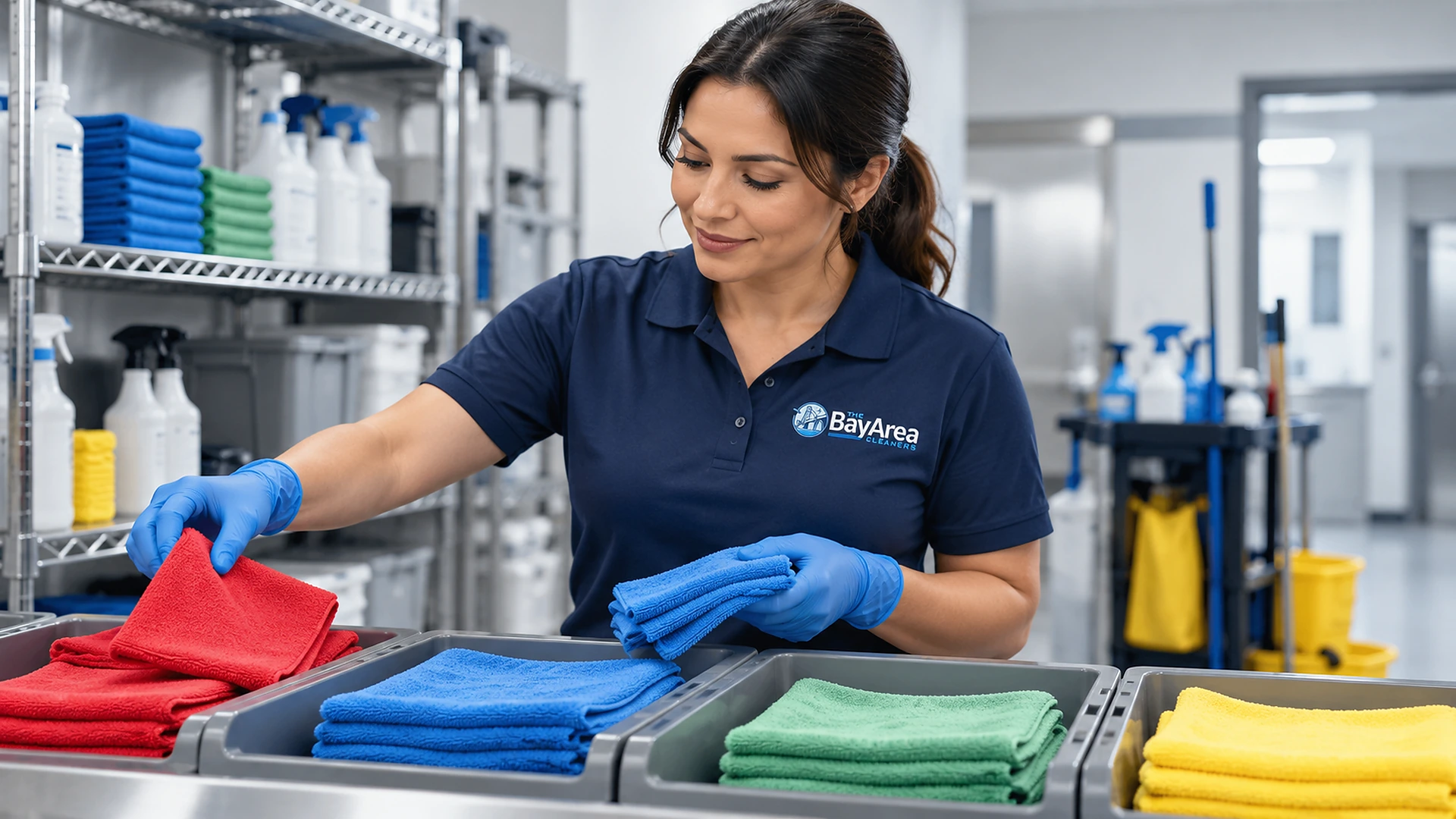
Pads are the part people run short on. A route with 20 rooms uses 20 pads a night, so stock about twice that many. One set rides on the cart, and the other goes through the wash.
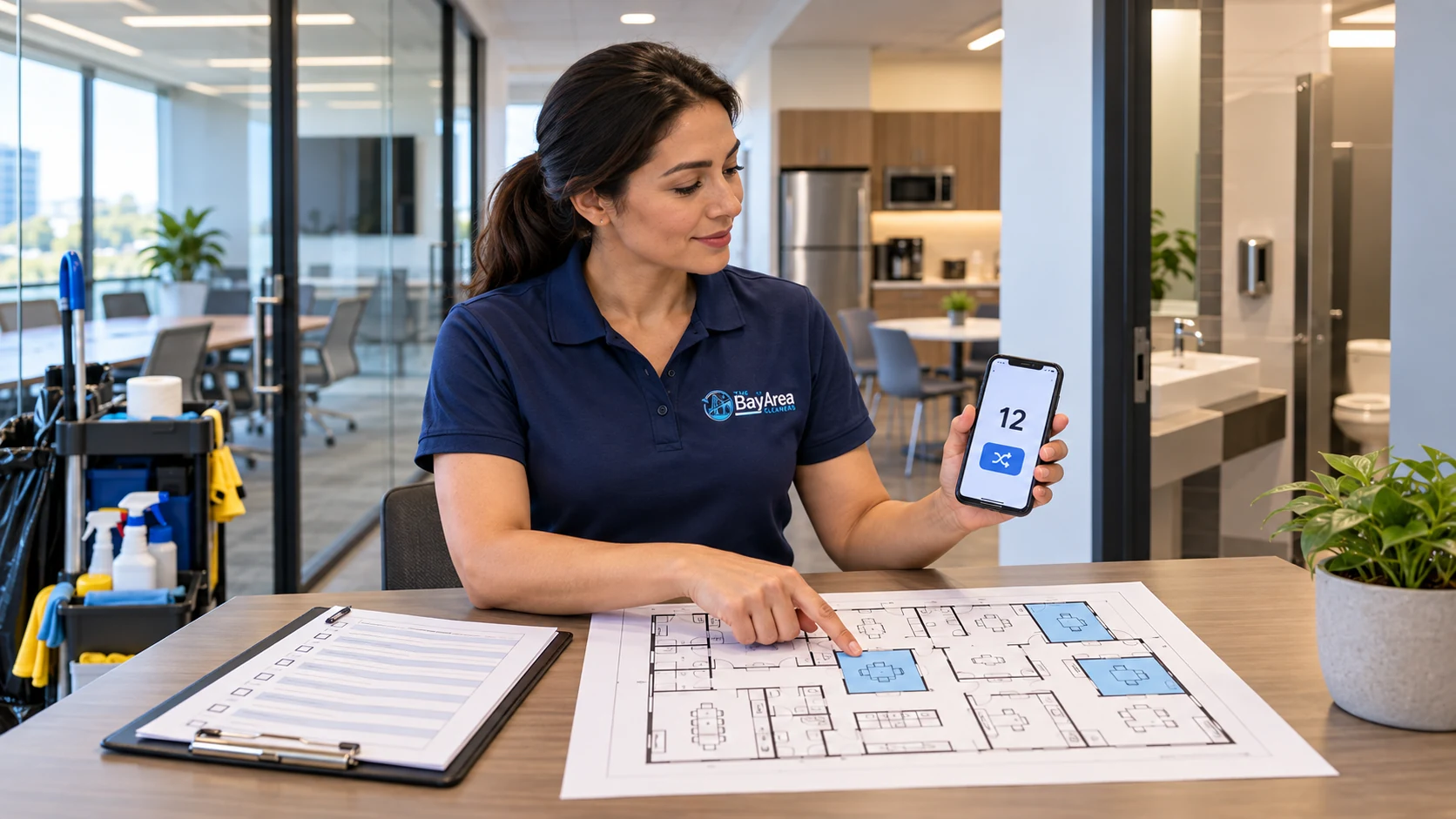
On a nightly route through offices with vinyl plank floors, write the change points on the route sheet. Then every crew member changes the water in the same places, and your last office gets the same result as the first.
Takeaway: Keep the cleaning solution and the rinse water apart, change both at set points on the route, and never put a used pad back in the solution.
The Best Way to Clean Vinyl Plank Floors Across a Large Lobby
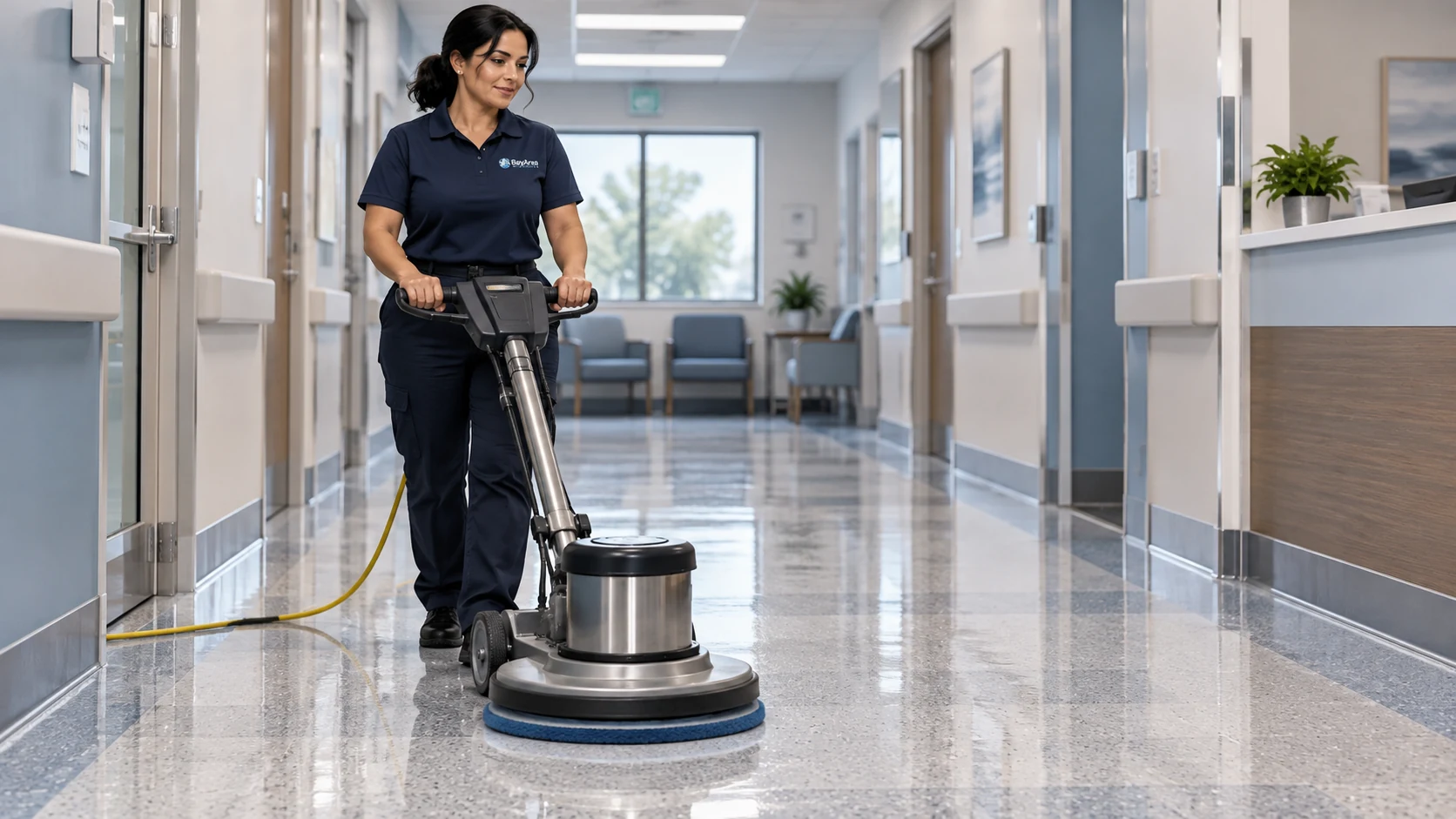
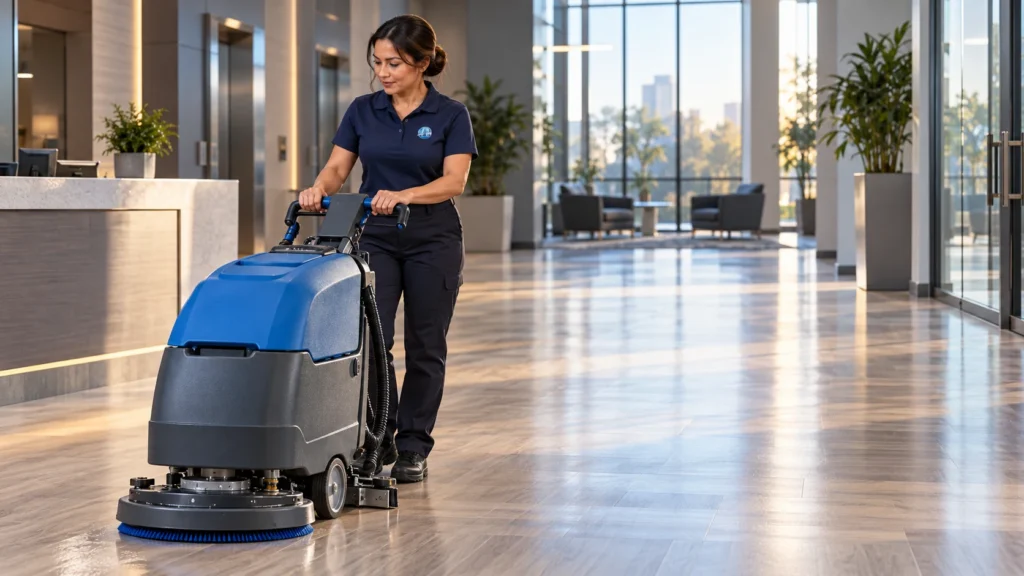
Past a few thousand square feet, a machine does what two buckets do, only faster. An automatic scrubber lays down fresh solution from one tank, scrubs, and vacuums the dirty water into a separate recovery tank. Nothing it picks up goes back on the floor, which makes it the best way to clean vinyl plank floors across a large lobby or an open office.
For restorative cleaning, Interface’s guide calls for a counter-rotating dual cylindrical brush machine with a white or soft brush, or an auto-scrubber with a non-abrasive pad, each with a neutral solution. The floor then gets a rinse with clean, hot water. J+J Flooring’s maintenance guide for its commercial vinyl tells crews never to use an orbital buffing machine.
The same restorative scrub and rinse clears film that has already built up, and Interface calls for it at least once every three months. You can book it through LVT and vinyl plank care. The nightly routine, two buckets or a scrubber, covers how to clean vinyl plank floors between machine visits.
Empty and rinse the recovery tank after every shift. Otherwise the next job starts with yesterday’s dirty water in the machine.
Takeaway: On large floors, use a scrubber that recovers its own water, and schedule a restorative scrub and rinse to clear film that has built up.
Where Leftover Mop Water Goes on Each Installation Type?
Vinyl plank goes down three ways, and each one reacts to leftover mop water in its own way. Your building’s closeout documents from the flooring job name the product and how it was installed.
| Installation | How the planks are held | Where extra water goes |
| Click-lock | Planks lock edge to edge and float over an underlayment, with no glue | Through the joints to the underlayment and subfloor, where it dries slowly |
| Glue-down | Each plank is bonded to the subfloor with adhesive | Into edges and seams at doorways and wet areas, where it can work at the adhesive |
| Loose-lay | Heavy planks held mostly by weight and friction, sometimes with a grip adhesive at the edges | Under the planks, where it spreads before anyone sees it |
The rule for all three is the one the makers print. J+J’s guide says not to soak or saturate the floor, and Interface’s says not to let puddles stay on it. That rule shapes how to clean vinyl plank floors near sinks, drinking fountains and doorways, where water tends to land near edges and joints.
On a glue-down floor, planks that start to lift at a doorway are an early sign that water has reached the adhesive. Report them before the next mopping, so the flooring contractor can reset them.
Takeaway: Keep water off the edges and joints on every installation type, and treat lifting planks at a doorway as a likely water problem.
What Steam Does to a Vinyl Plank?
Steam mops are sold for sealed hard floors, so facility teams still ask: can you steam clean vinyl plank floors? J+J Flooring says no. Its guide lists steam mops among the products not to use on its commercial vinyl.
The problem is heat as much as water. Vinyl is a plastic that softens as it warms, and a steam head puts heat right at the surface of the plank. On a glue-down floor, heat can loosen the adhesive under the edges. On a click-lock floor, it can distort the joints or curl the ends of the planks.
Hot tap water is part of how to clean vinyl plank floors, and steam isn’t.
Takeaway: Can you steam clean vinyl plank floors? No. J+J lists steam mops as a do-not-use item, and heat softens the plank and, on glue-down floors, the adhesive under it.
Rubber Mat Backings Stain Vinyl for Good
Entrance mats protect a floor, but the wrong backing damages vinyl. J+J’s guide says latex or rubber-backed mats can permanently stain or damage vinyl, and Interface warns that long-term contact with rubber can damage its LVT. The stain shows up as a yellow or brown shadow in the shape of the mat, and no cleaner lifts it.
Check the backing on every mat that sits on your vinyl plank, including the small ones at sinks, printers and coffee stations. Mohawk’s care guide asks for mats with a nonrubberized backing marked non-staining. Rubber feet on furniture and equipment carry the same risk, and Interface’s guide advises against them.
No change in how to clean vinyl plank floors removes a mat shadow. The only fix is replacing the stained planks, so check the backing before the first mat goes down. Planks from a later production run may not match, so keep a few boxes of spares from the original installation.
Takeaway: Use mats with a nonrubberized, non-staining backing on vinyl plank, and swap out rubber feet on furniture.
Damage That Happens Between Cleanings
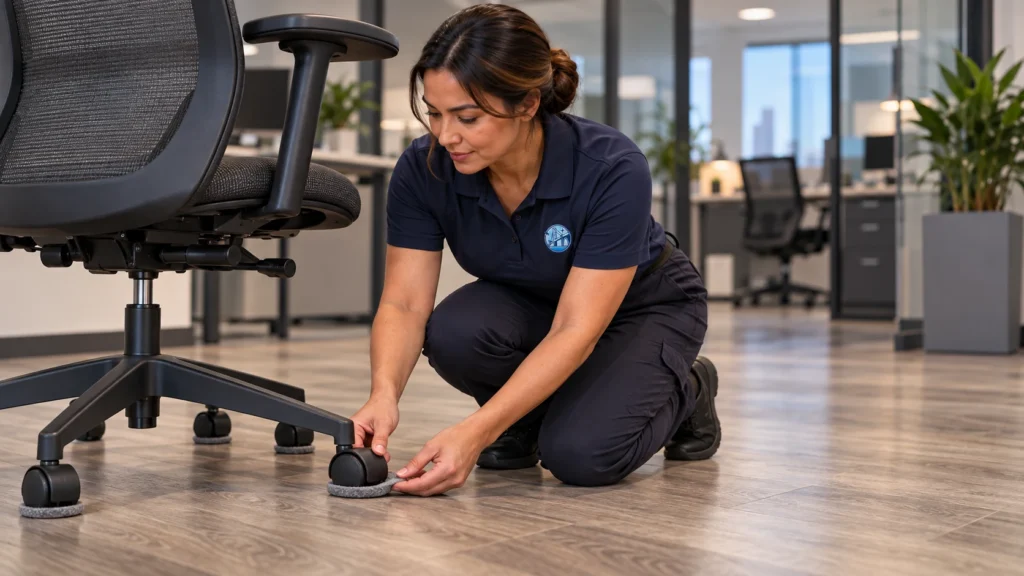
Heavy furniture dents vinyl plank, and dragged furniture scratches the wear layer. Put felt or other soft protectors under the legs, as Interface’s guide advises, and lift furniture instead of dragging it, as Mohawk’s guide says.
Rolling loads are harder on the floor. Pallet jacks, loaded carts and moving dollies put a lot of weight on small wheels. During a move-in or a large delivery, lay hardboard or plywood runners over the planks and roll on those. Apartment buildings see this on every move-in day, so runners belong in the move-in plan as much as corridor mopping in apartment buildings does.
Sun fades vinyl. J+J requires UV protective film, blinds, curtains or shades to protect its vinyl from the sun, and Mohawk warns that long exposure to direct sun can discolor the floor. Storefronts and west-facing glass get the most sun, so close the blinds against afternoon sun and put UV film on your worst windows.
None of this is about how to clean vinyl plank floors, and all of it shows up as floor complaints.
Takeaway: Protect vinyl plank from dents, dragging, rolling loads and direct sun, since cleaning can’t reverse any of them.
What to Use to Clean Vinyl Plank Floors in California?
The answer to what to use to clean vinyl plank floors is shorter than most supply closets suggest. Start with a neutral cleaner in your maker’s printed pH range, which is 6.0 to 9.0 in Interface’s guide. The rest of the list is two buckets or a scrubber, soft pads or brushes, and no steam.
The CDPH school guide says routine disinfecting of school floors usually isn’t necessary unless there’s blood, body fluids, vomit or feces, or a law requires it. Most offices can follow the same rule and save disinfectant for those spills. Medical spaces should follow their own infection-control requirements.
Fewer products make it easier to train a crew on how to clean vinyl plank floors. One labeled bottle of the cleaner in your maker’s pH range per cart is enough for the vinyl plank rooms on a route.
You may also like: How to Strip and Wax Floors: Process, Cost and When to Skip It
Polish is a separate question. California’s Air Resources Board caps floor polish for resilient flooring at 1 percent VOC by weight, but some vinyl makers don’t want polish on their planks at all. Interface doesn’t recommend waxes or polishes on its LVT, and J+J lists floor wax and one-step cleaner-polishes as do-not-use items, so check your maker’s position before any polish goes down.
Takeaway: Use a cleaner in your maker’s printed pH range, skip routine floor disinfecting outside medical spaces, and check the maker’s position before any polish goes down.
What a Vinyl Plank Care Guide Tells Your Crew?
Each maker publishes its own care guide, and the rules differ from one product to the next. Here’s how the two commercial guides cited in this article compare on water, machines, steam, mats, sun, new floors, room temperature and polish.
| Topic | Interface LVT guide | J+J Flooring DLVT guide |
| Water | Don’t let puddles stay on the floor | Don’t soak or saturate the floor |
| Machines | Cylindrical brush machine or auto-scrubber with a non-abrasive pad | Never use an orbital buffing machine |
| Steam | Not addressed | Steam mops on the do-not-use list |
| Mats | Avoid rubber-lined mats and rubber furniture legs | Latex or rubber-backed mats can permanently stain |
| Sun | Not addressed | UV film, blinds, curtains or shades required |
| New floors | Wait 48 hours after installation before cleaning | Not addressed |
| Room temperature | Not addressed | Keep between 65 and 85°F |
| Polish | Waxes and polishes not recommended | Floor wax and one-step cleaner-polishes on the do-not-use list |
With the guide in hand, how to clean vinyl plank floors is a written rule, not a guess. If your building has more than one vinyl product, keep a guide for each one. Two planks that look alike can come from makers with different rules, so how to clean vinyl plank floors can change from one wing of a building to the next.
Takeaway: Keep the care guide for each vinyl product in the building, and check its rules on water, machines, steam, mats, sun and polish.
Frequently Asked Questions
Does the installation method change how to clean vinyl plank floors?
The daily method stays the same: separate buckets for solution and rinse water, a fresh pad for each room, and no standing water. What changes is where a mistake shows up. On click-lock floors, extra water finds the joints, and on glue-down floors it works at the adhesive along edges and doorways.
Is two-bucket mopping the best way to clean vinyl plank floors in a small office?
For a few thousand square feet or less, it usually is. Two buckets and a fresh pad for each room keep dirty water off the floor at little cost. Past that size, a scrubber that recovers its own water covers the floor faster and leaves less behind. Either way, how to clean vinyl plank floors comes down to keeping dirty water off them.
Is hot tap water safe on vinyl plank floors?
Yes. Interface’s guide calls for a rinse with clean, hot tap water at 120 to 130°F after routine mopping and after treating greasy spills, and a rinse with clean, hot water after its restorative scrub. Water boils at 212°F at sea level, and J+J lists steam mops among the products not to use.
Is there a quick rule for what to use to clean vinyl plank floors?
Use a cleaner within your plank maker’s printed pH range, and no heat or polish the maker doesn’t allow. For routine floor cleaning outside medical spaces, skip disinfectants unless there’s a body-fluid spill or a rule requires one. That short list covers how to clean vinyl plank floors in most commercial buildings.
Conclusion
A dull film on a freshly mopped vinyl plank floor is usually soil from earlier rooms on the same route. Keep the solution and the rinse water apart, change both at set points, give each room its own pad, and use a scrubber that recovers its own water on large floors. When film has already built up, a restorative scrub and a rinse with clean, hot water clear it. Clean solution on every pass is how to clean vinyl plank floors so they look the same the next morning.
The Bay Area Cleaners maintains LVT and vinyl plank floors in offices and commercial buildings from Vallejo to San Mateo. Call 707-656-9339 to set up nightly care and periodic machine scrubbing for your floors.