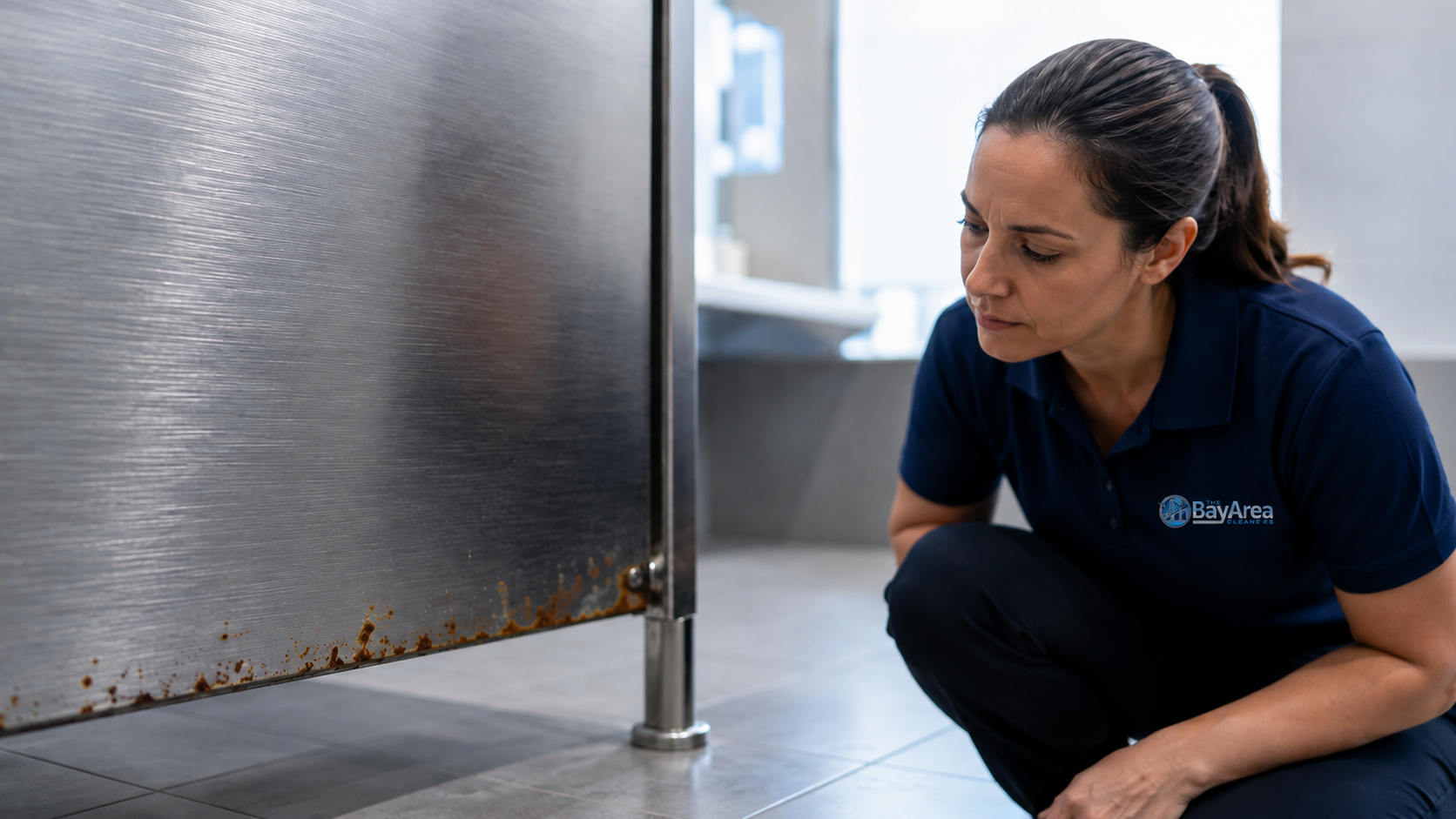
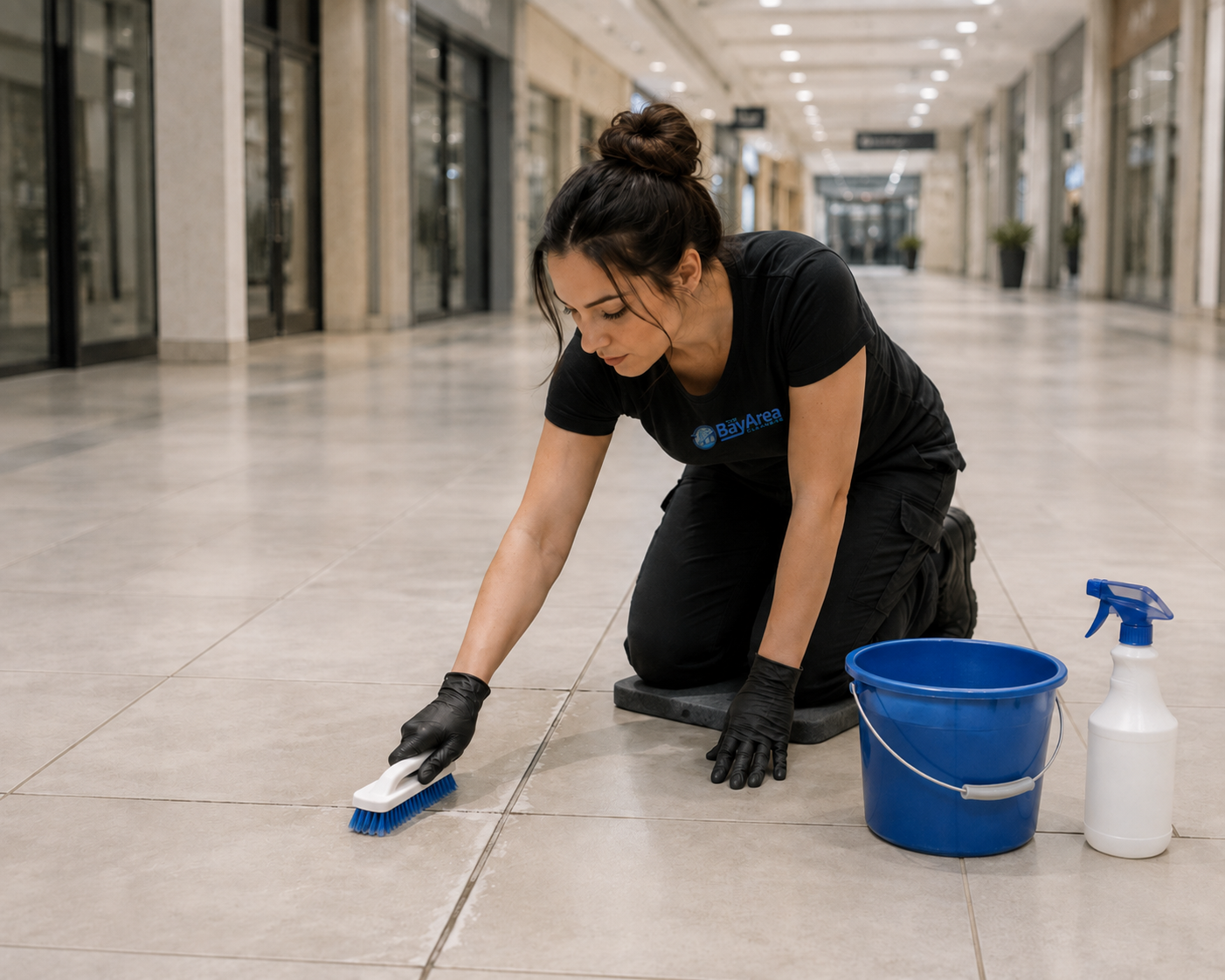
The tile in your lobby restroom looks fine. The lines between it do not. Every joint has gone from light gray to brown, so gradually that nobody logged a complaint.
Then a tenant mentions it. Suddenly the whole floor reads as neglected, even though it gets mopped six nights a week.
The quick version of how to clean grout on a commercial floor: dust-mop daily so grit never reaches the joints. Damp-mop with a pH-neutral cleaner. Scrub the joints with a mildly alkaline grout cleaner and a stiff brush every month or quarter. Reseal every one to two years. If the joints stay dark after a proper scrub and rinse, the grout is unsealed, and more scrubbing will not fix that.
Here is what most facility teams miss. Grout is not a stain problem. It is a porosity problem. This guide covers how to clean grout at commercial scale, why the joints darken before the tile does, and the point where cleaning harder stops helping.
Why Grout Gets Dark Before the Tile Does
Tile is fired and glazed. Nothing soaks in. Cement grout is unglazed, full of microscopic pores, and it sits slightly below the tile surface.
That makes every joint a channel that collects what the rest of the floor sheds.
Three things fill it. Grit tracked in from outside settles into the low line and stays. Mop water pushes dissolved soil off the tile and into the joint, where it dries and darkens. Cleaner residue leaves a tacky film that grabs the next round of soil faster than bare grout would.
Other hard surfaces in the building work the same way on a different clock, since a wood floor carries its protection as a finish on top rather than sealed into the material.
You may also like: How to Clean Hardwood Floors Without Ruining the Finish
This explains a pattern facility managers see constantly. A floor gets mopped nightly and the joints still darken every month. The mop is not failing. It is moving soil off the glazed surface into the only porous part of the floor, and nobody goes back for it.
Deciding how to clean grout starts with accepting that the joints need a schedule of their own, separate from the tile.
Takeaway: the tile stays clean because it is sealed by manufacture. The grout darkens because it is not. Two surfaces, one floor, two schedules.
What Is Wrong With Your Grout, and What It Costs to Fix
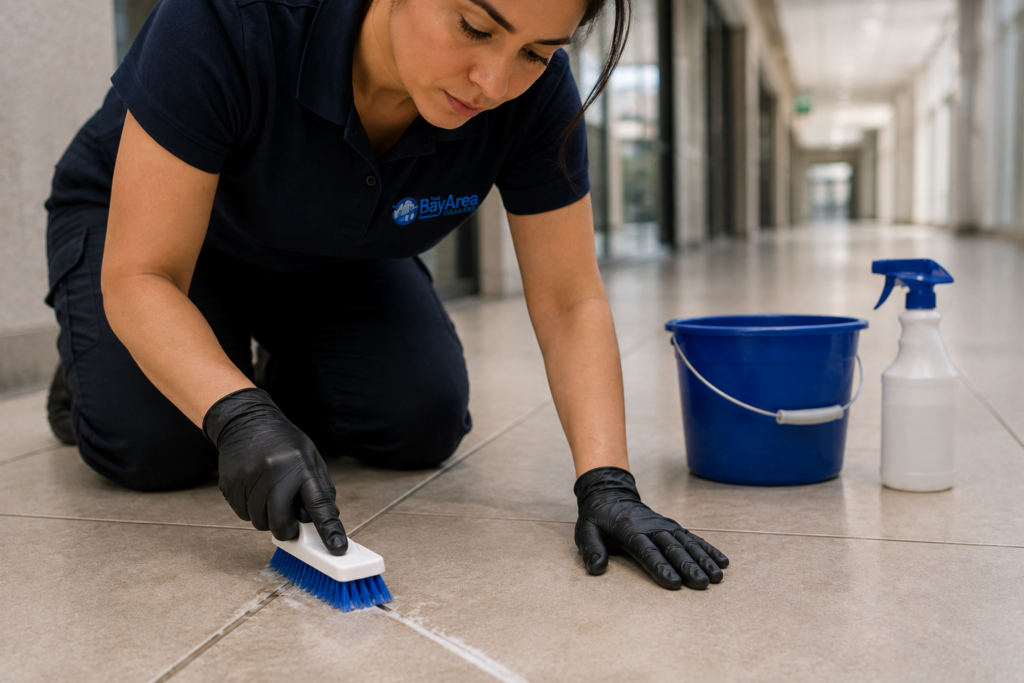
Four conditions cover almost every commercial grout complaint. Finding yours first saves buying the wrong product.
| What you see | What it needs | Typical cost | Who handles it |
| Joints dull but even in color | Routine scrub and rinse | In-house labor | Janitorial crew |
| Joints dark right after a scrub | Deep clean plus reseal | $0.75 to $2.00 per sq ft | Professional crew |
| Color uneven along the same run | Strip sealer, clean, reseal | $1.50 to $3.00 per sq ft | Professional crew |
| White film across the tile itself | Grout haze remover | Supplies only | Janitorial crew |
Two of these get misdiagnosed constantly. Dark joints right after a full scrub are not a scrubbing failure. They are open pores, which makes it a sealing job.
The white film is grout haze, left behind when installation residue was never fully rinsed. A stronger scrub does nothing to it. A haze remover clears it in one pass.
Knowing how to clean grout cost-effectively starts here, because a tile floor and grout cleaning quote for the wrong condition is money spent on the wrong problem.
Two questions belong in every quote request. Ask whether resealing is included, because a deep clean without it starts degrading immediately. And ask for the vendor’s safety data sheets. OSHA’s Hazard Communication Standard, 29 CFR 1910.1200, requires employers to keep those sheets accessible and addresses how on-site employers share them with each other, so a vendor who cannot produce them on request is a problem before the crew arrives.
Takeaway: diagnose before you buy. Three of these four conditions do not respond to more scrubbing.
Two Tests to Run Before You Buy Anything
Both take under two minutes, and most buildings have neither answer written down.
Test 1: Which grout is on the floor?
Run a fingernail along a joint away from traffic. Epoxy feels slightly plastic and resists scratching. Cement grout feels chalky and can flake under light pressure.
Sanded cement grout fills the wider joints used commercially, holds more soil, and takes scrubbing well. Unsanded cement grout fills narrow joints and cracks more easily under an aggressive brush. Epoxy resists staining and needs no sealing, so it skips the step that drives most of the schedule below.
Test 2: Is it sealed?
Put a few drops of water on a joint and wait a minute. If the water beads and sits, the sealer is intact. If it soaks in and the joint darkens, the sealer is gone.
Test a traffic lane and a corner separately. Sealer wears out where feet land and survives where they do not, so one floor can give you two different answers.
Both answers change how to clean grout on that particular floor. Unsealed grout absorbs everything, including the cleaner, so scrubbing harder drives soil deeper.
The order matters: clean first, dry completely, then seal. Sealing dirty grout locks the soil in for good, and the only way back is grinding the joints out. Building sealer into the floor care schedule is what makes the cleaning hold.
Takeaway: two minutes of testing decides every product choice that follows.
Daily and Weekly Grout Care by Facility Type
The question that comes up most is how do you clean tile grout on floor areas that never get a day off. The answer depends on what lands on that floor, not on the building type. Soft flooring in the same building runs on the same traffic logic, which is why the two schedules usually share one after-hours window.
You may also like: How to Clean Carpet: Methods, Costs and When to Call a Pro
Restrooms and Locker Rooms
Grout fails here first. Standing water, soap film, and constant traffic produce the fastest soil load in the building.
Damp-mop daily with a neutral cleaner and scrub the joints monthly rather than quarterly. Watch the perimeter and the area around fixtures, where mops reach least and moisture sits longest.
Knowing how to clean grout on a restroom floor is mostly about frequency, since these conditions never let a quarterly cycle hold. A restroom cleaning program that treats grout as a scheduled line item keeps these floors from aging out early.
Entryways and Lobbies
Grit arrives here before it reaches anywhere else. Walk-off matting long enough for several full strides catches most of it.
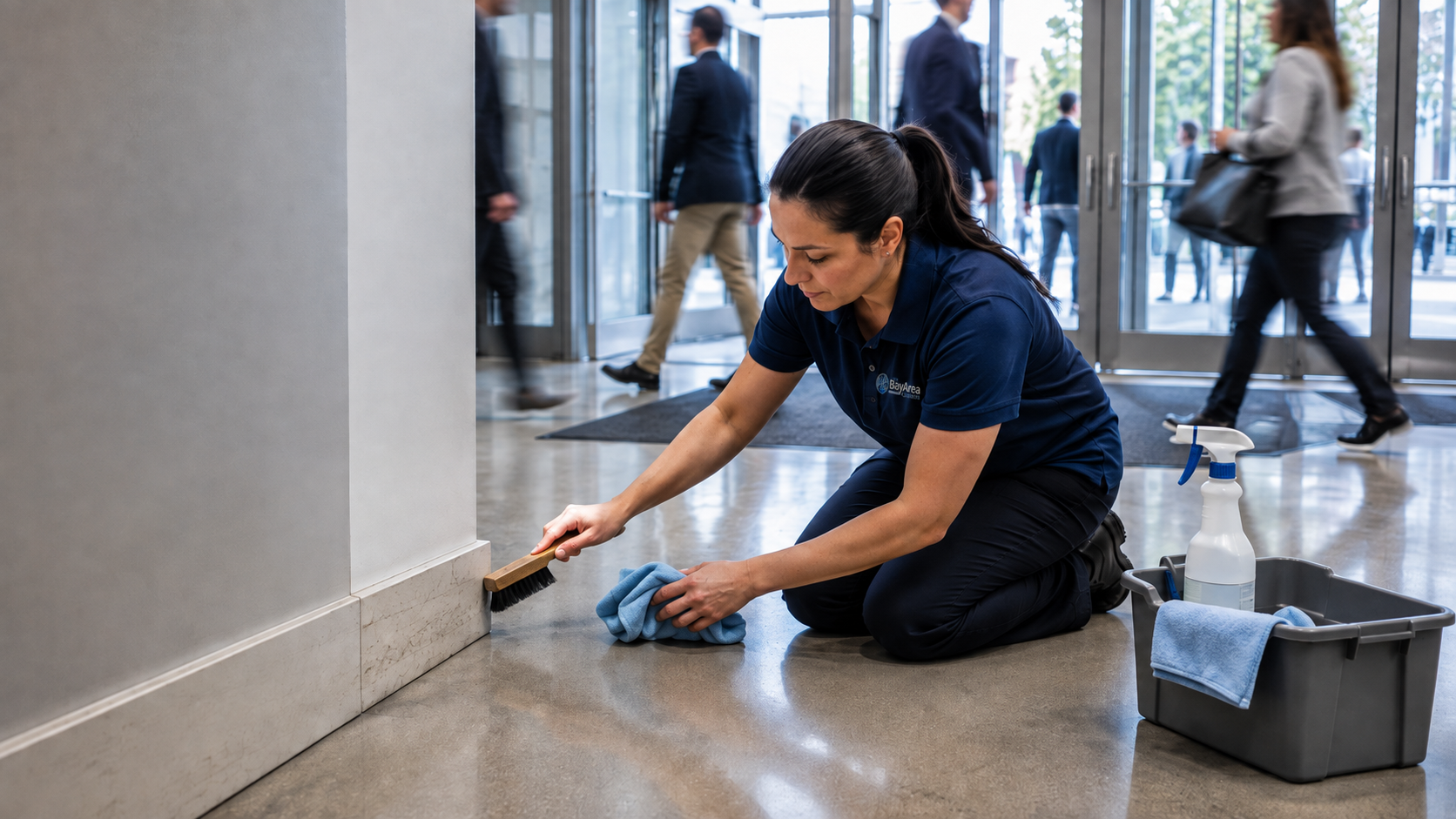
Dust-mop the tile daily. Grit left on the surface gets ground into the joints by the next hundred people who cross it.
Cafeterias and Break Rooms
Grease is the variable. It bonds to grout and then holds dry soil against it, which is why a neutral cleaner alone often does nothing here. These joints need a degreaser worked in with a brush, on a tighter cycle than the rest of the building.
Schools and Corridors
Volume without grease. Daily dust-mopping matters more than product choice here. Schedule joint scrubbing during breaks, when the floor can be worked and dried without students crossing it.
Takeaway: match the cycle to what lands on that floor. Restrooms need monthly attention. A dry corridor may hold for a quarter.
How to Clean Grout in a Tile Floor, Step by Step
Here is how to clean grout in a tile floor in the order that lifts soil out instead of pushing it deeper.
- Dry sweep or dust-mop first. Skipping this turns the next step into mud, because grit still on the tile gets dragged into the joints the moment water hits the floor.
- Apply a mildly alkaline grout cleaner and let it dwell for the time on the label, usually five to ten minutes. Do not let it dry on the floor. Grout work uses stronger chemistry than most floor tasks, and CDC guidance for environmental services recommends consulting the safety data sheet to determine the right precautions and protective equipment for the product in hand.
- Scrub along the joint, not across it, with a stiff nylon brush. A floor machine with a nylon grit brush covers large areas faster, but the joint still needs direct contact to release what sits in the pores.
- Rinse thoroughly and pick the water up. This step decides the result. Cleaner left in the joint creates the tacky film that makes a floor resoil within days, so rinse until the recovered water runs clear.
- Keep the area closed until the joints are dry. OSHA’s walking-working surfaces standard, 29 CFR 1910.22, requires floors to be kept clean and, to the extent feasible, dry, with hazardous conditions corrected before anyone uses the surface again. Grout that is still damp will not accept sealer either.
- Seal once the joints are clean and dry, then reseal every one to two years depending on traffic. Sealer is what keeps the next twelve months of cleaning from starting over.
One rule sits under all of it. Never mix an acidic product with a chlorinated one, and never combine two cleaners because one alone seemed slow.
Takeaway: steps two and four decide the outcome. Dwell time loosens the soil and rinsing is what gets it out of the building.
When to Stop Scrubbing and Call Someone
Everything above about how to clean grout in a tile floor assumes the joints can still respond. Sometimes they cannot, and recognizing that saves a lot of wasted labor.
The signal is simple. If a full scrub and rinse changes nothing visible, the soil is below the reach of a brush. More frequency will not close that gap.
Timing matters as much as method. After construction, fine dust settles into open joints and sets there, and new grout needs its cure time before anyone seals it. Scheduling a deep clean after the trades finish but before the space opens avoids locking that dust in for the life of the floor.
You may also like: Post Construction Cleaning Checklist
A professional tile floor and grout cleaning service uses pressurized extraction instead of a brush and a bucket. The tool sprays heated solution into the joint and vacuums it back in the same pass, which reaches what surface scrubbing cannot and pulls the dirty water off the floor instead of spreading it. That is the difference between a floor that looks better for a week and one that resets.
Takeaway: when a proper scrub changes nothing, the problem is porosity, not effort. That is a sealing job, not a cleaning job.
Frequently Asked Questions
How do you clean grout in a commercial building?
Start dry, then work wet. Dust-mop to pull grit off the tile, apply a mildly alkaline grout cleaner and let it dwell, scrub along the joint with a stiff brush, and rinse until the recovered water runs clear. Knowing how to clean grout also means knowing when to stop cleaning and start sealing, because unsealed joints darken again within weeks no matter how well the scrub went.
How do you clean tile grout on floor tiles in high-traffic areas?
Tighten the cycle rather than the chemistry. High-traffic runs need daily grit removal and monthly joint scrubbing, while quieter areas hold on a quarterly schedule. The steps for how to clean grout do not change with traffic, only the frequency does. Traffic lanes also lose their sealer first, so test them separately and expect to reseal them sooner.
Can you clean grout in a tile floor without stripping the sealer?
Yes, and it is the normal case. Knowing how to clean grout without stripping the sealer comes down to product choice: neutral and mildly alkaline cleaners lift soil without attacking most sealers. Acidic products and strippers are what remove sealer, which is why they belong in restoration work rather than routine maintenance. Test any new product in a low-visibility corner and check whether water still beads there afterward.
How much does tile floor and grout cleaning cost?
Professional tile floor and grout cleaning generally runs $0.75 to $2.00 per square foot for a deep clean with resealing, and more when old sealer has to be stripped first. Most vendors also carry a job minimum. What moves a quote is square footage, joint width, how long the floor has gone without service, and whether the work happens during business hours or overnight.
Conclusion
Grout is the part of a tile floor that records everything the building does to it. Knowing how to clean grout is half the answer. Knowing when the joints have stopped responding is the other half. A tile floor and grout cleaning schedule built around traffic, with sealing on its own cycle, keeps a floor from reaching the point where replacement is the only option left.
Call 707-656-9339 or request a free floor assessment, and we will check your grout, test the sealer, and map a cleaning and sealing cycle to how your building actually gets used.