Isopropyl alcohol splits the whiteboard makers. Magnatag tells owners to keep any solution containing isopropanol off its boards. Ghent recommends an isopropyl alcohol solution for its glass boards, and MooreCo lists an alcohol-based cleaner for a new board’s first cleaning. Before anyone works out how to clean whiteboard surfaces with alcohol, glass cleaner or water, check which of those liquids the board’s maker allows.
This guide is for office and facilities managers who look after meeting rooms. It covers what each maker says, how to tell the surfaces apart, the dry and wet passes, permanent marker, erasers and markers, storing the cleaners, and a simple rule for boards that hold notes someone wants to keep.
The quick version: Check which liquids your board’s maker allows before cleaning, since makers split on alcohol, glass cleaner and conditioners. When there’s no label, start with a microfiber cloth and plain water. Erase only when the ink is dry, and use a soft foam eraser or microfiber instead of paper towels. For permanent marker on porcelain steel, MooreCo’s method is to write over it with a dry-erase marker, wait about five seconds and erase both. Stock alcohol-based, low-odor markers. Keep isopropyl alcohol capped and away from heat, and post a dated save-or-erase rule in every meeting room.
Alcohol, Glass Cleaner and Water, Maker by Maker

Three makers give three sets of rules. Magnatag tells owners not to use kitchen or bathroom cleaners, industrial cleaners or any solution containing isopropanol, and recommends its own board cleaner. It says any other cleaner should double as a conditioner.
You may also like: How to Clean Hardwood Floors Without Ruining the Finish?
Ghent and MooreCo land elsewhere on the same liquids. Here’s how the three care pages line up.
| Liquid | Magnatag | Ghent | MooreCo |
| Isopropyl or denatured alcohol | Rules out solutions containing isopropanol | Isopropyl solution for glass boards | Alcohol-based cleaner for a new board’s first cleaning, and denatured alcohol on soil marks on glass boards |
| Glass cleaner | Rules out kitchen and bathroom cleaners | Glass cleaner for glass boards, but warns ammonia glass cleaners can yellow whiteboards | Household glass cleaner on a soft cloth for weekly cleaning and haze |
| Oil-based conditioner | Recommends conditioning as often as you clean | Warns wax or oil cleaners leave heavy film | Not covered on its care page |
| Plain water | Not covered | Water and microfiber for its GUV steel surface | Clear-water rinse after cleaning |
Alcohol is the first question to answer for each board. If the maker rules it out, keep it off that board, whatever another maker allows. If the maker allows it, the storage rules for a flammable liquid still apply.
Glass boards have their own rules
MooreCo suggests a liquid glass cleaner and a clear-water rinse for its glass boards, the same kind of routine used on interior glass and partitions. It allows household cleaners or denatured alcohol on soil marks and rules out any cleaner with paint remover or abrasives.
On colored or black glass, MooreCo notes that you may need neon markers for the writing to show. If your team says notes are hard to read, check the marker before you blame the cleaning. Glass shows every streak, so finish with a dry microfiber cloth wiped in one direction.
Takeaway: Answer the alcohol question first for each board. Keep any liquid off a board whose maker rules it out.
Four Board Surfaces on Office Walls

Most office whiteboards are one of four surfaces. Porcelain, sometimes sold as ceramic steel, is enamel fused onto steel, and painted steel has a coating over steel. Melamine and other laminates sit on a wood-based backing. Glass boards are tempered glass, often with a colored back.
A magnet narrows it down. It holds on porcelain and painted steel, and on glass boards with a steel backing. If a magnet slides off, the board is likely laminate over a wood-based backing. The model label, usually on the back or the frame, settles it.
Knowing the surface answers half of how to clean whiteboard surfaces in a given room, and the maker’s care sheet answers the rest.
| Surface | How to tell | What the makers say |
| Porcelain or ceramic steel | Magnet holds, hard glossy surface | Ghent: resists scratching, denting and staining |
| Painted steel | Magnet holds | Follow the maker’s sheet |
| Melamine or laminate | Magnet slides off | Follow the maker’s sheet, no abrasives |
| Glass | Clear or colored glass, often frameless | Ghent: resists stains but can show streaks |
When you can’t find a label, plain water is the least likely to cause harm. Ghent recommends water and a soft microfiber cloth for its GUV steel surface, and water doesn’t leave the film that oil or ammonia can. Step up to a board cleaner only after water fails, and ask the furniture supplier for the model before you try anything stronger.
Takeaway: A magnet and the model label tell you which care sheet to follow. With no label, start with water and microfiber.
The Dry Pass and the Wet Pass
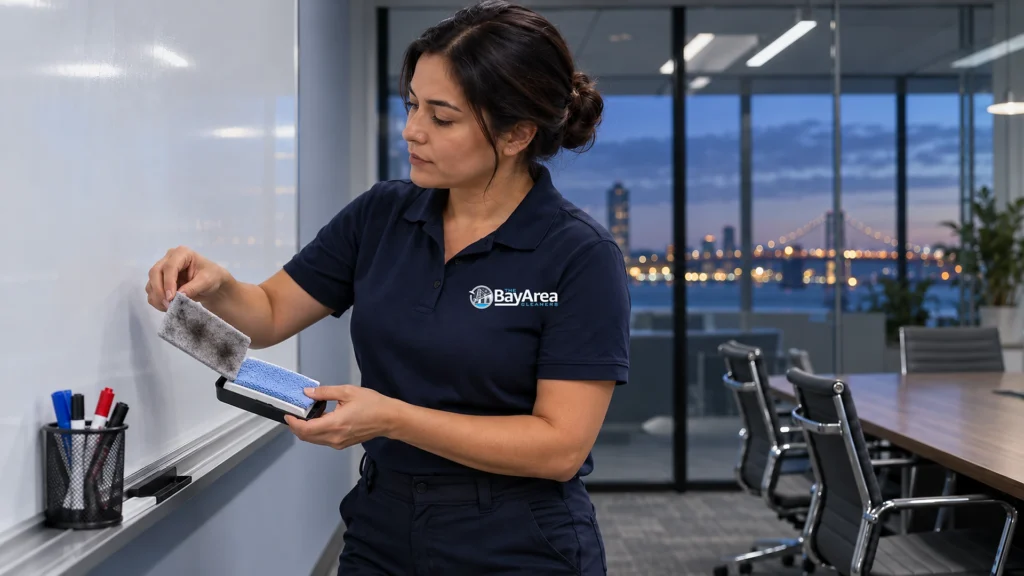
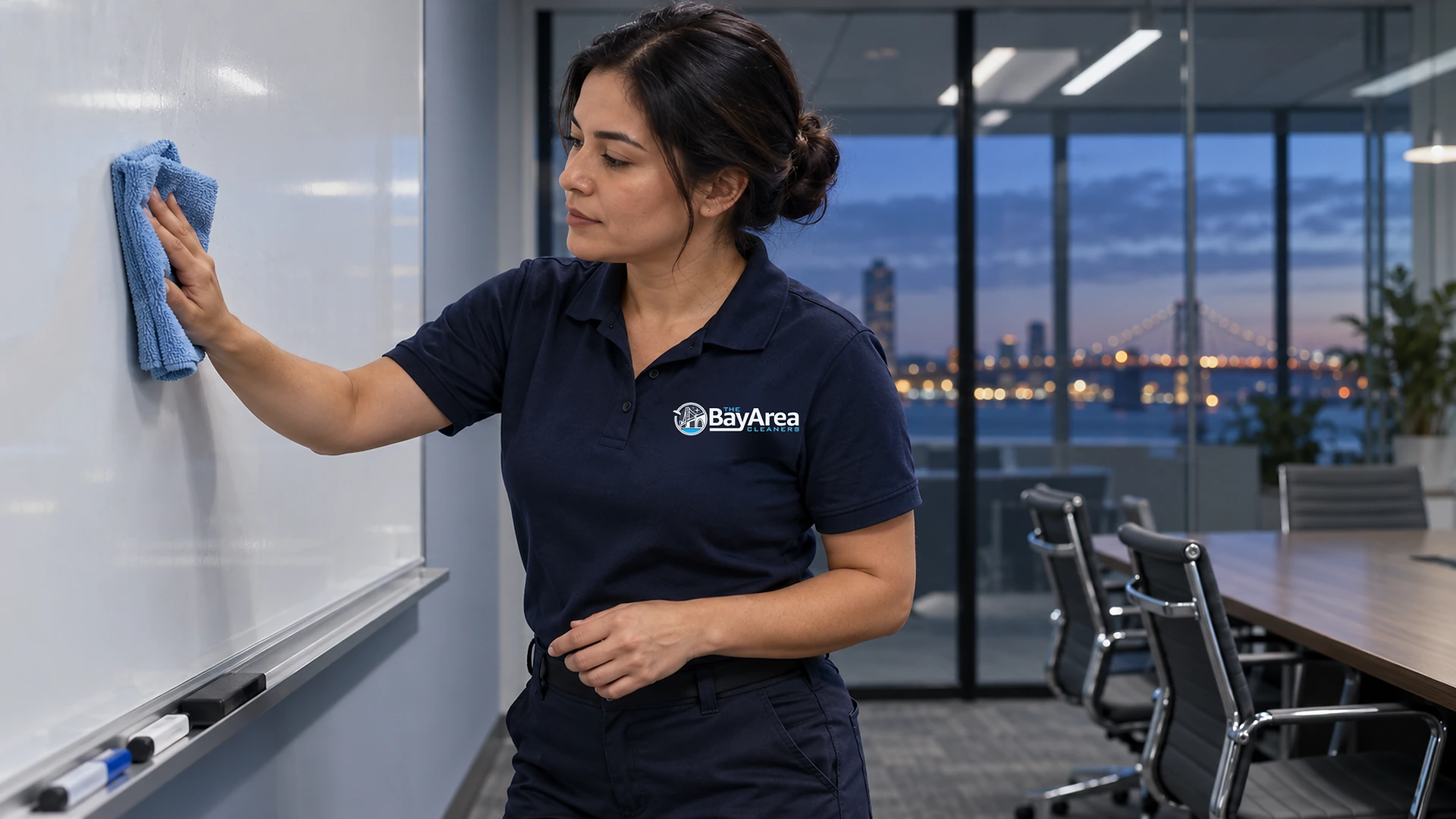
Day to day, how to clean whiteboard surfaces comes down to erasing well. Ghent’s guide says to erase only when marks are fully dry, since wet ink smears, and to wipe the board after every meeting so stains don’t settle. Ghent recommends soft microfiber cloths and soft foam erasers for daily care. MooreCo’s care page adds its own version: erase the board right after use.
Paper towels don’t belong on a board. Ghent calls them abrasive and Magnatag calls them coarse. Ghent warns against wiping with bare hands as well.
You may also like: Why Mopping Leaves a Film, and How to Clean Vinyl Plank Floors Instead?
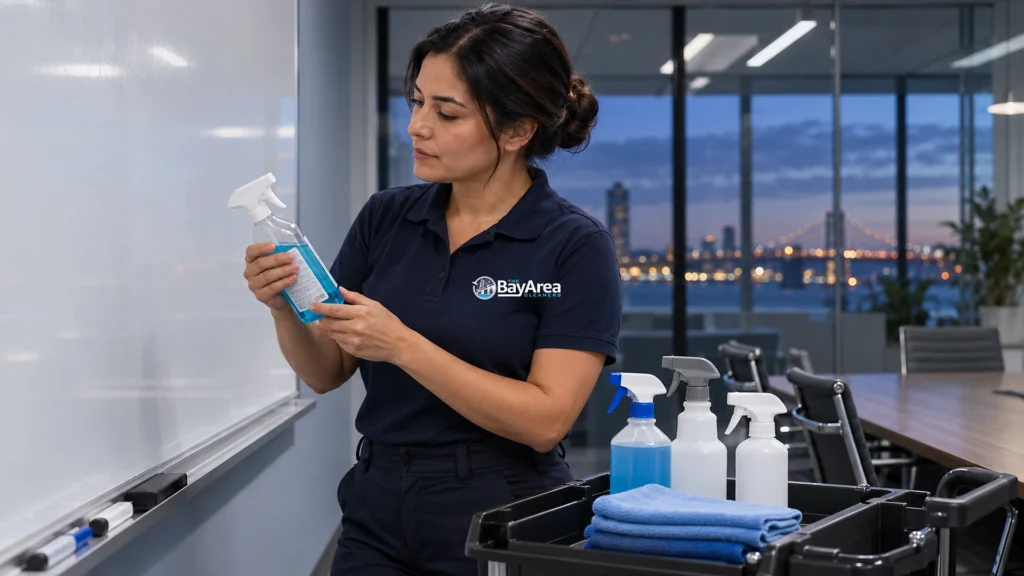
The wet pass is for the film that erasing leaves behind. MooreCo describes a haze that can develop after a period of use and suggests cleaning weekly to prevent marker color buildup. Spray the cleaner your board’s maker names, rub briskly with microfiber, then wipe dry. Where the care sheet calls for it, follow with a clear-water rinse.
Matte boards and projection surfaces need more care. MooreCo notes that matte surfaces may need a wet erase, sprayed and rubbed with microfiber, then rinsed.
Don’t skip the marker tray. Ink dust from erasing settles there, and the next eraser that touches it carries the dust back onto your board. Wipe the tray with a damp cloth during the wet pass. Erasing from top to bottom keeps loose ink dust falling toward the tray instead of across clean parts of the board.
If you’re working out how to clean whiteboard marker film from a board that gets heavy use, look at timing first. A wet clean after the last meeting of the week lifts a few days of film, and letting it sit for a month makes ghosting more likely.
Takeaway: Erase dry ink with foam or microfiber, never paper towels or hands. Wet clean with the maker’s cleaner, then dry the board.
How to Clean Whiteboard Stains From Permanent Marker
Ink left too long is the usual stain. Magnatag warns that marker residue left on a board for a prolonged period may damage the surface. Ghost images from last month’s meeting usually mean the board needs a wet clean, not harder erasing.
You may also like: How to Clean Grout on Commercial Tile Floors
MooreCo publishes a method for how to clean whiteboard stains from permanent marker on its porcelain steel boards. Draw over the mark with a good dry-erase marker, wait about five seconds for the new ink to dry, then wipe both away with a lint-free or microfiber cloth. MooreCo says to repeat the steps several times on heavy marks. Ghent offers a similar tip for stubborn old marks on its porcelain: mark over them with a black erasable marker.
| Problem | First step | If it stays |
| Light ghosting | Wet clean with the maker’s cleaner | Repeat, then check the care sheet for a stronger option |
| Permanent marker on porcelain steel | Write over it, wait about five seconds, erase | Repeat several times |
| Haze or film | Wet clean and wipe dry | Switch to the cleaner the maker names |
| Permanent marker on other surfaces | Check the care sheet first | Ask the maker before trying solvents |
Abrasives make it worse, whatever the surface. Ghent rules out abrasive cleaners and household products like Comet and toothpaste, which it says can cause irreversible damage. When you’re deciding how to clean whiteboard stains that won’t lift, reach for the right liquid and a soft cloth, not more pressure.
Takeaway: On porcelain steel, the write-over method lifts permanent marker. On any surface, wet clean ghosting and keep abrasives off the board.
Erasers and Markers in Every Meeting Room
An eraser holds the ink it removes. Once it’s loaded, it spreads gray streaks instead of lifting them, and the board looks dirty right after it’s cleaned. Learning how to clean whiteboard eraser pads is worth a minute, but a loaded felt pad is often easier to replace than to rescue.
Keep the routine short. Brush dry ink dust off the eraser over a trash can, not over the marker tray. When it still streaks, swap the pad or the eraser.
A microfiber cloth set aside for each board gives you a washable option. How to clean whiteboard eraser cloths comes down to washing them apart from greasy rags and skipping fabric softener, which can clog microfiber. Keep spare pads in the supply closet, so a streaking eraser gets swapped in seconds.
Foam erasers need less. For a foam block, how to clean whiteboard eraser faces comes down to tapping off the dust and wiping the face with a dry microfiber cloth. Once the foam tears or stays gray, replace it.
The marker matters as much. Seattle Public Utilities’ fact sheet on solvents in office products says dry-erase markers come in alcohol-based and ketone-based types and recommends the alcohol-based kind. It explains that low-odor or low-VOC labels mean the product is water-based or made with alcohol, and it advises avoiding xylene-based products.
Then handle the supply. Toss dried markers, which make people press harder and leave thin lines. Keep permanent markers out of meeting rooms, and cap markers after each use.
Flip-chart markers cause the same trouble. They often sit in the same cup as dry-erase markers and look almost identical, and their ink isn’t made to wipe off a board. Keep them in a separate, labeled cup, or in the flip-chart easel’s own tray.
That one habit removes most of the guesswork about how to clean whiteboard marker mistakes the next morning. Before you settle how to clean whiteboard marker residue in a problem room, check the cup of markers in it.
Takeaway: Replace loaded eraser pads, stock alcohol-based low-odor markers, and keep permanent markers out of the room.
Storing Isopropyl Alcohol and Board Cleaners
Where a board’s maker allows isopropyl alcohol, treat the bottle as a fire hazard. The New Jersey Department of Health’s hazardous substance fact sheet on isopropyl alcohol calls it a flammable liquid and lists a flash point of 53 to 57 degrees Fahrenheit for an 88 percent solution. It says to store it in tightly closed containers in a cool, well-ventilated area away from sunlight, with ignition sources kept away.
That changes how a cleaning cart gets packed. Keep alcohol in its original labeled bottle with the cap on, not in an open spray bottle left in a warm closet. Never mix it with other cleaners in the same bottle.
Your office may not need alcohol on the cart at all. If none of your boards’ care sheets calls for alcohol, leave it in the supply room and take one less flammable bottle into small rooms at night.
The fact sheet notes that repeated high exposure can cause headache and dizziness. In a small meeting room with the door closed, use as little as the job needs and let the air move. Seattle’s fact sheet advises using solvents only in well-ventilated areas and switching products if the odor bothers you.
Read the board cleaner’s label too. Seattle’s fact sheet says it’s best to look for a safer alternative when product information is incomplete or a product is unlabeled, and notes you can request the safety data sheet from the supplier. Keep those sheets where whoever stocks the cart can find them.
Takeaway: Store isopropyl alcohol capped, labeled and away from heat, use it sparingly in small rooms, and let the air move.
Wipe or Keep: A Rule for Boards With Notes
The hardest part of cleaning whiteboards in an office isn’t chemical. It’s knowing which boards to leave alone. Whoever cleans the room after hours sees project plans, sales numbers and hiring notes, and a board erased by mistake can cost a team a morning. The rule works only if it’s written down and posted where everyone sees it.
Set one rule and post it in each room, next to the board where people will see it before they leave. A board marked “Save” stays as it is through the night, and everything else gets erased after the last meeting. Teams that need a record should take a photo before they leave, and the room booking confirmation can carry the same reminder.
Make the save note carry a name and a date, like “Save until Thursday, Ana.” The person cleaning knows the board is still in use, and the team knows the note has an end. Without a date, a saved board can sit for months.
That deadline protects the surface too. Ink under an old “Save” note is the long-left residue Magnatag warns can damage the surface, so ask teams to clear saved boards within a set number of days. Then the wet pass can catch up.
Boards in client-facing rooms need one more step. Before a client meeting, the host photographs and erases sensitive boards, saved or not. If your building has a day porter who resets meeting rooms, decide with your provider whether boards are part of that reset. The Bay Area Cleaners’ meeting and conference room cleaning covers tables, chairs, glass walls and AV surfaces, so the board rule slots into a room that’s already on the cleaning plan.
Takeaway: Post a save-or-erase rule in every meeting room, put a name and date on saved boards, and photograph anything worth keeping.
Frequently Asked Questions
Can you use isopropyl alcohol when you learn how to clean whiteboard surfaces?
Only where the board’s maker allows it. Magnatag rules out solutions containing isopropanol, and Ghent recommends an isopropyl solution for its glass boards. Where it’s allowed, store it capped in its labeled bottle, away from heat and sunlight.
Is it worth learning how to clean whiteboard eraser pads, or should you replace them?
A felt pad that spreads gray streaks is often easier to replace. Brush off dry ink dust over a trash can in between, and keep spare pads on hand. Microfiber cloths are the washable option.
Is the write-over method the answer to how to clean whiteboard stains on every board?
MooreCo publishes it for its porcelain steel boards, and Ghent offers a similar tip for its porcelain. On other surfaces, check the maker’s care sheet before trying it or any solvent.
Which markers should you stock if you’re tired of working out how to clean whiteboard marker residue?
Fresh, capped, alcohol-based low-odor markers. Seattle Public Utilities recommends alcohol-based dry-erase markers over ketone-based ones and advises avoiding xylene-based products. Keep permanent markers out of meeting rooms, since they leave the stains that won’t erase.
Conclusion
Once your team knows how to clean whiteboard surfaces for each board type, most of the work is habit, and the habits are cheap. Erase dry ink with foam or microfiber, wet clean with the product the maker names, and use the write-over method where the maker publishes it. Store alcohol like the flammable liquid it is, and give every meeting room a dated save-or-erase rule.
If a board still ghosts after a proper wet clean with the maker’s product, check the surface before buying more cleaner. A worn surface is a common reason, and the maker can tell you whether it can be restored.
The Bay Area Cleaners cleans offices from Vallejo to San Mateo, including meeting and conference rooms, with after-hours, early-morning and weekend scheduling. Call 707-656-9339 for a free estimate.