A restroom mirror rarely fails in the middle. The damage starts at the edges, where the silver backing sits closest to the air, and it spreads inward as a dark band that no amount of wiping removes. So in an office, how to clean mirrors is less about the product you buy than about where the liquid ends up. Commercial mirror makers say the same thing in their care sheets: keep the edges and the joints dry.
This guide covers the nightly routine for restroom and lobby mirrors and how to stop streaks. It explains what cloudiness means, which cleaners to keep off the glass, and how LED, two-way and full-length mirrors change the job.
The quick version: Commercial mirror makers and the mirror division of the former Glass Association of North America (GANA) recommend clean, warm water on a soft, lint-free cloth that’s wrung out well. Put any cleaner on the cloth, never on the mirror. Dry the surface, the edges and the joints right away with a second dry cloth. Skip cleaners with ammonia, vinegar, acid or alkali, and skip abrasives and solvents. On a wall of several mirrors, wipe along each joint instead of across the panels. Haze that wipes off is residue. A dark band creeping in from the edge is damage to the backing, and it won’t clean off. That’s how to clean mirrors without voiding the warranty.
Mirror Edges Are Where the Damage Starts

A standard mirror is a sheet of glass with a reflective silver layer on the back, sealed under protective coatings. The face of the glass handles water and wiping well. The edges are the weak spot, since that’s where the backing meets the open air.
Liquid that runs down the glass collects at the bottom edge and wicks behind it. GANA’s cleaning bulletin calls the result black edge, and Bobrick, a maker of commercial restroom accessories, calls it silver spoilage. Its care bulletin says much of that damage can be prevented with proper cleaning and installation.
You may also like: Commercial Restroom Cleaning: The One Room That Grades the Whole Building
You can spot it early if you know where to look. Check the bottom corners nearest the faucets first, since they get the most splashes. Early damage often shows as gray specks or a thin dark line along the edge.
Framed mirrors need the same care. American Specialties (ASI), a restroom mirror maker, warns that acid, alkali, abrasive and concentrated ammonia cleaners can attack the mirror’s surface and edges, and possibly its stainless steel frame. A channel frame can trap water against the edge, so run the dry cloth along the inside lip on every pass.
The warranty is on the line too. Bobrick warns that ignoring its guidelines could void the warranty. ASI says mistreatment voids its warranty and that silver spoilage isn’t covered. Replacing a mirror wall means a glazing crew, a closed restroom and a bill the warranty may not cover.
Takeaway: Black edge starts where liquid reaches the backing. Keep cleaning solution away from the edges and the frame lip, and you protect the mirror and its warranty.
How to Clean Mirrors on a Nightly Restroom Round?
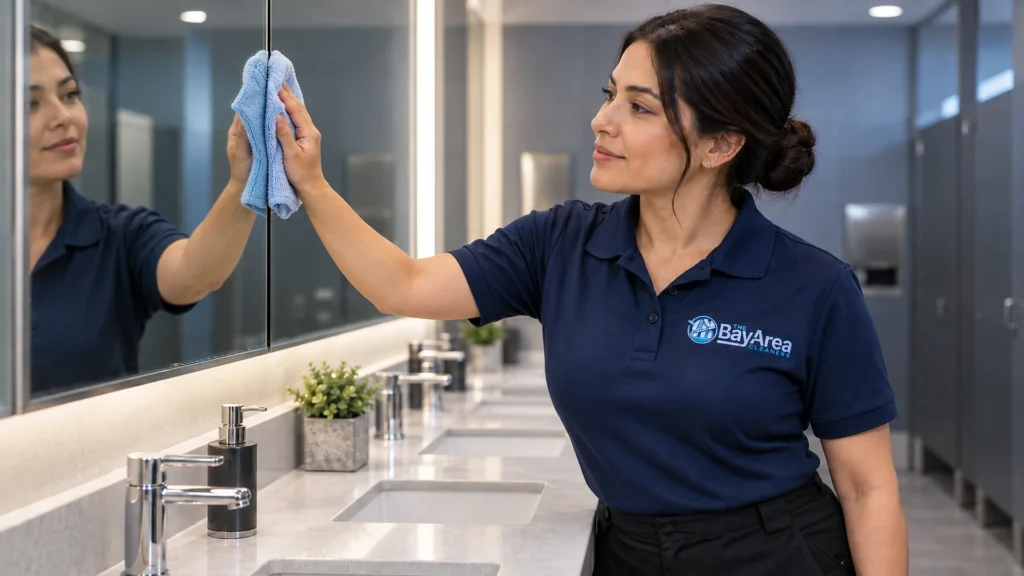
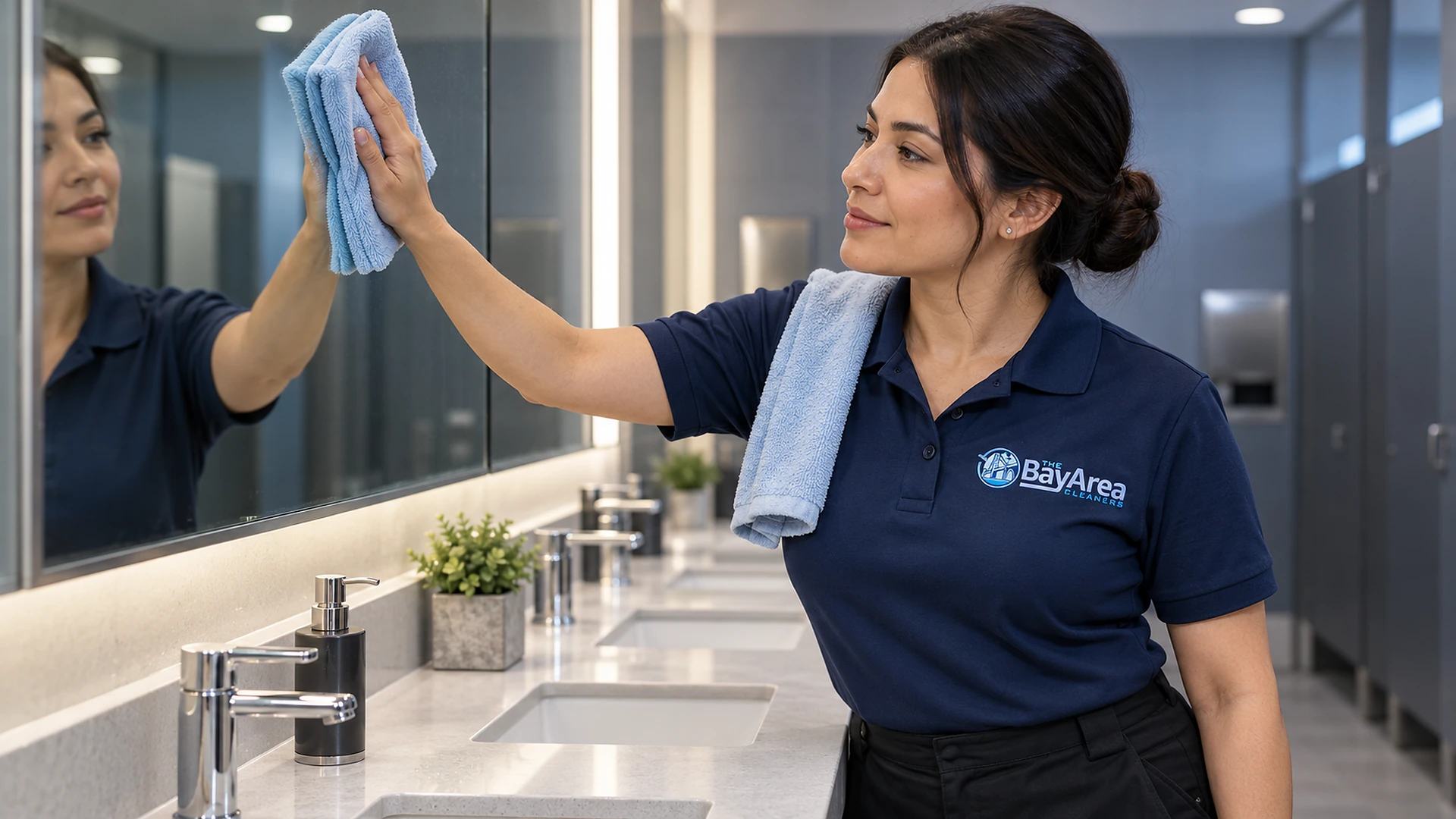
The makers’ instructions fit on an index card. Start with clean, warm water on a soft cloth that’s free of lint and grit, the first choice in both the Bobrick and GANA bulletins. Wring the cloth out until it stops dripping, so there’s nothing left to run toward the edges.
Clean the sinks and counters first, then the mirrors. That way faucet splashes hit the mirror before you clean it, not after. Here’s the nightly routine for a restroom mirror:
- Dampen a soft, lint-free cloth with warm water and wring it out.
- Wipe the mirror from the top down, keeping the cloth a little inside the frame or edge.
- Go over any spot that’s still there with the same cloth instead of adding water.
- Dry the face of the mirror right away with a separate dry, lint-free cloth.
- Run the dry cloth along every edge and joint until no moisture is left.
- Finish with a dry wipe of the backsplash where it meets the mirror.
If you do use a cleaner, apply it to the cloth first. Cleaner sprayed on the mirror runs to the edges, the problem GANA’s bulletin guards against. In ASI’s care sheet, a puddle at the edge can attack the backing.
Launder mirror cloths without fabric softener and hang them until they’re completely dry before the next shift. Softener leaves a coating on cloths that smears on glass. A cloth with grit in it can scratch the glass, so drop any cloth that hits the floor into the laundry bag.
Restroom rounds during the day can catch fingerprints before they build up. If your building uses porter restroom rounds that wipe surfaces between full cleanings, a dry cloth on the mirror can join that list. The nightly visit covers the full routine, and restroom cleaning that lists mirror and glass cleaning in its scope should spell out which mirrors are on it.
Takeaway: Warm water, a wrung-out cloth and a dry cloth on every edge. Clean sinks first and mirrors second.
How to Clean Mirrors Without Streaks?

A streak is whatever the cloth left on the glass: cleaner, soap, skin oil, hairspray or lint. The answer to how to clean mirrors without streaks is to leave less behind, not to add more product.
Start with the cloths. ASI recommends a separate lint-free cloth for drying and polishing, kept apart from the one that does the washing. A damp cloth used to dry will just spread a thin film. Swap your drying cloth as soon as it starts to feel damp.
Watch the amount of liquid, too. A soaked cloth leaves water that dries into spots and lines. A cloth that’s barely damp, followed by a dry one, works best in a restroom with bright vanity lights.
Hairspray leaves a tacky film near the sinks. It smears on the first pass and needs a second damp pass and a fresh dry cloth. If the same mirror smears every night, rinse your washing cloth more often as you go.
Mirror walls need one more habit. GANA’s bulletin says to wipe the joints between mirrors in the same direction as the joints, and not to wipe across several mirrors at once. Each panel gets its own pass, and the joint gets a dry wipe of its own. That’s how to clean mirrors without streaks on a wall of four or five panels.
Takeaway: Two cloths, very little liquid and one panel at a time. Change the drying cloth the moment it feels damp.
How to Clean Mirrors That Are Cloudy or Spotted?
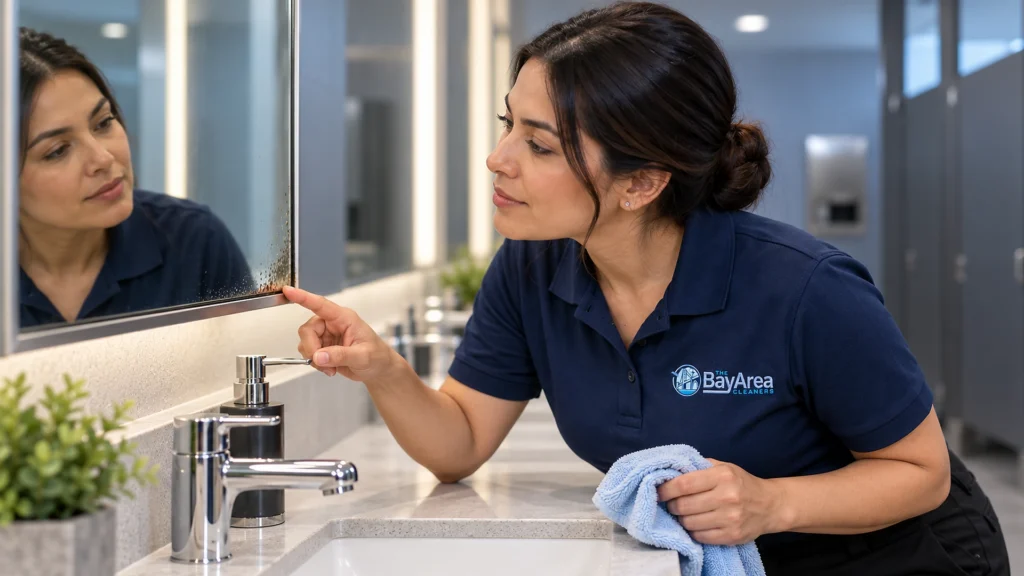
Any plan for how to clean mirrors that are cloudy starts with a two-minute test that tells dirt from damage. Wipe a small spot with warm water and dry it. If it comes up clear, the haze was a film on the surface. If it still looks dull, or the dark area follows the edge, the problem is in the backing.
You may also like: Elevator Cleaning: Why a Six-by-Six Room Gets Noticed More Than the Lobby
Surface haze usually comes from old cleaner residue, hairspray or splashes from the sink. Repeat the warm water routine and dry each section at once. For a mark that warm water won’t lift, Bobrick and GANA both name #0000 oil-free steel wool, not solvents. Test it on a small spot near the middle first, keep it away from the edges and keep it off two-way mirrors and any mirror with a coated face.
Dried splash spots over the sinks usually lift with the warm water routine. Keep acid and alkali cleaners off the glass. GANA’s bulletin warns that either one can attack the front surface, the edges and the backing once a mirror is installed.
Damage to the backing is a different case. No tip on how to clean mirrors that are cloudy will fix black edge or silver spoilage, since the dark area sits behind the glass. Take a photo, note the mirror’s location and how far the band has spread, and add it to the repair list for building engineering. Catching it early points to the leak or cleaning habit behind it before the next panel shows the same band.
Takeaway: Test a small spot first. Haze that wipes off is residue, but a dark band at the edge is damage to the backing and needs replacement.
Vinegar, Ammonia and What Mirror Makers Allow
Most home advice for mirrors reaches for vinegar or an ammonia glass cleaner. Commercial mirror makers say no. GANA’s bulletin tells readers not to use commercial mirror cleaners that contain ammonia or vinegar. Bobrick lists ammonia, vinegar, acid and alkali cleaners as products that can attack the mirror’s face, edges and backing.
The confusion comes from window cleaning. The General Services Administration’s procedure for cleaning historic glass washes windows with an ammonia solution or a vinegar solution, then dries them with a squeegee. That’s a window recipe. A window has no silver backing at its edge, and a mirror does.
Read the labels on the sprays already in your restroom closet. A bathroom cleaner made for sinks and tile often lists an acid for mineral scale, and that bottle shouldn’t touch a mirror. Keep it pointed at the sink and away from the glass.
ASI is the most flexible of the three care sheets. It names clean, warm water and a soft cloth first and allows an approved glass cleaner. Concentrated ammonia-based cleaners stay off its list, along with acid, alkali and abrasive ones.
How to clean mirrors without glass cleaner
Knowing how to clean mirrors without glass cleaner isn’t a workaround here. It’s the default in these care sheets. Warm water on a wrung-out cloth, followed by a dry cloth, comes first in all three. If you keep a glass cleaner in the closet, read the label for ammonia and vinegar before it touches a mirror.
Learning how to clean mirrors without glass cleaner pays off in an office for simple reasons. You have one less product to buy, store and label. It’s one less chemical in a closed restroom, and nothing on the cloth can creep behind the edge and stain the backing.
Takeaway: Keep ammonia, vinegar, acid and alkali cleaners off mirrors. Warm water comes first, and any approved glass cleaner is the exception.
LED, Two-Way and Full-Length Mirrors
Newer restrooms and wellness rooms often have mirrors with lighting built in. Keep liquid from seeping under the edges of these LED mirrors. Bobrick’s bulletin says seepage can permanently discolor the etched areas, and its warranty doesn’t cover that damage. On a lit mirror, dry each edge right after the pass next to it.
You may also like: Commercial Window Cleaning for Hallways & Common Areas in Multi-Tenant Buildings
Two-way, or transparent, mirrors carry a coating on the face that scratches easily. Hard objects such as rings or metal cleaning tools can damage that surface for good, a risk GANA’s bulletin singles out. Take off rings and watches, use only soft cloths and leave the steel wool in the closet.
Full-length mirrors show up in wellness rooms, locker areas and some restrooms. The advisory to the 2010 ADA Standards notes that a full-length mirror works for more people, including children. It says the top edge of mirrors should be at least 74 inches from the floor. For taller mirrors, use an extension handle with a soft pad, and never stand on a countertop or sink.
Takeaway: Dry LED mirror edges right after each pass, keep rings and metal tools off two-way mirrors and use an extension handle, not the sink, for tall mirrors.
Splash Zones, Floors and Mixed Glass
Restroom mirrors sit low on purpose. The 2010 ADA Standards set the bottom edge of the reflecting surface at 40 inches maximum from the floor for mirrors over lavatories or countertops, and 35 inches maximum elsewhere. That keeps mirrors usable from a wheelchair, and it puts the bottom edge right in the splash zone of the sink.
Bobrick’s installation guidance calls for at least 10 millimeters (about 2/5 inch) between the mirror’s bottom edge and other surfaces, and it warns against puddling. When you clean the counter under a mirror, wipe the backsplash dry before you move on. Water pooled against the bottom edge is the same risk as a sprayed mirror. If a mirror sits right on the backsplash, flag it to building engineering.
Restroom floor cleaning can reach the mirrors, too. Bobrick and ASI both say never to hose a mirror down. Keep hoses away from mirror walls, and wipe the lower edge if water splashes up during floor care.
Remodels carry their own risk. GANA asks for mirrors to go in last, after wall texture and wallcovering adhesive have fully cured.
If your lobby or conference rooms mix mirrors and glass, they need different handling. Partition and conference glass cleaning covers doors, dividers and conference walls, which have no silver backing to protect. Keep mirrors on their own line in your cleaning scope so nobody treats them like a glass door.
Takeaway: Restroom mirrors sit in the splash zone, so dry the backsplash, keep hoses away and list mirrors apart from interior glass.
A Monthly Walk to Check Mirror Edges
Nightly cleaning keeps mirrors clear, but a crew working fast looks at the glass, not the edges. Once a month, walk each restroom with the vanity lights on and look only at the edges. Damage caught at a few millimeters lets you fix the cause before it spreads. Caught at a few inches, the panel needs replacing.
Here’s what to look at on that walk:
- The bottom corners closest to each faucet.
- Every joint on a mirror wall, top to bottom.
- Inside the lip of any stainless steel frame.
- Etched areas on LED mirrors.
- Each gap between a mirror and the backsplash.
Check the restroom closet on the same walk. Move any spray bottle with ammonia, vinegar or acid on the label off the mirror cart, and pull cloths that look gray or stiff before the next shift.
Takeaway: A monthly look at corners, joints, frames, LED etching and the backsplash gap catches edge damage when it’s still small.
Frequently Asked Questions
Should paper towels be part of how to clean mirrors in an office restroom?
They shed lint, and the care sheets ask for a soft cloth that’s free of lint and grit. A clean cloth for washing and a second one for drying give a clearer finish. Save the paper towels for hands.
Does the room’s lighting affect how to clean mirrors without streaks?
Bright vanity lights show every line that dim light hides. Check each mirror under the lights people use, from the angle someone at the sink would see it. A streak you catch then takes one more dry pass.
What if you’ve tried every tip on how to clean mirrors that are cloudy and the haze stays?
Then the haze sits behind the glass. A dark band that grows in from the edge is damage to the silver backing. Report it with the mirror’s location so it can be replaced.
If you’re learning how to clean mirrors without glass cleaner, is plain water enough?
For most nightly cleaning, yes. Warm water on a soft, wrung-out cloth is the first choice in the makers’ care sheets. For stubborn marks on standard mirrors, Bobrick and GANA name #0000 oil-free steel wool instead of a solvent.
Conclusion
Office mirrors stay clear when the routine stays simple. That means warm water on a wrung-out cloth and a dry cloth along every edge and joint. Skip ammonia, vinegar, acid, alkali, abrasives and solvents, and clean the sinks before the mirrors.
Knowing how to clean mirrors the right way protects more than the shine. It protects the silver backing, the warranty and the budget for your next restroom upgrade. Check the edges once a month, and replace a mirror when the band starts to spread.
The Bay Area Cleaners cleans restroom mirrors on nightly rounds for offices from Vallejo to San Mateo. Porter restroom rounds can add a dry wipe during the day. Call 707-656-9339 to walk through your restrooms and get a free estimate.