California’s workplace safety rules cover the office water cooler as a source of drinking water. Title 8, section 3363 requires every drinking water source at work to be kept clean and sanitary, and it requires portable dispensers to be serviced so they stay that way. A cooler that dozens of people use every day doesn’t stay clean on its own. Knowing how to clean a water dispenser, and how often, is how an office keeps that promise.
This guide shows how to clean a water dispenser in a busy breakroom. It covers what the rule asks for, a short routine for every bottle change, the deeper clean every few months, bottom-loading models and the signs that a cooler is overdue.
The quick version: The routine for how to clean a water dispenser is short. California requires workplace drinking water dispensers to be kept clean and sanitary. At every bottle change, wash your hands, wipe the top and neck of the new bottle with a clean cloth and wipe the spigots. Empty the drip tray before it fills. Every one to three months, unplug the cooler and clean the reservoir with the method its manual allows. The two published methods are a mild bleach solution from MassDEP and a vinegar flush from Primo, each followed by a full rinse. On bottom-loading models, clean the bottle probe with dish soap and a damp cloth. Keep full bottles cool and out of the sun, and never put a cooler in a restroom.
What California Expects From an Office Water Cooler?
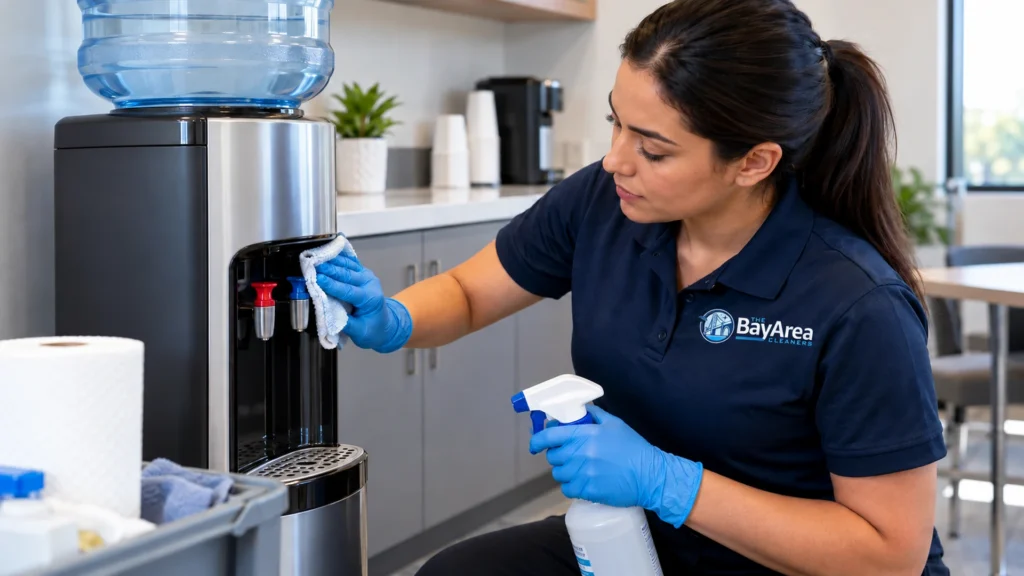
Before getting into how to clean a water dispenser, it helps to know what the state expects. Section 3363 of Title 8 sets the rules for drinking water at work, and several of them apply directly to a breakroom cooler.
Drinking water sources have to be kept clean and sanitary. Portable dispensers need a faucet, a way to close tightly and servicing that keeps them sanitary. They have to be marked with what they hold.
Two rules surprise people. Drinking fountains and portable dispensers can’t be placed in toilet rooms, so the cooler belongs in the breakroom or a hallway, never inside the restroom. The rule bans the common use of a cup, glass or other drinking vessel, too, so a shared mug parked on top of the cooler is out.
You may also like: Office Cleaning Standards for Napa County Workplaces
None of this spells out a cleaning method. The rule sets the outcome, a clean and sanitary source, and leaves the steps to the dispenser’s maker and the people who run the office. A written routine for how to clean a water dispenser turns that outcome into tasks someone can check.
Takeaway: California requires workplace water dispensers to be kept clean, closed, marked and out of restrooms. Keep paper cups or personal bottles at the cooler instead of a shared mug.
How to Clean a Water Dispenser at Every Bottle Change?
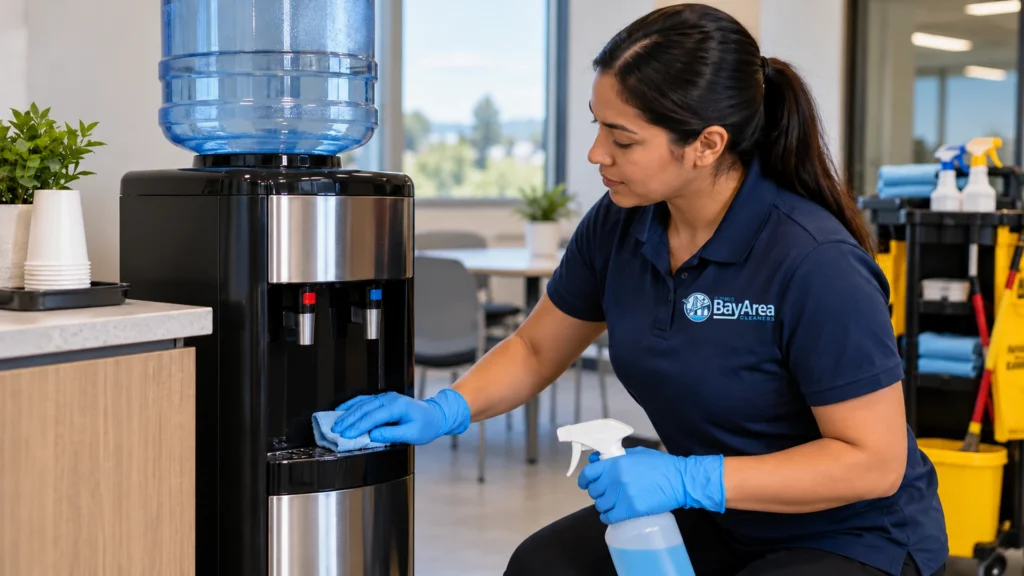
The bottle change is the natural moment for a quick clean, since the cooler is already open. The Massachusetts Department of Environmental Protection (MassDEP) wrote its guide for schools, but its bottle-change steps fit any office. Wash your hands first, then wipe the top and neck of the new bottle with a clean cloth. That stops whatever sat on the bottle in storage from riding into the reservoir.
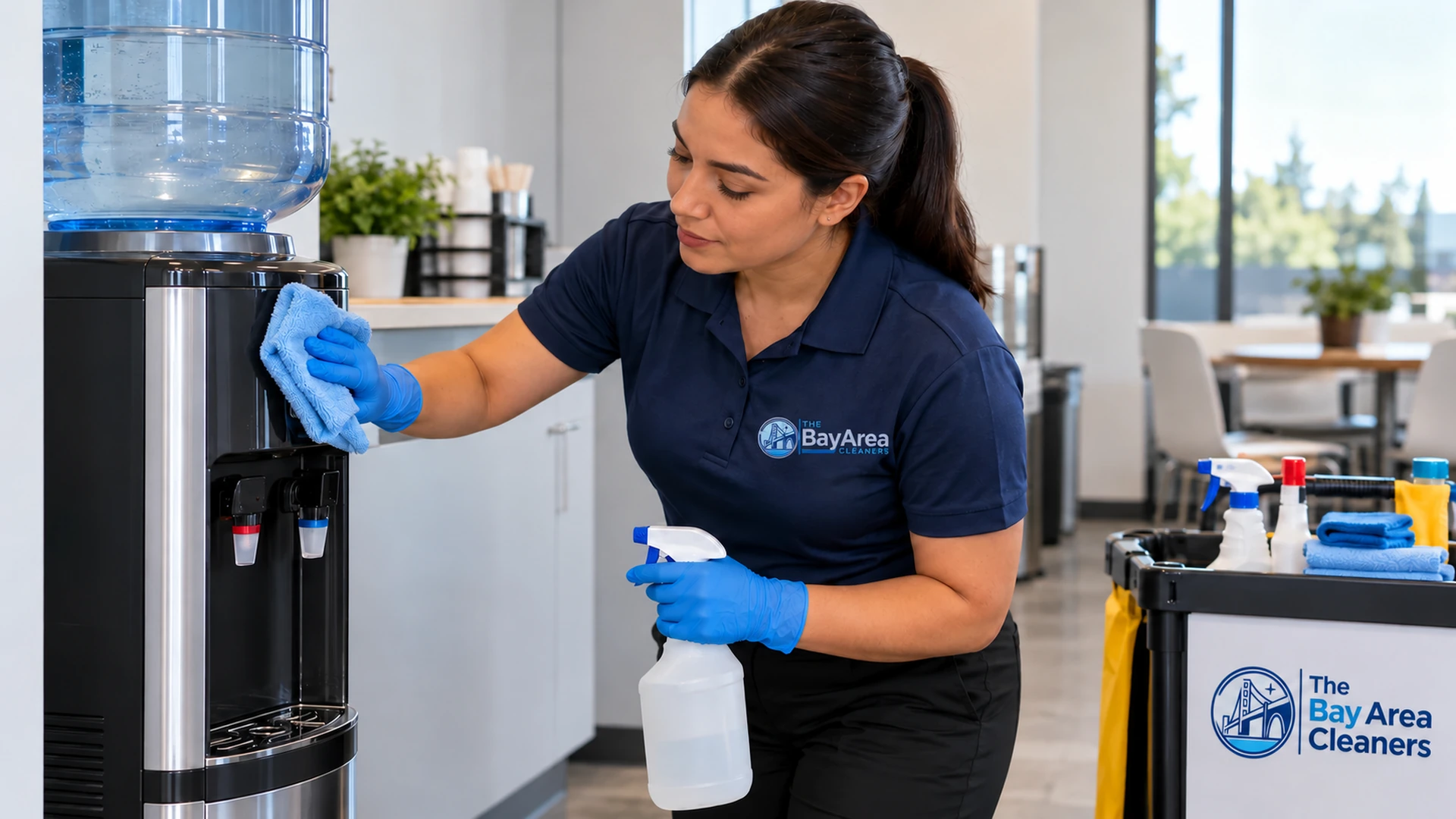
This is how to clean a water dispenser in the few minutes a bottle change takes:
- Wash your hands before you touch the new bottle.
- Wipe the top and neck of the new bottle with a clean cloth.
- Wipe both spigots, the push buttons or levers, and the area around them.
- Empty the drip tray and wash it with dish soap and water.
- Wipe the outside of the cabinet, top to bottom, and dry it.
The drip tray needs more attention than it gets. MassDEP points out that it isn’t a drain, only a tray to catch the occasional spill. A tray left full turns into standing water right under the spigots. Primo’s bottom-loading manual says its tray is dishwasher-safe and has an indicator that rises when it’s time to empty.
Wiping the outside of the cooler fits a nightly visit, so that part of how to clean a water dispenser can go to your cleaning crew. If your breakroom cleaning covers appliance exteriors, add the cooler cabinet and the area around the spigots to that list. The inside work at bottle changes and deep cleans stays with whoever your office assigns, following the dispenser’s manual.
Takeaway: At every bottle change, wash your hands, wipe the new bottle’s neck, wipe the spigots and empty the drip tray. Add the cooler’s outside to the breakroom’s nightly wipe.
The Deep Clean Every One to Three Months
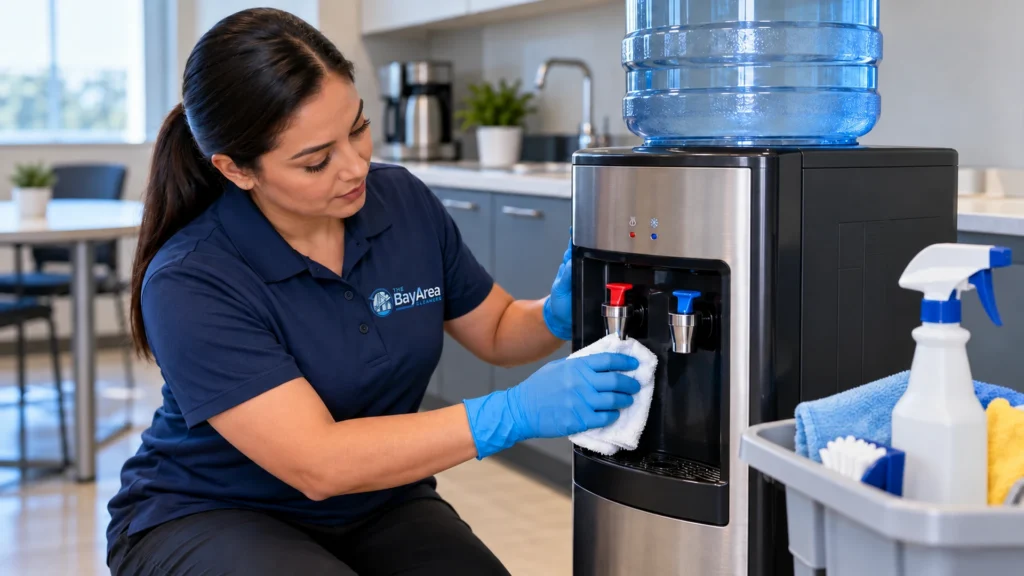
The reservoir needs a full clean on a schedule. This is the part of how to clean a water dispenser that slips off a busy calendar first. MassDEP suggests every one to three months or at a bottle change.
Primo, a national water delivery company, recommends every three months, and sooner with heavy daily use, shared use, or a change in taste or flow. One of its bottom-loading manuals asks for the cold reservoir to be cleaned at least once every three months.
Unplug the cooler before either method and let the hot tank cool before you drain it. Primo’s manuals warn that these units dispense water hot enough to cause severe burns.
The two published methods use different solutions. MassDEP uses bleach, and Primo’s guide answers how do you clean a water cooler with vinegar. Pick the one your dispenser’s manual allows, use its own ratio if it gives one, and never mix vinegar and bleach, which releases chlorine gas.
| Step | MassDEP bleach method | Primo vinegar method |
| Solution | 1 teaspoon of non-perfumed bleach in 1 gallon of water | 2 cups of distilled white vinegar with hot tap water in an empty 5-gallon bottle |
| How it reaches the reservoir | Wipe the inside of the reservoir and the spigots with a cloth dampened in the solution | Run the solution into the reservoirs and let it sit for 10 minutes |
| Draining | Drain through the cold spigot | Drain through the taps and the drain at the back |
| Rinse | Rinse with at least 1 gallon of clean water | Flush by running clean water through the taps |
MassDEP specifies a clean cloth, not a paper towel, for the wipe. Don’t cut the rinse short, since a rushed rinse undoes the rest of how to clean a water dispenser. Whichever method you use, rinse with at least a gallon of clean water and keep going until there’s no bleach or vinegar smell. Then put a new bottle on and plug the cooler back in.
Running Primo’s Vinegar Flush
Primo publishes a vinegar flush for its own dispensers, and it gives a plain answer to how do you clean a water cooler with vinegar.
Mix 2 cups of distilled white vinegar with hot tap water in an empty 5-gallon bottle, run it into the reservoirs and let it sit for 10 minutes. Then drain it and flush with clean water through the taps. Primo’s guide sets the hot and cold switches for the soak. Anyone asking how do you clean a water cooler with vinegar should set both the way their own manual says.
Takeaway: Deep clean the reservoir every one to three months with the method your manual allows. Unplug first, let the hot tank cool, use a cloth instead of paper and rinse until no bleach or vinegar smell is left.
How to Clean a Bottom Loading Water Dispenser?
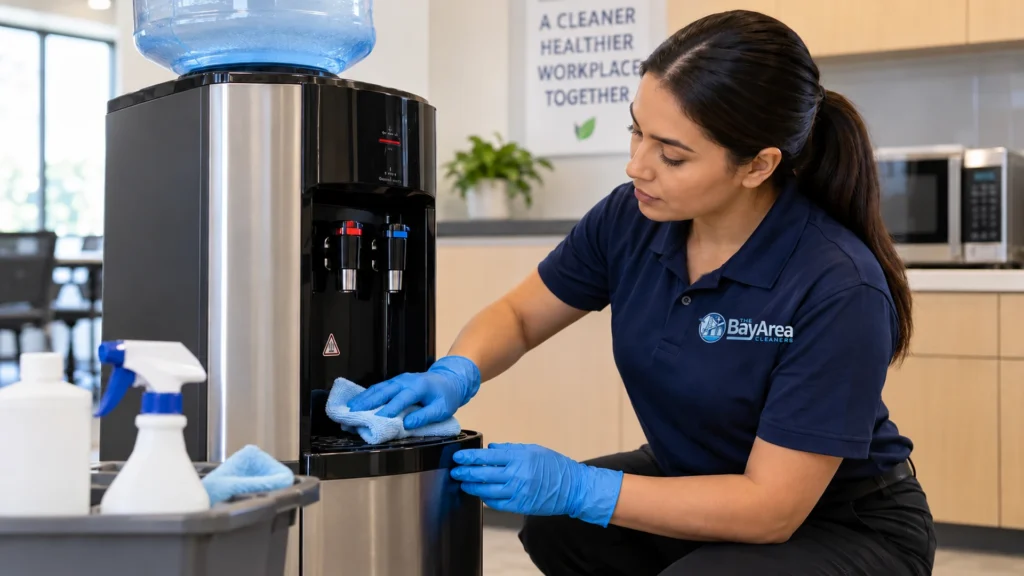
Bottom-loading coolers hide the bottle in a cabinet and pump water up through a probe. That brings in parts the top-loading routine never touches. A bottom-loader adds steps to how to clean a water dispenser, but none of them take long. Primo’s web guide notes that bottom-loading models may need a quick disconnect of the water line before cleaning.
You may also like: Breakroom Cleaning Checklist for Hayward Offices
The probe goes into every new bottle, so it gets touched more than anything else in the cabinet. Primo’s setup instructions say to clean it with a damp cloth and dish soap.
The manual with the three-month reservoir rule asks for the cabinet, controls, probe and spout to be cleaned at each bottle change. It calls for a soft cloth and a food grade sanitizer or bleach. Primo’s other bottom-loading manual asks for the same parts to be cleaned regularly.
Here’s how to clean a bottom loading water dispenser around a bottle change:
- Unplug the cooler and switch off the heater if it has one.
- Open the cabinet, lift the probe out of the empty bottle and set the bottle aside.
- Wipe the probe with a damp cloth and dish soap, rinse it, then use a food grade sanitizer if your manual calls for one.
- Clean the cabinet floor and walls, where drips collect.
- Wipe the new bottle’s neck, seat the probe and close the door fully.
- Plug the cooler back in and switch the heater back on if it has one.
The door matters. On Primo’s bottom-loaders, water won’t pump from the bottle unless the door is fully closed. A cooler that seems broken after cleaning may just have a door that didn’t latch. For a cooler with a hot tank, the deep-clean part of how to clean a bottom loading water dispenser starts with letting that water cool.
Takeaway: On bottom-loading coolers, clean the probe with dish soap at each bottle change, wipe the cabinet floor and close the door fully. Check the manual before you disconnect the water line.
Signs a Cooler Is Overdue
Primo lists heavy daily use, shared use and changes in taste or flow as reasons to clean sooner than every three months. In a shared office, the first two apply almost every day, so treat three months as the longest gap, not the target.
You may also like: Workplace Sanitation in San Jose Offices: How It Works
Watch for water that tastes flat, plastic-like or off, and for a slow trickle from the cold tap. A visible film or green tint in the reservoir counts too. Green tint points to light reaching the water, and MassDEP ties algae growth to bottles stored in sunlight.
If you notice any of these, don’t wait for the next scheduled clean. If the off taste comes back with a fresh bottle after a deep clean, call your water supplier.
These signs mean the schedule for how to clean a water dispenser has fallen behind how often people use it. Pull the cooler out of use, deep clean it and check where the bottles are being kept. Knowing how to clean a water cooler dispenser helps, but finding why it got dirty keeps it from happening again. Often the answer sits in storage or in a deep clean that slipped off the calendar.
Takeaway: Clean early if the water tastes off, the flow slows or the reservoir shows film or tint. Treat three months as the longest gap between deep cleans.
Bottles, Storage and the Floor Around the Cooler
Storage happens away from the cooler, but it’s part of how to clean a water dispenser all the same. Plenty of what goes wrong with a cooler starts before the bottle goes on. MassDEP asks that full bottles be stored at a constant temperature in a cool area, out of sunlight, and rotated so the oldest bottle is used first.
In an office, the bottle stack often ends up in a sunny corner of the breakroom or next to a window in the mailroom. Move it to a shaded storage room or a closet away from heat. A cool, dark shelf leaves less algae to fight when it’s time for how to clean a water cooler dispenser. Keep cleaning chemicals off the same shelf and keep the stack off the floor where mop water and grit can reach the caps.
Watch the floor around the cooler, too. Bottle changes and overfilled cups leave water on the floor, and a wet spot by the breakroom door is a slip waiting to happen. Porter coverage for spills and slip hazards keeps that spot dry between nightly visits. Put the cooler on the list in the written scope for your recurring janitorial service, so the floor, the cabinet and the inside each have a named owner.
Takeaway: Store bottles cool, shaded and oldest-first, away from chemicals. Keep the floor around the cooler dry, and write the cooler into the cleaning scope.
A Simple Record for Each Cooler
MassDEP’s guide goes past cleaning steps. For schools, it recommends a sanitizing and maintenance program with a named bottled water coordinator, an ID number for each cooler and a maintenance log for each unit.
An office with two or three coolers doesn’t need that much paperwork, but the idea scales down well. Give each cooler an ID, as MassDEP suggests, and keep a one-line log of each deep clean with the manual. When someone asks how to clean a water dispenser on the third floor, that log shows the method and the date it was last done.
Name one coordinator for the coolers, the scaled-down version of MassDEP’s bottled water coordinator. In many offices that’s an office manager or whoever orders the water. That person keeps the manuals, books the deep cleans and checks that each method matches the model. If a cooler has a filter, they track when it’s due, since a clogged filter can slow the flow.
Steps for how to clean a water cooler dispenser stay consistent when one person checks the work, even when different people change the bottles. An ID, a short log and one coordinator turn a chore that’s easy to forget into one with a date on it.
Takeaway: Give each cooler an ID and a short deep-clean log kept with its manual, and name one coordinator for all of them.
Frequently Asked Questions
What cloth should you use when you learn how to clean a water dispenser?
A clean, soft cloth. MassDEP asks for a clean, sterile cloth at bottle changes and rules out paper towels for the reservoir wipe, and Primo’s bottom-loading manuals call for a clean, soft cloth. Start each deep clean with a freshly washed one.
Which signs mean it’s time to look up how to clean a water cooler dispenser again?
Water that tastes off, a slower trickle from the cold tap, or a film or green tint in the reservoir. Any one of them is reason to pull the cooler and deep clean it now, not at the next scheduled date.
What extra parts are covered in how to clean a bottom loading water dispenser?
The bottle probe, the cabinet floor and the door. The probe gets washed at each bottle change, the cabinet floor collects drips, and water won’t pump until the door is fully closed. Primo notes that some bottom-loading models need the water line disconnected before cleaning.
How do you clean a water cooler with vinegar instead of bleach?
Primo’s guide mixes 2 cups of distilled white vinegar with hot tap water in an empty 5-gallon bottle and leaves it in the reservoirs for 10 minutes. Then it flushes the cooler with clean water. Check that your cooler’s manual allows vinegar, and never mix vinegar and bleach.
Conclusion
A shared water cooler stays sanitary through small habits and one scheduled job. Wipe the bottle neck and spigots at every change and empty the drip tray before it fills. Deep clean the reservoir every one to three months with the method your manual allows.
Getting how to clean a water dispenser right depends as much on storage and placement as on the cleaning. A schedule for how to clean a water dispenser holds only when someone owns it. Keep bottles cool and out of the sun, keep the cooler out of restrooms and keep shared mugs away from the taps. Then the cooler stays in line with California’s rule and the water tastes the way people expect.
The Bay Area Cleaners keeps office breakrooms clean between Vallejo and San Mateo, including appliance exteriors and the floor around the water cooler. Call 707-656-9339 to talk through your breakroom and get a free estimate.