Plenty of Bay Area offices have pulled up old carpet to show the concrete slab underneath, and many of those slabs were never sealed. A few weeks later the same complaints start. The night crew’s mops come back gray, dark shoes pick up a pale film, and the front desk blames the cleaning crew. Concrete floor cleaning starts with knowing what sits on top of the slab, since bare, sealed and densified concrete each wear out in their own way.
This guide covers indoor slabs in offices, lobbies, stores and schools. It shows you how to read the finish you have, what gray dust, pale rings and white crust are telling you, which pads and machine settings belong on each finish, and which jobs go to a specialist. Warehouse floors, epoxy coatings and concrete polishing are outside its scope.
The quick version: Before concrete floor cleaning starts, find out whether your slab is film-sealed, penetrating-sealed, densified or bare. Gray powder in the walking lanes of a bare slab is surface dusting, and a densifier hardens the weak top layer that sheds it. Acids, from muriatic acid down to soda and citrus juice, dissolve the cement paste and leave pale rings. White crust comes from moisture moving up through the slab, so remove it dry. In the Bay Area, concrete sealers are capped at 100 grams of VOC per liter.
Read the Finish Before Any Concrete Floor Cleaning Starts
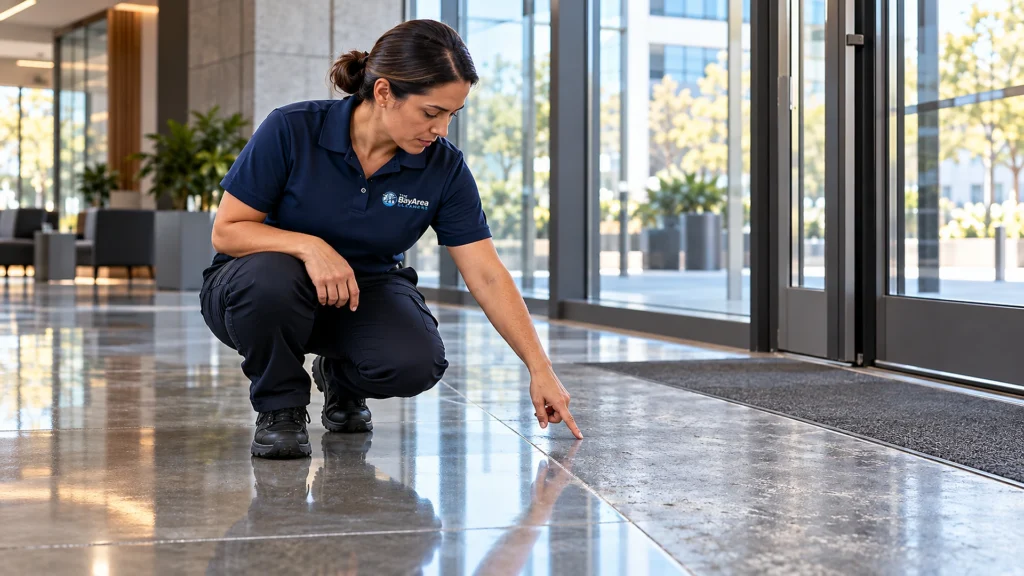
Indoor slabs in commercial buildings fall into four groups. A film sealer, usually acrylic or urethane, sits on top of the concrete as a thin coat. A penetrating sealer soaks in and leaves no coat, and a densifier reacts with the concrete to harden its top layer. A bare slab has nothing at all.
You may also like: Warehouse Cleaning: What a Professional Program Should Include
A film sealer is easy to spot by its gloss and its worn lanes. The other three can look alike, so use this table as a first read and have a concrete floor cleaning service confirm the finish before any new product goes down.
| Finish | What you see | What it means for the crew |
| Film sealer (acrylic or urethane) | Even gloss that dulls in walking lanes and peels at door thresholds | The coat takes the wear, not the concrete. Clean the coat and keep grit off it. |
| Penetrating sealer | Plain concrete look, with no gloss and no loose dust | Clean it like sound concrete. The sealer slows stains but does nothing against wear. |
| Densified slab | Plain concrete look, sometimes with a light sheen from traffic, and no peeling | The top layer is hard. Grit and acids are its main threats. |
| Bare slab | Flat gray look, with gray powder on mops and shoes if the surface is weak | Sound bare concrete takes a light scrub. A dusting slab loses a little surface with every pass. |
Mixed floors are common. A lobby may have film sealer near the entrance and bare concrete under the stairs, where the sealer crew never reached. Walk the whole floor once and mark each finish on a floor plan, so you and the crew work from the same map. Sealed concrete care is part of our floor care work.
Where carpet came up, dark or tacky patches are usually leftover adhesive. On a newer slab, a patchy sheen may be curing compound, a coating sprayed on fresh concrete to hold in moisture as it cures. Neither one is a sealer, and new sealer bonds poorly over both, so get them removed first. In older buildings, black adhesive can contain asbestos, so have it tested before anyone scrapes or grinds it.
Takeaway: Name the finish in every area of the floor before you choose pads, water flow or a resealing plan.
Gray Dust That Comes From the Slab Itself
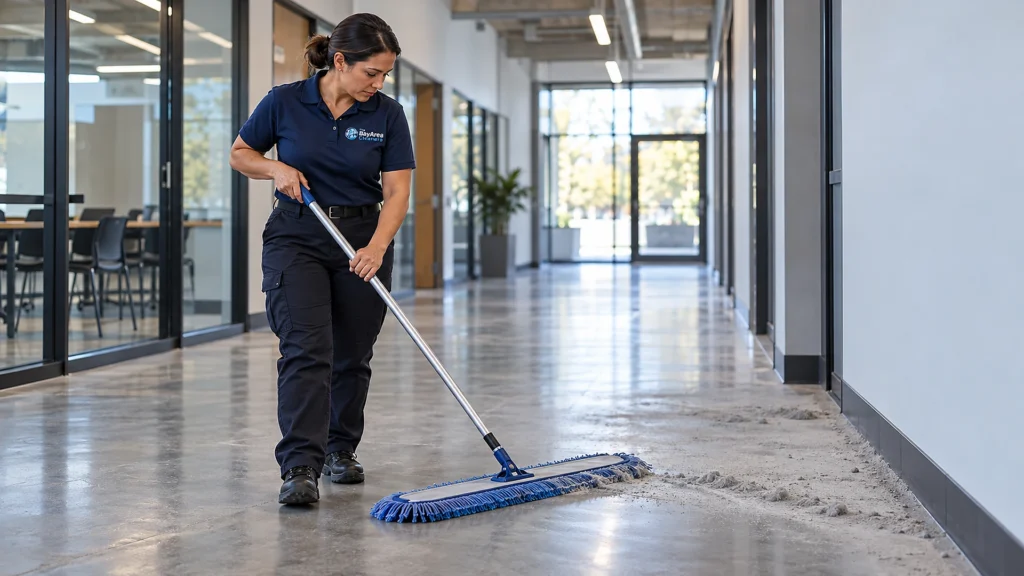
Bare slabs often shed their own top layer. If the concrete was finished with extra water on the surface, or dried out too fast in its first days, the top few millimeters end up weaker than the rest. Foot traffic grinds that weak layer into a fine gray powder, a defect known as surface dusting. The powder is heaviest in walking lanes, and it matches the gray of the floor.
You may also like: High Dusting: Why Your Clean Floors Do Not Stay Clean
Every sweep and every scrub lifts a little more of the weak layer, and wet mopping turns the powder into a gray slurry that dries as a haze. A crew can slow the wear with less water, a white pad and fewer passes. The powder only tapers off once the surface is hardened.
The usual fix is a densifier, a liquid silicate that reacts with the lime in concrete to form a harder surface. It’s specialist work, and the slab has to be clean and dry before the product goes down. Once the surface is hard, the shedding drops off, and indoor concrete floor cleaning moves to a nightly scrub with a blue pad.
Takeaway: Surface dusting is a defect in the slab, and a densifier that hardens the top layer is the fix.
Acids Dissolve the Surface You’re Trying to Clean
Concrete is held together by cement paste, and acid dissolves that paste. The National Park Service’s guidance on historic concrete warns that products with strong acids such as hydrochloric (muriatic) or hydrofluoric acid will damage concrete and should not be used. The same brief tells readers to pick the gentlest cleaning method that works.
Weaker acids etch concrete too, only more slowly. Cola, citrus juice, wine and coffee machine descalers all leave pale, dull rings on bare, densified or penetrating-sealed concrete. The ring is missing paste, with fine sand showing through, and its rough texture grabs soil faster than the floor around it.
Breakrooms and coffee stations collect the most rings. A descaler drip under a coffee maker or a bin full of half-empty soda cans can mark a slab in a single afternoon. A film sealer protects the concrete until the coat wears through, and then the acid reaches the concrete under it.
Three habits prevent most etching. Wipe acidic spills as soon as someone sees them, before they dry. Read the label on every product that goes near a sink, a coffee maker or a restroom, and keep anything acid-based or citrus-based off the cart used for concrete floor cleaning. If your building has a coffee service, ask the vendor to descale the machines over a tray or at a sink, never over the floor.
When an acid does land on the floor, blot it up first. Then flush the spot with plain water and pick the water up. For a small spill, that’s all it needs. The sooner the acid is diluted, the smaller the ring you’ll be looking at next week.
Takeaway: Keep every acid, strong or mild, off any concrete without an intact film sealer, and treat pale rings as lost surface, not as stains.
Indoor Concrete Floor Cleaning Around White Crust and Damp Spots
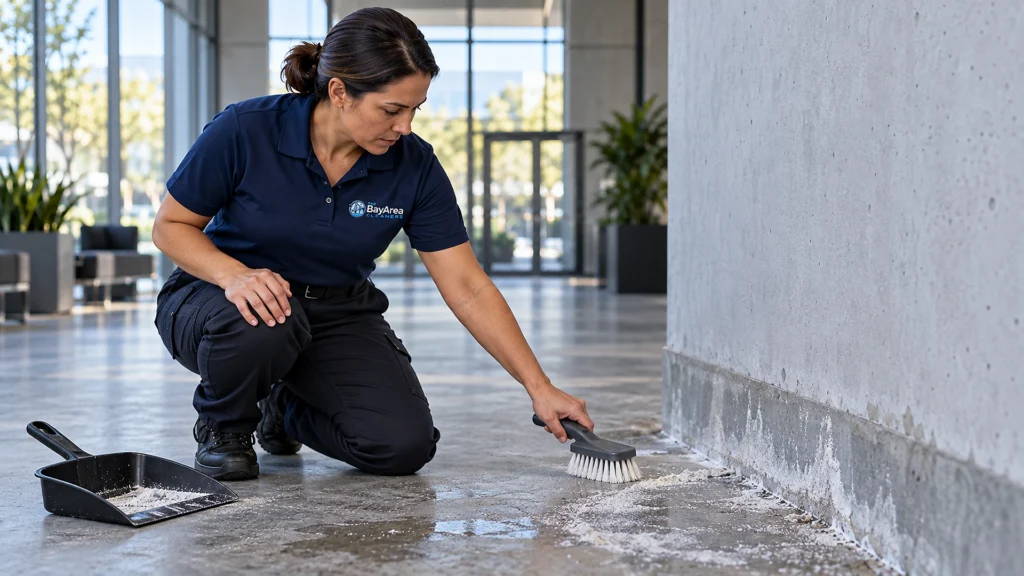
White, powdery crust along an outside wall or around a column is usually efflorescence. The same National Park Service brief describes efflorescence as soluble salts deposited on the concrete surface as water moves through it. Water climbs through slabs poured on the ground, and it seeps in from planters, leaks and damp soil. It leaves its salts behind when it dries at the surface.
Wet cleaning feeds the problem. Mop water dissolves the salts and soaks part of them back into the concrete, and the next dry spell brings them up again. For indoor concrete floor cleaning around efflorescence, brush the crust off dry with a stiff nylon brush and pick up the powder. Follow with one damp wipe of clean water at most.
Write down where the crust shows up and pass the locations to your facilities team. When crust forms near an indoor planter, check how often it’s watered and whether the pot drains onto the slab. A slab that pushes moisture up will lift or cloud a film sealer, so no one should reseal that area until the slab has been tested. The flooring trade measures slab moisture with relative humidity probes set into the concrete, a method laid out in the ASTM F2170 standard.
Moisture can turn a film sealer milky white in patches too. The trade calls it blushing, and it won’t wipe off, since the cloud sits inside the coat. Fixing it is specialist work, and it waits until the moisture source is under control.
Takeaway: Remove white crust dry, log where it appears, and get the slab tested before anyone reseals a damp area.
Heel Marks, Chair Casters and Worn Lanes
Sealed concrete in offices and stores takes its wear in the same places year after year. Rubber heels and cart wheels leave black marks, rolling chairs grind circles under desks, and entrances lose their gloss first. These three problems take up a good share of commercial concrete floor cleaning in lobbies and stores.
Heel and cart marks are rubber sitting on top of the coat. On a film sealer, a white pad rubbed dry over the mark usually lifts it without cutting the coat. Spraying a general cleaner and scrubbing hard tends to smear the rubber and scratch the film around it.
Rolling chairs are harder on a film sealer than they look. Hard plastic casters pick up grit and grind it into the coat, and within months each desk sits on a dull circle. Chair mats, or soft urethane casters sold for hard floors, stop most of the grinding. Crews cleaning offices with sealed concrete floors should report new circles early, before the concrete shows through.
Walking lanes at entrances, elevator banks and checkout counters lose their gloss long before the rest of the floor. Once the film wears through, the concrete under it takes grit and spills like a bare slab. That’s the point to plan a reseal of the lanes. In schools, the same wear shows up at classroom doors and cafeteria lines, where chairs and carts move all day.
Takeaway: Lift rubber marks dry, keep chair casters from grinding grit, and plan a reseal once a lane’s gloss is gone.
Pads, Water and Speed for Commercial Concrete Floor Cleaning
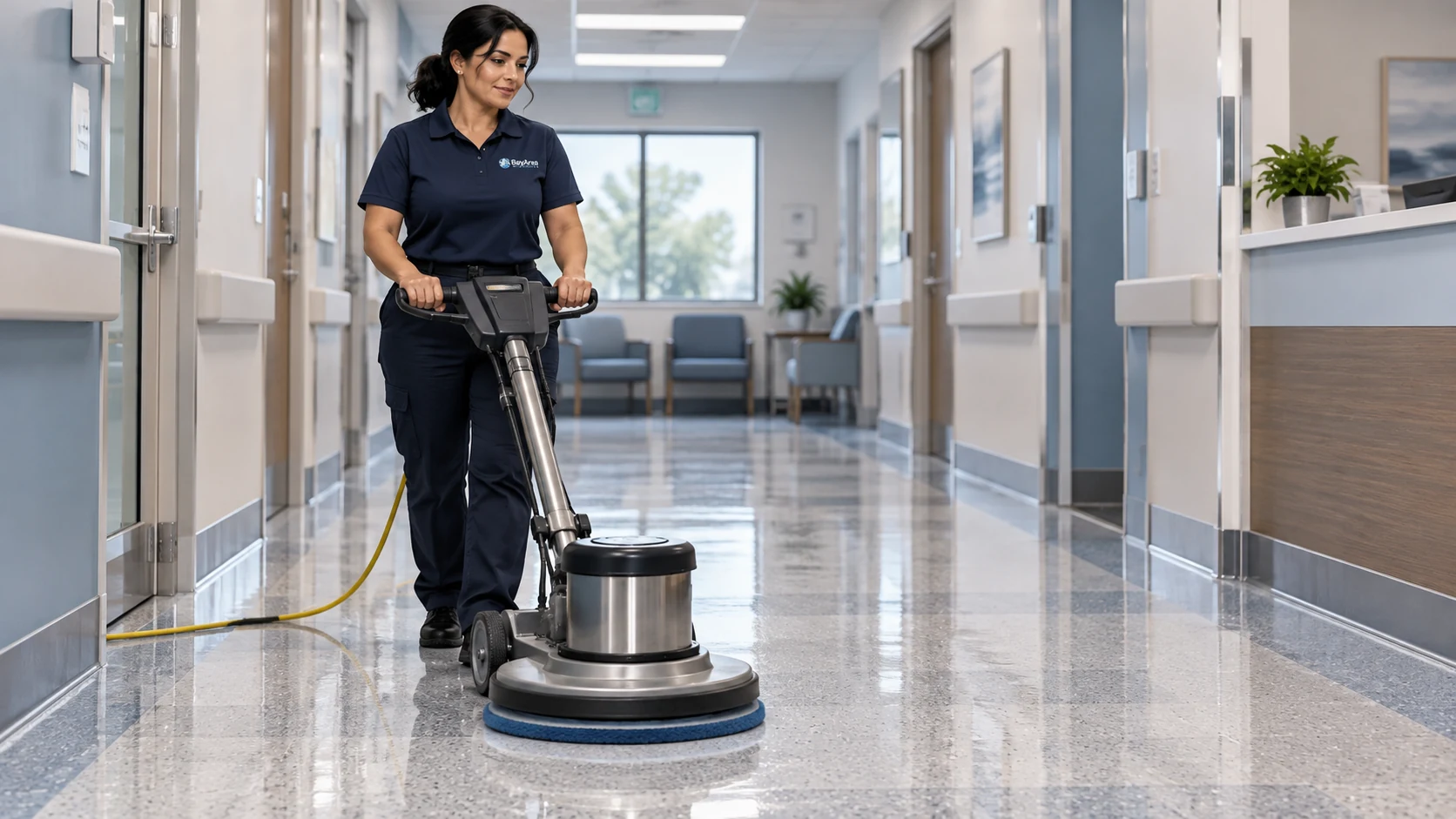
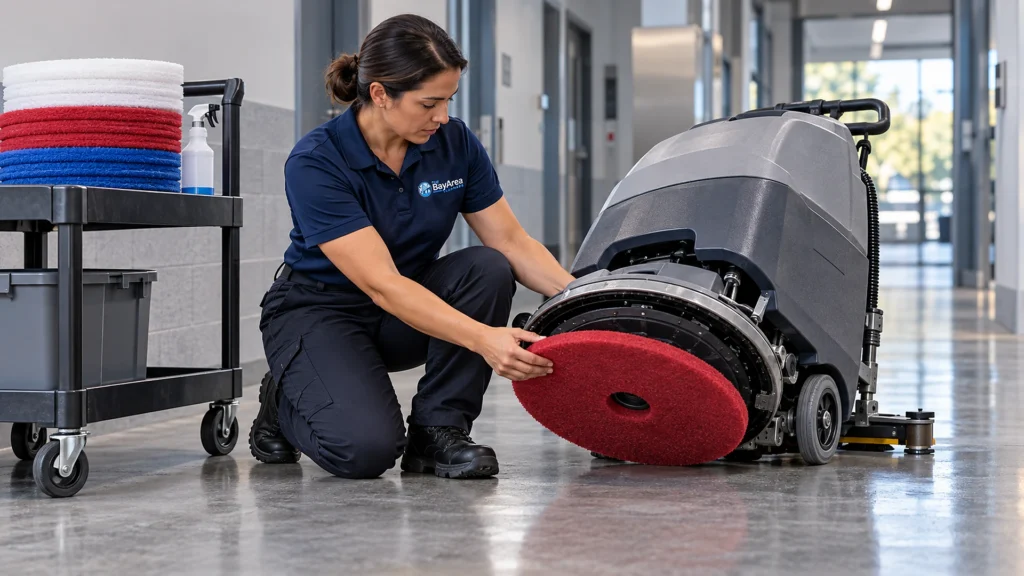
Nightly commercial concrete floor cleaning comes down to three settings: which pad goes on the machine, how much water goes down, and how fast the machine travels. Get those right for each finish and the floor wears slowly. On a nightly janitorial route, those settings should sit on a card kept with the machine, one line per area.
| Pad color | Use on concrete | Keep it off |
| White | Rubber and heel marks by hand or at slow speed, and light scrubbing on dusting slabs | Grease and heavy soil, since it’s too soft to cut them |
| Red | Nightly scrub on film sealers and on sound bare or penetrating-sealed slabs | Dusting slabs and heavy buildup |
| Blue | Nightly scrub on densified floors | Film sealers, which it dulls, and bare or penetrating-sealed slabs |
| Green | Occasional deep scrub on densified floors | Film sealers, bare slabs and penetrating-sealed slabs |
Pad colors vary a little by brand, so check the maker’s chart before you switch suppliers. The table follows the common color scale.
Water flow matters most on bare and film-sealed floors. On a bare or dusting slab, low flow keeps the powder from turning into slurry, and the squeegee should pick up everything the brush puts down. On a film sealer, water left standing in cracks or along the edges works under the coat and starts it lifting.
Run the scrubber at the travel speed its manual gives for scrubbing, and overlap each pass by a few inches. A squeegee that leaves wet stripes has a nicked or worn blade. Flip the blade to a fresh edge or replace it, since those stripes dry into lines that look like dirt the next morning.
Pads wear too. A pad packed with grit cuts like a coarser pad, so flip or swap it once its face turns dark and matted. Rinse used pads at the end of the shift and hang them to dry, so the next night starts with a clean pad.
Takeaway: Write the pad, the water flow and the speed for each area on a card that stays with the machine.
Resealing, Densifying and the Bay Area VOC Limit
In the Bay Area, concrete sealers fall under the same VOC rule as paint. A concrete floor cleaning service that reseals worn lanes or renews a penetrating sealer has to use products within its limits.
You may also like: How to Strip and Wax Floors: Process, Cost and When to Skip It
The Bay Area Air Quality Management District’s rule on architectural coatings caps VOC content at 100 grams per liter for concrete and masonry sealers and for floor coatings. Its definition of a concrete sealer includes coatings made to harden the surface, not just the ones that keep water out.
The rule requires each container to show its VOC content in grams per liter. Before work starts, ask your concrete floor cleaning service for the product name and the VOC figure on its label.
For entrances and ramps, ask whether the sealer can take an anti-slip additive, since a fresh film sealer can turn slick when wet. You should get the expected life of the coat in writing too, so you know when the lanes will be due again.
Keep a floor file for your building. It should hold a plan with the finish in each area, the product and VOC figure for each reseal, the date it went down, and any moisture test results. With that file, the next crew or service starts from facts, and you can see how long each reseal lasted.
Sealers and densifiers take the floor out of use for a set time. Book the work for a weekend or a day the space is closed, so no one walks on the floor before the product is ready.
Takeaway: Get the product name and its VOC figure in writing before anyone seals or densifies your floor, and keep both in the floor file.
Frequently Asked Questions
Does concrete floor cleaning remove etch marks?
No. An etch mark is concrete that an acid dissolved, so there’s nothing on the surface to wash off. Concrete floor cleaning can lift the soil that collects in the rough spot, and the ring looks better for a few days. Evening it out is repair work for a specialist.
Can you densify a concrete slab that already has a sealer?
Usually not. A densifier has to soak into open concrete, so a film sealer has to come off first. Many penetrating sealers block it too, so a concrete floor cleaning service should test a small spot before treating the whole floor.
How soon can indoor concrete floor cleaning resume after a reseal?
Go by the product’s label or data sheet, which usually lists one time for foot traffic and a longer one for full cure. Dry dust removal can start once foot traffic is allowed. Hold off on wet mopping and machine scrubbing until the full cure time has passed, since water and pads can mark a sealer that’s still curing. Keep those times in your floor file.
Which pads work for commercial concrete floor cleaning on each finish?
Use a white pad for rubber marks on any finish, and a red pad for nightly scrubs on film sealers and on sound bare or penetrating-sealed slabs. Save blue pads for nightly scrubs and green pads for occasional deep scrubs on densified floors only. On a dusting slab, stick to a white pad until the surface is densified.
Conclusion
Concrete floor cleaning goes well when the crew knows the finish in each area and reads dust, rings and crust as signs, not dirt. Gray powder calls for hardening, pale rings for keeping acids away, and white crust for a moisture check. Pads, water flow and scrubber speed set for each finish keep the wear slow, and every sealer or densifier should arrive with its VOC figure in writing. If you’re not sure which finish your slab has, start there.
The Bay Area Cleaners cares for sealed concrete and other hard floors in offices and commercial buildings from Vallejo to San Mateo. Call 707-656-9339 to book a walkthrough of your floor and get a written, itemized estimate.