Ask three contractors to bid the same exterior and the numbers rarely land close: the top quote often doubles the bottom one for what looks, on paper, like identical work. The property didn’t change between phone calls. What changed is what each bidder decided to include — which surfaces, what chemistry, how much access equipment, and who takes responsibility for where the wash water ends up.
Understanding commercial pressure washing cost starts with accepting that there is no useful universal rate. There are variables, and every quote is a bundle of assumptions about them. The skill is making those assumptions visible before you sign, not after the crew has driven away.
The quick version: exterior cleaning is priced by area, by hour, or by defined scope. Seven variables move commercial pressure washing cost more than anything else, and one of them — wash water containment — is a legal obligation in the Bay Area rather than an optional extra. It is also the first thing a suspiciously low bid tends to drop.
How Commercial Pressure Washing Is Priced
Most commercial pressure washing services quote one of three ways, and each format hides different information.
| Pricing model | Where it fits — and what to watch |
| Per square foot | Standard for large, continuous areas: sidewalks, parking decks, building faces. Easy to compare across bids — and easy to game by leaving pre-treatment, degreasing or water recovery out of the rate. |
| Hourly | Used for mixed or unpredictable scopes: gum removal, dumpster pads, drive-through lanes, graffiti response. Fair when the work is genuinely variable; vague when the hours aren’t capped. |
| Flat rate per visit | Typical for recurring exterior programs where areas, frequency and inclusions are written into a contract. The most predictable format for budgeting. |
No format is inherently cheaper. A per-foot rate tells you nothing about what rides along with those feet, and an hourly rate tells you nothing about how many hours a crew intends to take. In every case the real information sits in the scope description, which is why a commercial pressure washing cost comparison starts with scope, not with rate cards.
Whatever the format, a serious proposal itemizes: the surfaces included, the treatment each one gets, the wash water plan, the schedule window, and what a return visit runs if a landlord or an inspector flags a miss. When those lines are absent, you are reading a number — not a commercial pressure washing cost you can compare.
Takeaway: the pricing format is packaging. Compare what each bid commits to do, not how it formats the number.
The Seven Cost Drivers, One by One
When a commercial pressure washing cost quote lands far above or below the pack, one of these seven is almost always the reason.
| Factor | Why it moves the number |
| Surface material | Smooth concrete gives up soil quickly. Brick, exposed aggregate, pavers and textured stucco trap it in pores and joints, demanding lower pressure and more passes. |
| Total area and layout | Large open slabs price efficiently. Scattered small zones — an entry here, a patio there, three dumpster pads across a campus — repeat setup time at every stop. |
| Height and access | Ground-level flatwork needs a machine and a hose. Anything above the first story needs lifts, extension equipment and operators trained for them. |
| Soiling type | Dust and pollen rinse off. Loading-dock grease, entrance gum, rust and algae need chemistry, heat and dwell time, and each adds hours. |
| Water source | If the property can supply water, the crew hooks up. If it can’t, tanks ride on the truck and the logistics show up in the price. |
| Wash water recovery | Containing and legally disposing of the runoff takes berms, drain covers, vacuums and time. It is also the law in the Bay Area — the section below covers why. |
| Frequency | A property on a quarterly cycle never lets soil compound. A once-a-year rescue pays for twelve months of buildup in a single visit. |
One boundary worth drawing early: exterior glass above the ground floor is its own trade, with its own access equipment and streak-free standards, and usually belongs with the window and glass cleaning program rather than the wash crew.
To see the seven at work, picture two properties with the same 20,000 square feet of flatwork. One is a single open garage level with a working hose bib at each corner. The other is a retail plaza where the footage scatters across entries, patios and three dumpster corrals, half of it gum-speckled, with no usable spigot on the far side. Same area, very different totals — and neither bidder is wrong. The drivers, not the square footage, wrote those numbers.
You may also like: Commercial Window Cleaning for Hallways & Common Areas in Multi-Tenant Buildings
Takeaway: ask every bidder which of the seven they actually measured. The lowest number usually belongs to the bidder who measured the least of your property.
Estimate the Job Yourself Before Anyone Quotes It
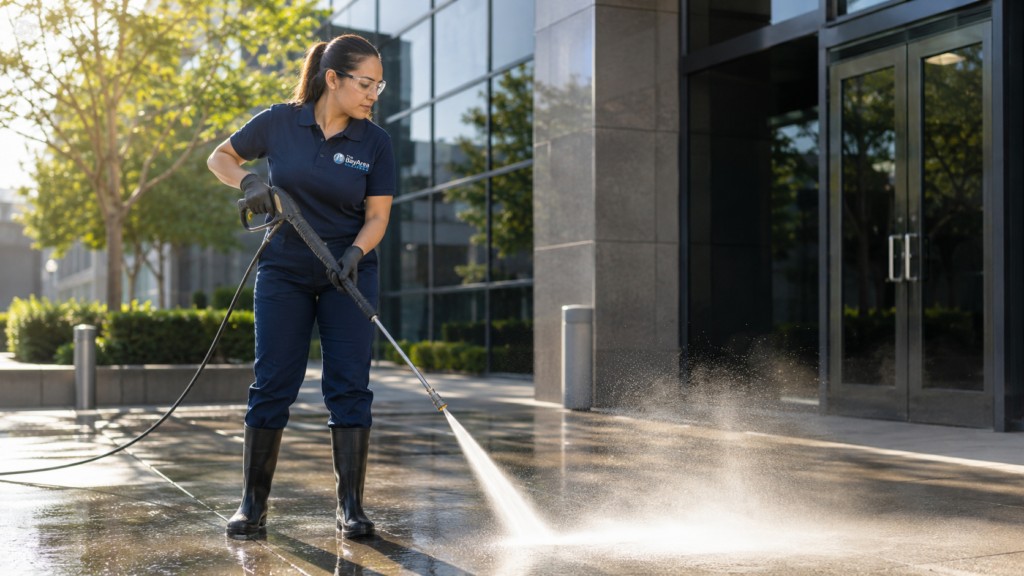
You don’t need a commercial pressure washing calculator so much as a one-page inventory that every bidder is forced to price against. Walk the property once — a tape measure and a satellite map view will do — and record:
- Flat areas in square feet: sidewalks, entries, plazas, patios, dumpster pads, each garage level.
- Vertical surfaces by story: building faces, columns, awning surrounds — flag everything above the first floor.
- Problem zones: gum concentrations, grease at docks and pads, rust staining, moss or algae on shaded faces.
- Water access: where the spigots are, whether they work, and whose meter they run on.
- Operating constraints: hours each area must stay open, tenants who need notice, vehicles that need moving.
Send the same sheet to every contractor and require line-item pricing against it. Identical inputs are what make a commercial pressure washing cost estimate comparable: that single document turns three incompatible proposals into one usable commercial pressure washing price list — and it exposes the bid that never intended to touch the dumpster pads at all.
Takeaway: whoever writes the scope controls the comparison. Write it yourself.
Wash Water: The Line Item That Keeps the Job Legal
Here is the divide between a professional operation and a rented machine. Across most of the Bay Area, storm drains are direct pipes to local waterways: the City of Dublin’s surface cleaning procedures for contractors state that wash water travels from parking lots, streets and gutters to creeks and to San Francisco Bay without treatment, that allowing polluting substances into the storm drain system is prohibited, and that only rain should go down a storm drain.
San Francisco applies the same principle. The SFPUC’s water use rules prohibit discharging water that contains pollutants — or any water from sources other than rain — into storm drains and catch basins, and allow pressure washing only for defined purposes: health and safety needs, cleaning building sides and windows, and meeting the city’s sidewalk cleanliness standards, always without creating runoff toward the drains. Above all of it sits the federal Clean Water Act, under which discharging pollutants to U.S. waters requires a permit that no mobile washing crew realistically carries.
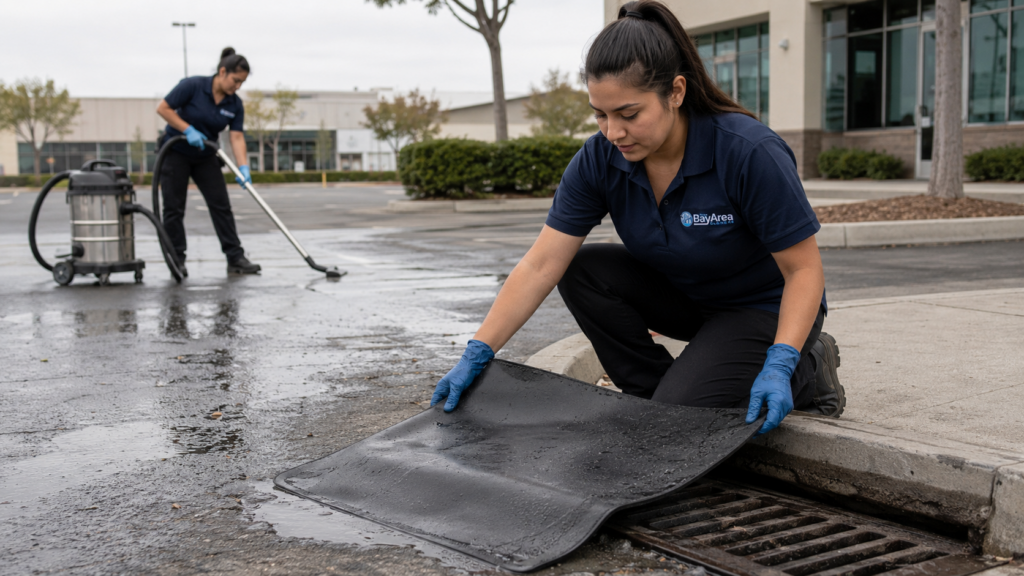
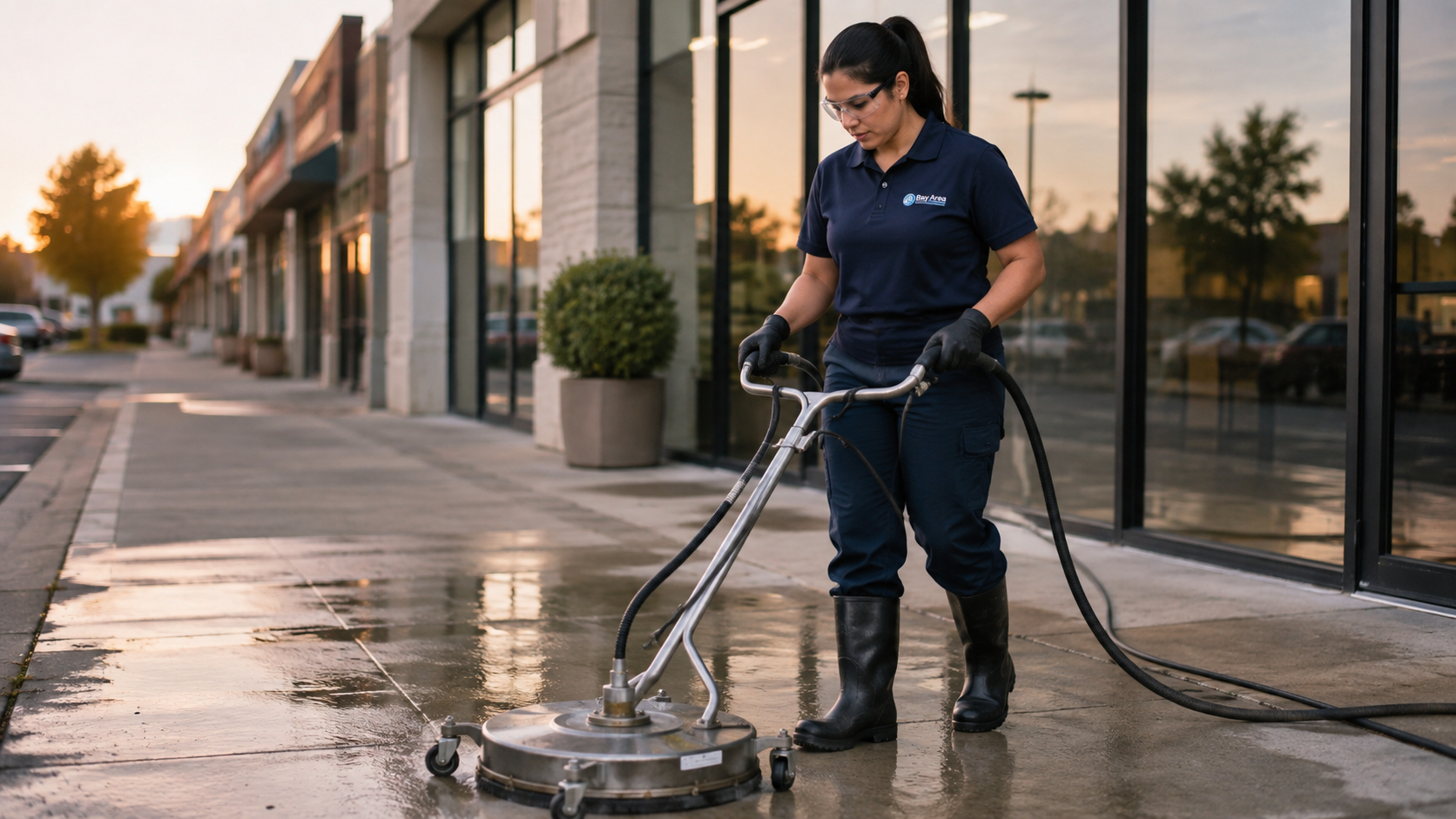
In practice, compliant crews mat or block nearby drains, capture the runoff with berms and wet vacuums, and dispose of it to landscaping or to the sanitary sewer where the local district allows it. That equipment and that time are visible in a serious quote. A bid low enough to raise an eyebrow has often solved its math by letting the water find the curb — and enforcement for an illicit discharge can reach the property owner, not only the contractor who drove away.
On service day, the checks take thirty seconds: drain mats or berms visibly deployed before the first trigger pull, a recovery vacuum on the pavement rather than on the equipment list, and a disposal point the crew lead can name without radioing anyone. A quick look tells you whether the plan you paid for actually arrived with the truck.
Takeaway: require every bidder to state, in writing, how wash water will be contained and where it will be disposed. If the answer is vague, the price is fiction.
How Property Type and Season Change the Math
Two exteriors with the same square footage rarely carry the same commercial pressure washing costs once traffic and the calendar have their say. By facility type:
Offices and multi-tenant buildings
Entries, walkways and garage levels respond well to a quarterly or semiannual cycle, sequenced with the interior program so exterior work never blocks a lobby mid-morning. Garage levels in particular reward a fixed rotation — one level per visit — so no tenant ever loses the whole structure at once.
Retail and restaurants
Gum and grease compound fastest exactly where customers walk, so entrances and patios usually justify the shortest cycles on the property, worked overnight. Food-service pads and grease corrals sit at the aggressive end of both the chemistry and the frequency.
Schools and churches
Real closures — summer, winter, the gap between services — make these the easiest exteriors to schedule and the cheapest windows to book. Courtyards and drop-off zones cleaned during a break return to service without a single cone in front of a parent or a parishioner.
New construction
Dust, mud and concrete residue are their own category of exterior cleanup, and pairing the exterior pass with the interior handover saves a mobilization. Sequencing matters here: exterior flatwork goes last, after the trades stop tracking the site.
Season cuts across all of them. Bay Area winter rain feeds moss and algae on shaded, north-facing concrete, so a spring pass ahead of the dry season tends to keep the rest of the year light.
You may also like: Post Construction Cleaning: A 3-Phase Checklist for Contractors and Property Managers
Takeaway: frequency is the lever you control. A written exterior cycle costs less per year than emergency cleanings booked after the property already looks neglected.
Comparing the Bids
Once the proposals arrive, judge commercial pressure washing cost the way you would any contracted service: against a fixed scope, on five checks.
- Identical scope: every proposal priced against your inventory sheet, line by line. A bid that skips a line is answering a different question.
- Wash water method in writing: containment, recovery and the disposal point, named.
- Insurance and training: high-pressure equipment injures untrained operators; proof of coverage and safety practice is part of what the rate buys.
- Before and after documentation: ask for photos from comparable properties, and require them for your own job at completion.
- Local references: a contractor who maintains properties like yours nearby can show you those exteriors today, not in a portfolio.
Takeaway: you are not hunting the lowest total. You are hunting the proposal whose scope matches your property, with the water handled lawfully.
Frequently Asked Questions
How much does commercial pressure washing cost?
It depends on the seven variables above — surface, area, height, soiling, water source, recovery and frequency — and they move independently. A figure offered before anyone has walked the site is a placeholder, not a price.
What should a price per square foot include?
Whatever the scope sheet says — and nothing it doesn’t. Confirm whether pre-treatment, degreasing, gum removal and wash water recovery ride inside the rate or bill separately. Two identical rates can describe two very different jobs, which is why per-foot commercial pressure washing cost figures travel so poorly between properties.
How often should a commercial property be pressure washed?
Most Bay Area exteriors settle between quarterly and annual depending on foot traffic, food service and shade. High-traffic entries earn the short end of that range; back-of-house concrete the long end. Frequency is also the quietest lever on commercial pressure washing cost: a standing cycle keeps every visit light, while the first visit after years of neglect is priced like the restoration it is.
Is soft washing the same thing?
No. Soft washing pairs low pressure with cleaning solutions for surfaces that high pressure would damage — painted stucco, certain siding, awning fabric. A complete exterior program usually mixes both, and the proposal should say which method goes where.
Can the work happen during business hours?
Flat work at entrances usually can’t without closing the walkway, which is why most programs run overnight or in the early morning. Those windows carry a labor premium; they also protect your customers, which is the point.
Who is responsible if wash water reaches a storm drain?
Enforcement can land on the property as well as the contractor, which is why the containment method belongs in the written scope. A contractor who documents disposal is protecting your organization, not just their own license.
Get a Number Built From Your Actual Property
If the walkways are darkening, gum is spreading at the entrance, or a bid on your desk looks improbably cheap, send us your inventory sheet — or have us build it with you on site. What comes back is a line-item quote with the wash water plan named, because around the Bay that part isn’t optional. The Bay Area Cleaners provides commercial pressure washing as a standalone project or inside a recurring exterior program, alongside one-time cleaning for handovers and special situations, for offices, retail, schools, churches and multi-tenant properties across the San Francisco Bay Area.
Call 707-656-9339 or request a free estimate — we price from the scope sheet, so you can put our commercial pressure washing cost next to any other bid, line by line.