A single letter on a seat fabric’s spec decides what liquid that seat can take. Commercial seating maker MityLite uses four codes: W for water-based cleaners or foam, S for water-free dry cleaning solvents, WS for either one, and X for vacuuming or light brushing with no liquid at all. That letter is the first thing to find when you decide how to clean office chair fabric on a shared floor.
This guide on how to clean office chair parts follows one task chair from the seat down to the casters. It then covers recall checks and who on your side handles each part.
The quick version: Find the fabric’s cleaning code before any liquid touches a seat. MityLite’s W takes water-based cleaners, S takes only water-free solvents, WS takes either, and X takes no liquid at all. Blot spills right away with an absorbent cloth, skip hot water and never soak the foam. Vacuum mesh with an upholstery tool and don’t brush it. Wipe the plastic and metal frame with mild detergent and warm water, then dry it. Pull hair off the casters so the chair rolls freely on its five-leg base, and read the label under the seat to check for recalls.
How to Clean Office Chair Fabric by Its Cleaning Code
The code tells you which family of liquid the fabric can take. MityLite tells owners to make certain a treatment won’t damage the fabric or its color, and a cleaner from the wrong family can do that damage. Its care page spells out all four codes.
You may also like: Tips for Keeping Your Commercial Office Space Clean and Tidy
Here’s what each code allows, with the steps we’d keep off the seat.
| Code | What MityLite allows | Keep off the seat |
| W | Water-based cleaning agents or foam | Dry cleaning solvents |
| S | Mild, pure, water-free dry cleaning solvents | Water and water-based cleaners |
| WS | Either method | Mid-stain switches between methods |
| X | Vacuuming or light brushing only | Liquid agents of any type |
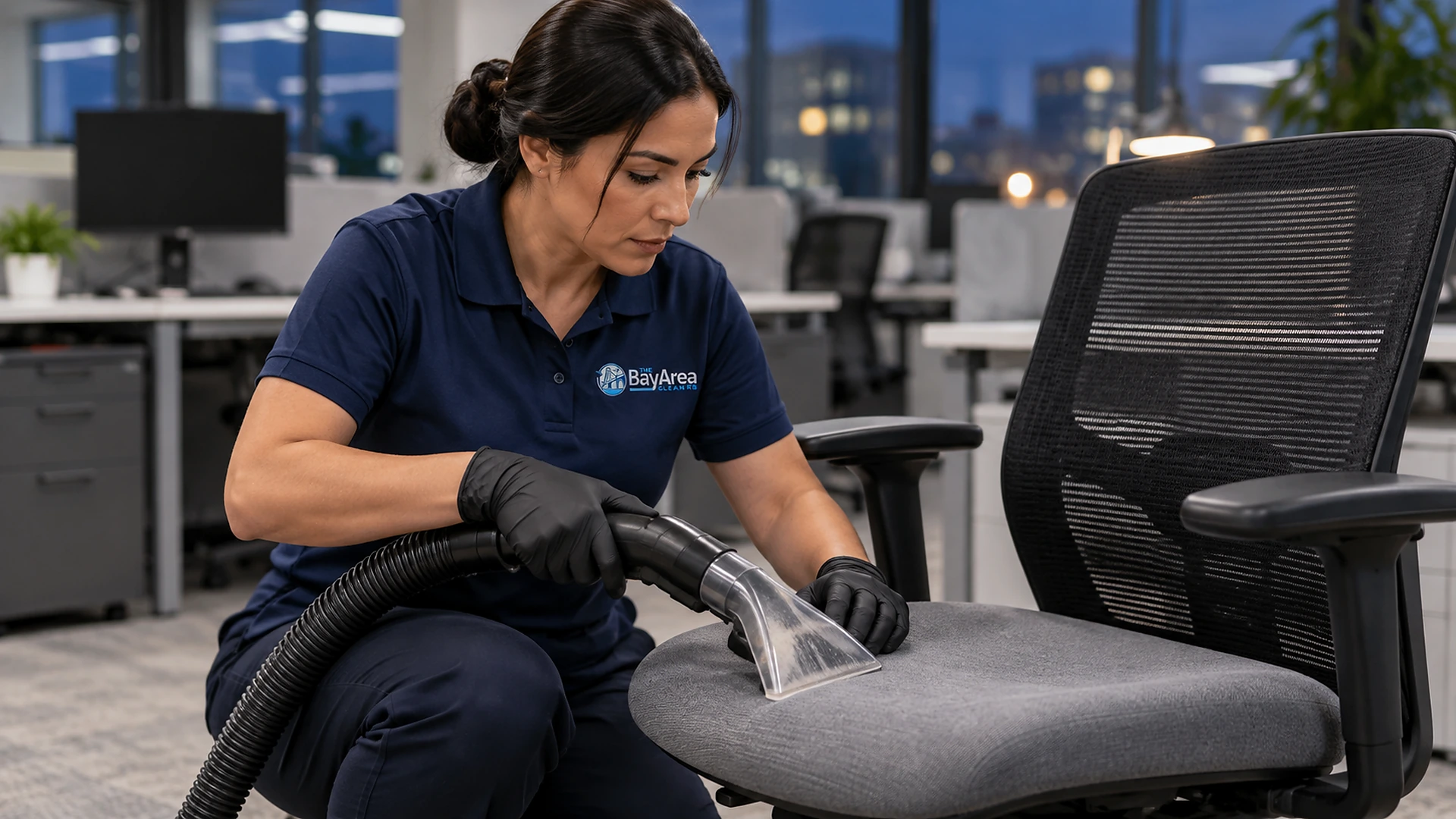
Most dust comes off with a vacuum and an upholstery tool, whatever the code. That dry pass is the safe first step on every seat, and on an X seat it’s the only step.
WS seats give your team the most room, but the choice still matters. Pick water-based or solvent for each stain and stay with it until the stain is gone. Switching methods halfway leaves two different cleaners in the same fabric at once. On a floor full of mixed chairs, one method per stain is the simplest rule for how to clean office chair fabric.
Where the code hides
MityLite says its code isn’t on the furniture itself. You find it by looking up the fabric in the maker’s fabric library. Other makers may print it on a spec sheet or keep it with the dealer. You need the maker and the fabric name, and the label under the seat is the place to start.
Until you know the code, treat the seat as an X and stick to the vacuum. A chair that waits a week for its code costs less than one with a water ring across the seat.
Test first, and keep bleach and ammonia apart
MityLite says to always test a treatment on a hidden area first, and Steelcase gives the same advice before a broader cleaning program. The underside of the seat edge works. Wait until the spot dries, then check it for a ring or a color change before you clean the rest.
MityLite’s mix for its own W fabrics is 2 tablespoons of ammonia or ammoniated detergent in 1 quart of water. Steelcase warns never to mix cleaners, especially bleach and ammonia, since the mixture gives off toxic fumes. If your team keeps both products, never follow one with the other on the same seat.
Takeaway: Find the fabric code from the maker’s fabric library, spec sheet or dealer before any liquid goes on. Until then, vacuum only, and test every cleaner on a hidden spot.
Spills, Stains and How to Clean Office Chair Cushion Foam
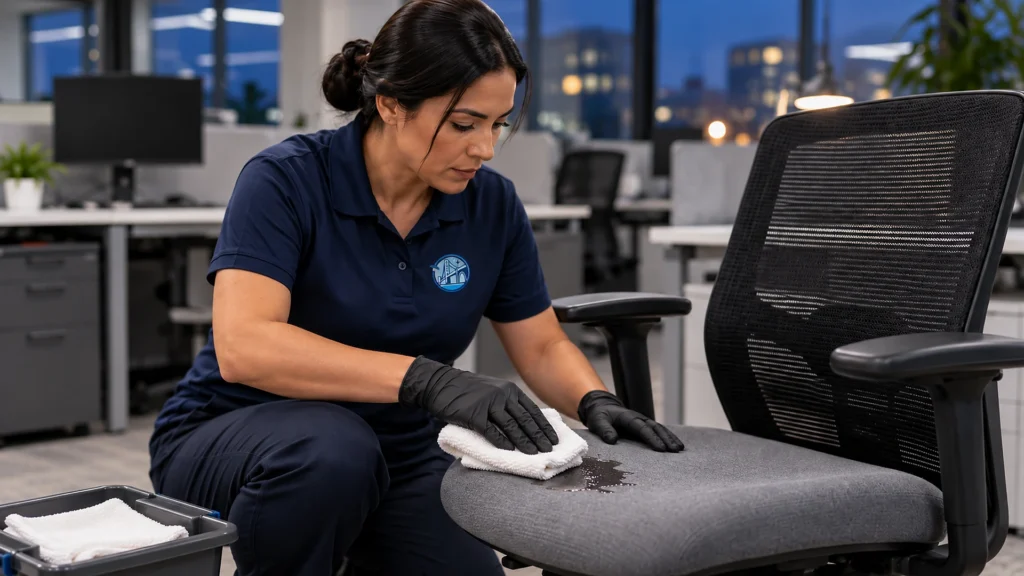
Herman Miller’s care guide for the Aeron ESD chair sets the order for spills on its suspension fabric. Soak up the stain right away with a soft, absorbent cloth, and don’t let it dry completely or it may set. For coffee, soda, juice or milk, use a water-based fabric cleaner or mild warm soapy water on a damp cloth. Never use hot water, which sets the stain, and avoid scrubbing.
MityLite gives the same order of steps. Blot the spill without rubbing it deeper, and lift solid or semi-solid spills like ketchup with a dull knife before you blot. Herman Miller adds that the longer a stain stays on a fabric, the harder it is to remove.
Keep the liquid in the fabric, not the foam
The cushion under the fabric is where trouble hides. The Aeron has no foam cushion, but Herman Miller’s rules for its suspension fabric carry over to upholstered seats. It warns that heavy wetting with any liquid may damage the material for good, and it says several light applications beat one heavy one. Steelcase’s guidance on spraying fabric says the spray should coat the surface without soaking through to what’s under it.
Foam that soaks up liquid stays damp long after the fabric feels dry, so the same light touch carries over to how to clean office chair cushion stains on any upholstered seat. For oil-based stains, Herman Miller directs owners to start at the outside of the stain and work toward the center, careful not to over-saturate the fabric. After any stain, soak up what’s left with a clean cloth, then wipe with a cloth dipped in cool water to lift the residue.
Let the fabric dry fully and vacuum it before anyone sits down. For large soiled areas, Herman Miller sends owners to a professional cleaning firm.
A small spill kit by the breakroom
Speed decides most seat stains, so keep the tools near the spills. A small bin by the breakroom with a stack of white absorbent cloths, a dull plastic scraper and a small fan covers most cases. White cloths show you when the stain stops transferring, and they don’t bleed dye into a light seat. Restock the cloths after each use, and keep any cleaner in the bin matched to the seat codes on that floor.
With the kit in one place, how to clean office chair cushion spills stops being a guess for whoever reaches the chair first.
Takeaway: Blot spills fast, skip hot water and never scrub. Use light applications from the outside in, and keep the liquid out of the foam under the fabric.
Mesh Backs Need Dry Work First
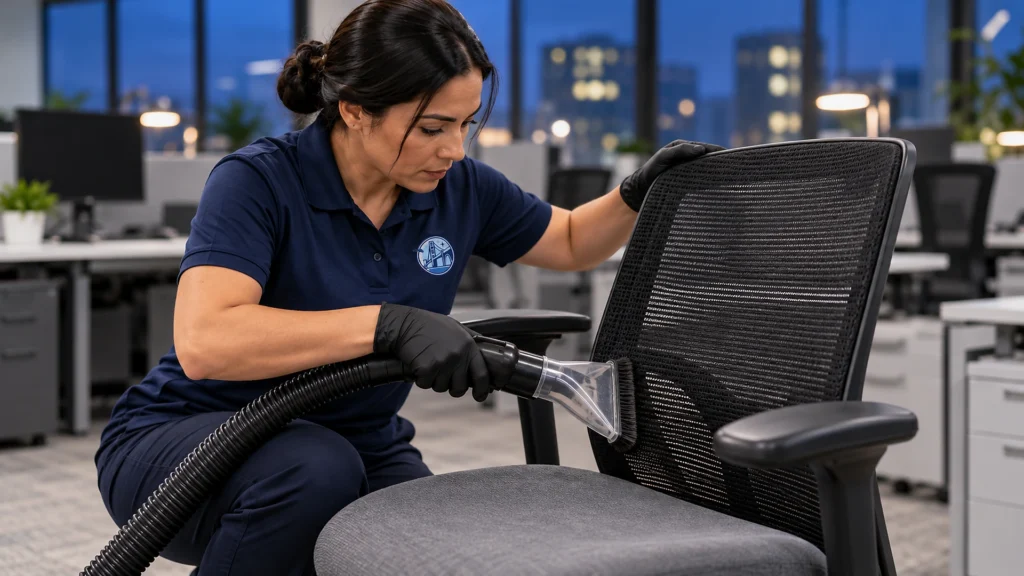
Dust on a mesh back sits deep in the open knit. Orangebox, a Steelcase brand, tells owners of its Workday mesh chairs to vacuum the mesh regularly and wipe it now and then with a damp cloth.
The tool matters. Herman Miller’s Aeron ESD guide says to vacuum the suspension fabric with an upholstery attachment. It says not to brush the fabric or use a rotary-brush attachment, since brushing may damage the nap for good. A crevice tool works along the frame, where the mesh meets the plastic.
Orangebox points out that dust collects in hard-to-reach spots, mostly between the seat and the back of task chairs. Recline the back to open that gap, then run the crevice tool through it. On mesh, the vacuum does nearly all the work, and that’s the biggest difference in how to clean office chair backs made of mesh instead of fabric. Spills on mesh follow the same rules as fabric, so blot fast and keep the liquid light.
Takeaway: Vacuum mesh with an upholstery tool and don’t brush it. Recline the back and clean the dust out of the gap between seat and back.
Plastic, Metal and Armrests
The frame is the most forgiving part of the chair and takes more liquid than the fabric does. Herman Miller’s guide for the Aeron ESD chair says to wash the base and frame with a soft cloth soaked in mild detergent and warm water, rinse well and dry with a soft cloth. It rules out solvents and abrasive kitchen cleaners.
Orangebox gives similar rules for its seating. Plastic shells and nylon parts get a damp cloth. Chrome plated or powder coated steel and aluminum get a damp cloth and a buff with a dry one, with no abrasive cleaners.
Armrests and adjustment levers get more hand contact than any other part of the chair. Wipe them with the same damp cloth and dry them so no film is left behind. Padded armrests follow their maker’s fabric rules, and Herman Miller rules out steam on the Aeron ESD’s armpads. The lower frame and the five legs gather dust out of sight, which is why detail dusting of chair bases and cable trays belongs on a deep-clean visit.
Takeaway: Use mild detergent, warm water and a soft cloth on the frame, then rinse and dry. Keep solvents and abrasives off the frame, and steam off the armpads.
How to Clean Office Chair Wheels and the Five-Leg Base
OSHA’s computer workstation guide says a chair should have a five-leg base with casters that allow easy movement along the floor. It adds that casters should suit the type of flooring at the workstation. Los Angeles County’s February 2026 safety bulletin on selecting workstation furniture gives the same rule.
You may also like: VCT Floor Care Under the Asbestos Rules for Older Vinyl Floors
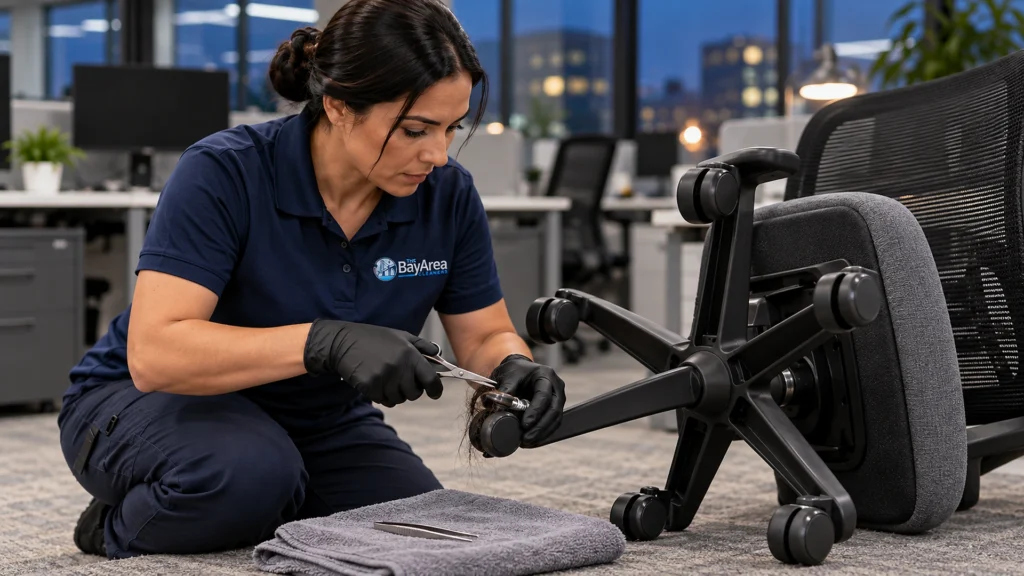
OSHA’s guide notes that the wrong casters can make it hard to position a chair at the desk, which leads to extra reaching and bending. Hair, carpet fiber and thread wrapped around the axle cause the same drag. Here’s how to clean office chair wheels with the casters left on the chair.
- Lay the chair on its side on a towel, with the casters facing you.
- Pull loose hair and thread off each wheel by hand.
- Cut wrapped strands with small scissors or a seam ripper, working along the gap between the wheel and its housing.
- Pull the cut strands free with tweezers.
- Wipe each wheel’s tread and housing with a cloth dampened with mild detergent and water, then dry it.
- Spin each wheel by hand. If one still sticks, ask the dealer about a replacement caster.
The table sorts the signs you’ll run into as you work out how to clean office chair wheels across a whole floor.
| What you see | Likely cause | What to do |
| Wheel turns in jerks | Hair or thread around the axle | Cut and pull the strands, then spin to test |
| Chair drags in one direction | One caster seized | Clean that caster, and ask the dealer about a replacement if it still sticks |
| Gray film on the tread | Floor soil picked up by the wheel | Wipe with mild detergent and water, then dry |
| Caster wobbles in its socket | Worn stem or cracked socket | Take the chair out of use and report it |
Clearing the wheels is a short job, and a chair that rolls freely keeps people from fighting their desks all day. Wipe each of the five legs of the base on the same pass. Once your team knows how to clean office chair wheels, the casters rarely need more than scissors, tweezers and a damp cloth.
Takeaway: Cut and pull hair from each caster, wipe the tread and dry it, and spin it to test. Report a wobbly caster instead of forcing it.
Check the Underside for Cracks and Recalls
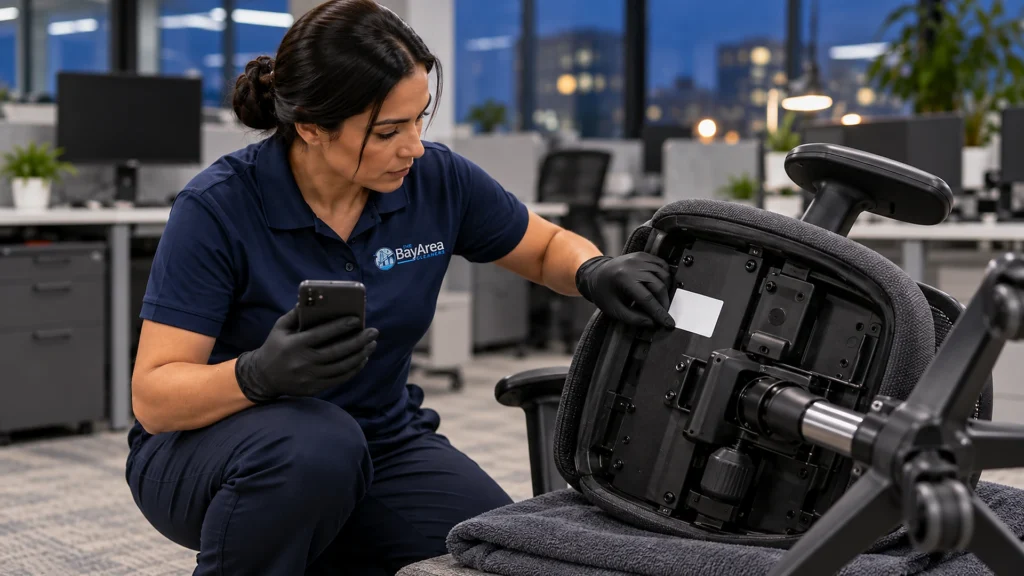
With the chair already on its side for the casters, add one check to how to clean office chair parts: read the label under the seat. CPSC’s notice for a 2020 HON recall says the maker’s name, model number and manufacture date are printed on a label on the underside of the seat. That label is how you check a chair against a recall.
You may also like: Why Vallejo Businesses Need a Local Commercial Cleaning Company?
That HON recall is one example. It covered about 13,400 HON Gateway and Maxon chairs sold from February 2019 through February 2020, through dealers and online office stores. HON received reports of 11 chair backs breaking, including two minor injuries. CPSC told owners to stop using the chairs right away and contact HON for a free replacement back.
Search the recall listings on cpsc.gov by the maker and model on your chairs’ labels. On the same pass, look for cracked legs, a back that flexes more than its neighbors and missing casters. OSHA’s guide notes that chairs with four or fewer legs may tip, so a five-leg base with a broken leg needs to come off the floor.
Tag a damaged chair and move it out of the work area. Don’t let anyone take it back to a desk until the dealer or maker has looked at it.
Takeaway: Read the label under the seat and check its model on cpsc.gov. Pull any chair with a cracked leg, a loose back or a missing caster.
Who Handles Each Part of the Chair
Chairs sit at the line between your office team and your cleaning provider. Some chair tasks fit a night crew, and some need someone who knows the chairs and the people who sit in them.
A crew handles the hard-surface work well. That covers wiping desks and shared equipment during workstation cleaning that works around desks still in use, cleaning meeting room chairs, and detail dusting of chair bases on a deep-clean visit.
Your office team owns seat and mesh vacuuming, the fabric codes, the casters, the recall checks and the decision about any liquid on a seat. Ask people to report spills the same day so a stain doesn’t dry before anyone blots it. At the walkthrough that opens a recurring janitorial contract, agree on how the crew flags a fresh spill or a cracked leg it finds at night. Tell it which chairs it wipes and which ones it leaves alone.
Takeaway: Give the crew hard surfaces and chair bases. Keep fabric codes, casters, spill reports and wet cleaning decisions with your office team.
Frequently Asked Questions
What decides how to clean office chair seats?
The fabric code decides, and the label under the seat gets you to it by naming the maker and model. Some makers, MityLite among them, list the code in their fabric library rather than on the chair. If the fabric isn’t named anywhere, the dealer who sold the chairs can look it up.
Is taking the casters off part of how to clean office chair wheels?
No. Most hair comes off with the chair on its side, using small scissors and tweezers. If a wheel still sticks after that, ask the dealer about a replacement caster.
Which steps of how to clean office chair fabric still apply under a no-liquid code?
Only the dry ones. MityLite’s X code allows vacuuming or light brushing, with no liquid agent of any type. A spill on an X seat gets blotted with a dry cloth, and anything that stays goes to an upholstery specialist.
What’s the last step in how to clean office chair cushion spills?
Drying. Herman Miller tells owners to let the fabric dry thoroughly and then vacuum it well before using the chair. On an upholstered seat, the foam stays damp longer than the surface, so leave the seat empty and point a fan at it.
Conclusion
Most office chair care comes down to two lookups: the fabric code in the maker’s fabric library and the model label under the seat. The code tells you which liquid a seat can take. The model label lets you check the chair against CPSC’s recall listings.
Keep liquid light on fabric and out of the foam, vacuum mesh without brushing it, and wash the frame with mild detergent and warm water. Clear the hair from the casters so every chair rolls freely on a sound five-leg base. With the codes on file and a spill kit by the breakroom, nobody on your team guesses at how to clean office chair parts.
The Bay Area Cleaners cleans offices from Vallejo to San Mateo, including detail dusting of chair bases and furniture during deep cleaning visits. Call 707-656-9339 for a free estimate.