A tenant walks through your lobby on a Monday morning and the first thing they notice is the floor. Dull patches near the entrance. A faint white haze by the windows. Scuff marks that did not come out even though someone mopped Friday night. You know the crew was there. So why do your hardwood floors still look tired by the second week of the month?
The quick version of how to clean hardwood floors without wrecking them: sweep or dust-mop daily to lift grit before it scratches the finish. Damp-mop weekly with a pH-neutral cleaner made for finished wood. Set your deep-cleaning and recoating schedule by actual traffic, not a fixed date. Skip anything that floods the floor with water or strips it down to bare wood. That is where finishes fail.
Most facility teams already know the basics of keeping hardwood clean at home. Fewer know how that changes once you are covering thousands of square feet of lobby, hallway, and open-plan office with dozens of people crossing it every hour. This guide covers how to clean hardwood floors in a commercial setting, and where borrowing a tile-floor routine quietly ruins the finish.
Why Commercial Hardwood Floors Wear Out Faster Than They Should
Most damage is not foot traffic. It is the wrong cleaning method applied consistently, week after week, until the finish cannot recover.
Three habits do the most harm. Wet-mopping with a soaked mop head, instead of a barely-damp one, pushes water into the seams between boards. There, it swells the wood and clouds the finish from underneath. Acidic or ammonia-based cleaners, vinegar included, slowly break down polyurethane coatings, despite what a lot of DIY advice says. The result is a dull, slightly sticky surface that attracts more dirt. Running a rotary floor machine built for vinyl composite tile over hardwood can grind grit into the finish instead of lifting it off.
Before choosing a cleaner, it helps to know which finish is actually on the floor. Most commercial hardwood installed in the last twenty years has a water-based or oil-based polyurethane topcoat, which is what a pH-neutral cleaner is designed to protect. Older buildings, or floors refinished with a hardwax-oil product, need a different maintenance oil entirely. Using a standard polyurethane-safe cleaner on an oil finish can leave it looking patchy instead of protected. When in doubt, ask whoever installed or last refinished the floor which finish is on it. Or have a professional floor care team confirm it during an initial assessment.
That rotary-machine habit deserves its own warning, because it is easy to confuse hardwood care with a different process. How to strip and wax floors is a different job entirely. It works by dissolving a resilient tile’s finish down to bare tile, then rebuilding it with fresh acrylic coats. Hardwood has no bare-tile equivalent to strip back to. Sand it too aggressively, or too often, and the crew is removing wood, not a sacrificial layer sitting on top of it. That is a full refinishing job, not routine floor care, and it changes both the cost and the downtime involved.
If a deep-clean crew does use a floor machine on hardwood, it should run at a low speed with a soft, non-abrasive pad made for wood floors, not the high-speed rotary equipment and stripping pads built for VCT. That distinction is worth confirming with any vendor before work begins, since the wrong pad can scratch a finish in a single pass.
You may also like: How to Strip and Wax Floors: Process, Cost and Timing
Takeaway: if a routine looks right for a tile hallway, it is probably wrong for the hardwood one next to it. The finish, not the wood, is what breaks first.
Daily and Weekly Hardwood Floor Care by Facility Type
The right frequency depends less on square footage than on when people are walking across the floor.
Entryway matting does more work here than most facility teams give it credit for. A walk-off mat long enough for several full strides catches the grit and moisture that would otherwise get tracked directly onto the hardwood. It also cuts down how often the floor needs a full damp-mop. Place one at every exterior entrance, and clean or replace it on its own schedule. It is one of the cheapest ways to extend the time between deep cleans.
Offices and Coworking Spaces
Morning and evening are the two windows that matter most. A quick dust-mop before doors open clears overnight dust before the first wave of foot traffic grinds it in. A second pass at close catches coffee spills and the grit tracked in from outside. Day porter coverage fits this pattern well. Someone on-site during the day can catch a spill before it sits on the finish for six hours instead of overnight.
Schools and Classrooms
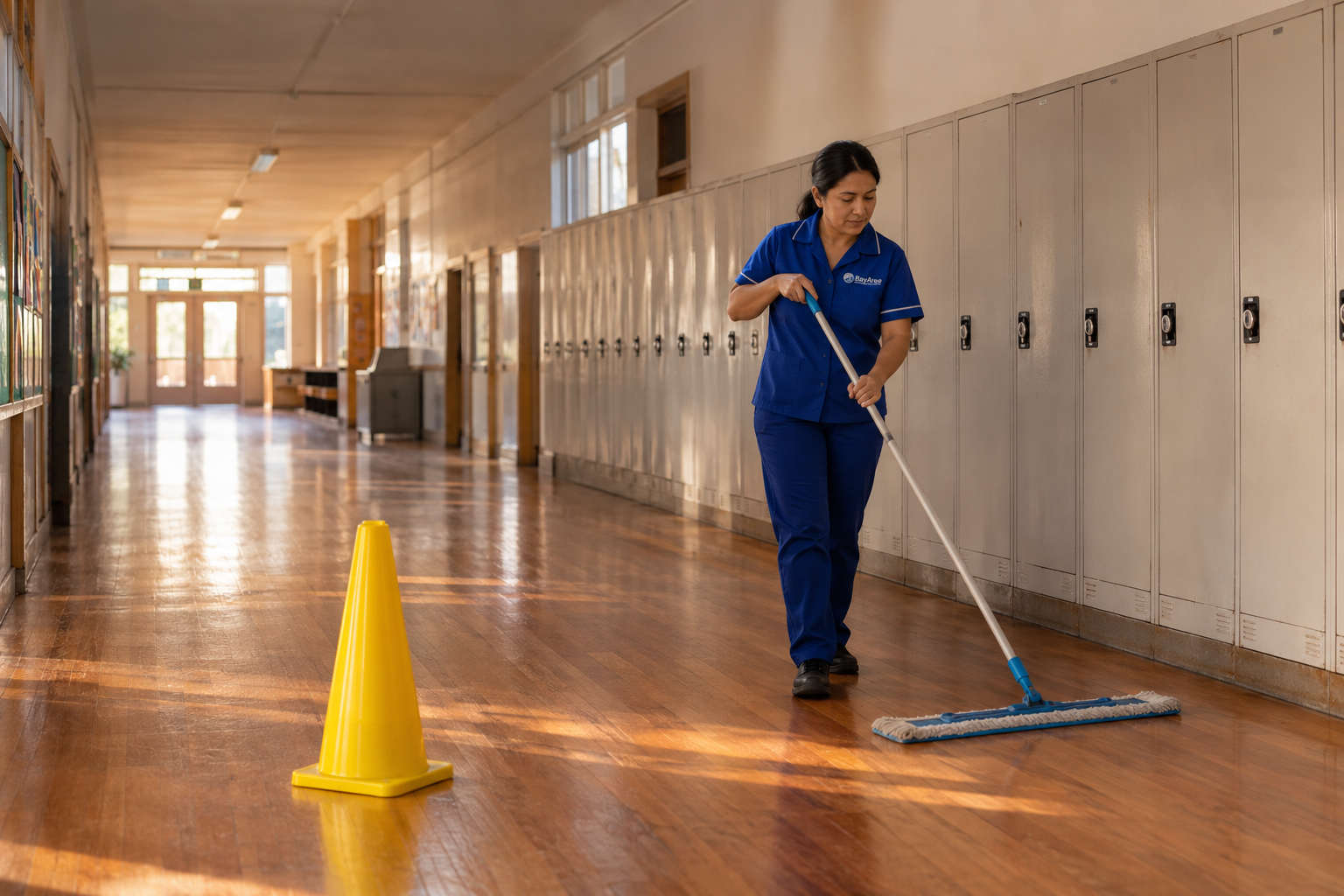
Timing is the real constraint here, not frequency. Damp-mopping has to happen after students leave, not between periods. A floor that is still slightly damp when a hallway fills with backpacks and sneakers is a fall risk, not a clean floor. Dust-mopping between classes is fine. Wet work waits for an empty building.
Retail Stores and Showrooms
Customers judge the space in the first ten seconds, so the floor needs to look finished, not just be clean. That usually means a light daily dust-mop plus a damp-mop before opening, timed so the floor is fully dry before the first customer walks in.
Churches and Community Halls
Traffic here is heavy but concentrated. A packed Sunday service followed by five quiet weekdays means the cleaning schedule should follow the event calendar, not a fixed weekly pattern. One thorough clean after the highest-traffic day usually covers the rest of the week.
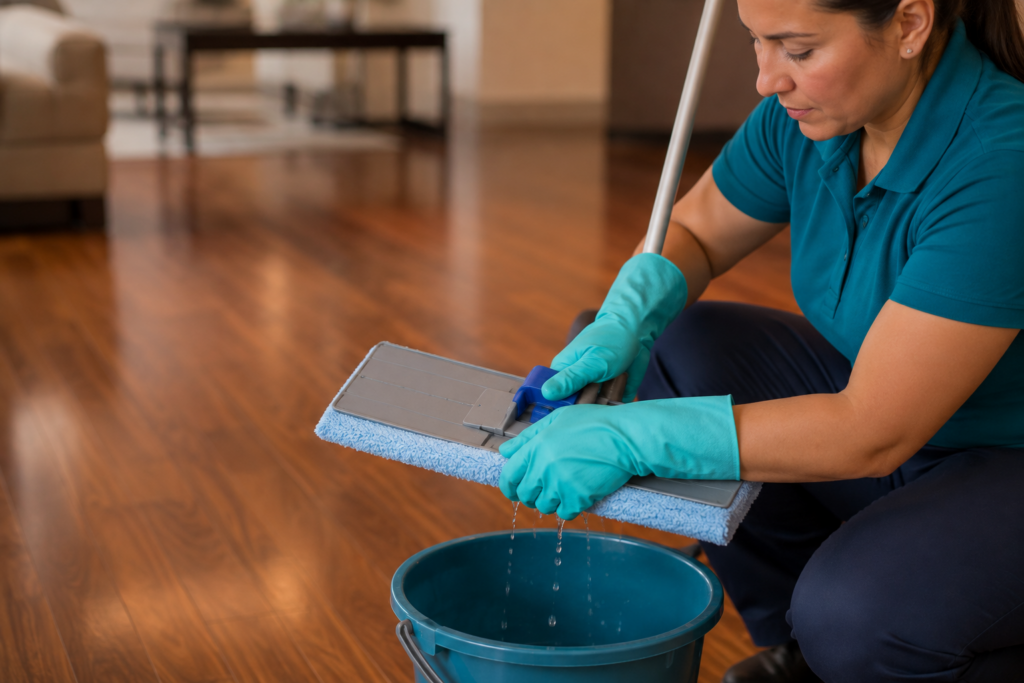
Takeaway: match the schedule to when people cross the floor, not to a generic weekly checklist. A recurring janitorial services plan can build that timing in instead of treating hardwood the same as every other surface on the route.
How to Clean Hardwood Floors Without Damaging Them: Step by Step
Here is how to clean hardwood floors in six steps a facility team can keep up with, week after week.
- Dust-mop or dry-vacuum daily. Use a soft brush attachment, never a beater bar, to lift grit before shoes grind it into the finish.
- Wipe up spills immediately. Standing liquid seeps between boards and clouds the finish from below. OSHA’s walking-working surfaces standard, 29 CFR 1910.22, requires floors to be kept clean and, to the extent feasible, dry. Hazards such as spills must be corrected before anyone walks across them again. A five-minute wipe-up handles both problems at once.
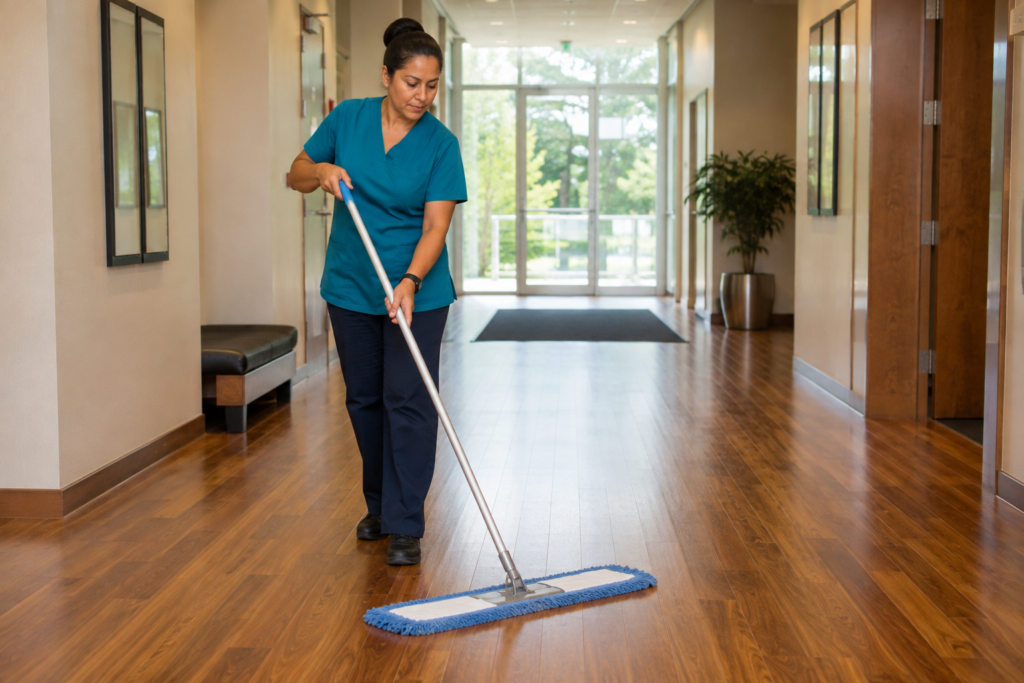
- Damp-mop weekly with a pH-neutral, wood-safe cleaner. The mop head should feel barely damp, not wet. If it leaves visible streaks of water behind, wring it out further before continuing.
- Avoid steam mops. The combination of heat and moisture can warp boards and cloud the finish faster than almost any other single mistake on this list.
- Dry the floor fully before reopening the area. A damp hardwood floor is also a same-level slip hazard. CDC’s occupational safety research through NIOSH found that same-level slips and falls cause most nonfatal fall injuries in education and healthcare settings, the same building types this guide covers. Workplace falls also cost US employers an estimated seventy billion dollars a year in medical bills and injury claims.
- Schedule a professional deep clean and recoat on a traffic-based cycle, not a fixed calendar date.
Takeaway: most of what damages commercial hardwood happens in step three, not step six. Get the weekly routine right and the deep-clean cycle takes care of itself.
Routine Maintenance vs. Deep Cleaning: When to Call a Professional
Day-to-day dust-mopping and damp-mopping keep the wood protected between service visits. Neither one restores a finish that has already gone dull, streaky, or scratched. That is a different job, and it is worth knowing exactly where the line sits.
| Task | Frequency | Handled by |
| Dust-mop or dry-vacuum | Daily | On-site staff or day porter |
| Spot-clean spills | As they happen | Whoever is nearest |
| Damp-mop with pH-neutral cleaner | Weekly | Janitorial crew |
| Deep clean and recoat | Set by traffic, typically 1-3x/year | Professional floor care team |
| Post-construction fine clean | After any renovation or buildout | Professional crew |
Cost is usually the reason this decision gets delayed. A professional deep clean and recoat costs more up front than another month of routine mopping. A full sand-and-refinish, the option a badly neglected floor eventually forces, costs several times more. It also takes the space out of service for days instead of hours. Getting a floor assessed before the finish is visibly failing is what keeps a facility on the cheaper side of that gap. A walk-through assessment usually takes under thirty minutes and does not commit a facility to anything beyond that visit.
A hardwood floor cleaning service earns its cost back fastest in two situations. The first is when the finish has gone visibly dull despite a correct weekly routine. The second is after any construction or renovation work, when fine dust settles into a finish that has not fully cured yet. A post-construction cleaning checklist covers that second scenario in more detail, including timing around when a newly refinished floor is safe to walk on.
You may also like: Post Construction Cleaning Checklist
Deep hardwood floor cleaning typically combines a thorough dust and grit removal pass with a maintenance coat or a light screen-and-recoat, which restores shine without the downtime of a full refinish. It sits as the middle option between routine mopping and the multi-day sanding job a badly neglected floor eventually needs.
Takeaway: the goal of routine care is to push that deep-clean cycle out as far as possible, not to skip it.
Natural and Low-Chemical Hardwood Cleaning Methods
Facility managers with sensitive occupants, such as schools, medical offices, or daycare-adjacent buildings, often ask about how to clean hardwood floors naturally, without harsh chemicals.
The honest answer is that plain water and a light touch go further than most homemade recipes. Vinegar is the most common suggestion online. It is also one of the more common ways hardwood finishes get damaged over time, since its acidity slowly etches polyurethane and other film finishes. The safer approach is a pH-neutral, low-VOC cleaner made specifically for finished wood, used sparingly, on a barely-damp mop. That combination gets floors clean without leaving residue or breaking down the finish, and it does not require harsh fumes in an occupied building.
Takeaway: natural and safe for the finish are not always the same thing. Choose a product for what it does to polyurethane, not for what is printed on the label.
Frequently Asked Questions
How do you clean hardwood floors in a commercial building without damaging the finish?
To clean hardwood floors without damage, dust-mop or dry-vacuum daily, damp-mop weekly with a pH-neutral cleaner made for wood, and keep the mop barely damp rather than wet. Wipe up spills right away, skip steam mops, and schedule a professional deep clean on a cycle based on foot traffic rather than a fixed date.
When should a facility hire a hardwood floor cleaning service instead of handling it in-house?
Bring in a professional service in two cases. First, when the finish looks dull or scratched despite a correct daily and weekly routine. Second, after any construction or remodeling project, when fine dust has settled into the floor. Both situations usually need equipment and products beyond what an in-house janitorial routine covers. Most in-house teams can handle daily and weekly upkeep well, but not the low-speed buffers, screening pads, or recoat products a proper deep clean requires.
What does a deep hardwood floor cleaning actually involve?
Deep hardwood floor cleaning pairs a thorough removal of ground-in grit and buildup with a maintenance coat or a light screen-and-recoat that restores shine without a full sanding job. It is a middle step between routine mopping and a complete refinish.
How often should a commercial hardwood floor get a professional deep clean?
It depends on traffic, not the calendar. A quiet office suite might need a deep clean once a year. A high-traffic lobby or school hallway can need it two to three times a year to keep the finish from wearing through in the busiest zones. Good entryway matting and a consistent daily routine tend to push that interval toward the longer end of the range.
Conclusion
Knowing how to clean hardwood floors is only half the job. The other half is knowing when the finish has moved past what a routine can fix, and handing that part to a hardwood floor cleaning service before a recoat turns into a refinish. Hardwood floors are one of the more visible investments in a commercial building, and they show neglect faster than almost any other surface. Building the right daily habits keeps that investment looking the way it did on day one.
Call 707-656-9339 or request a free floor assessment, and we will build a hardwood care schedule around your actual traffic instead of a generic checklist.