
Chalkboards never went away in commercial buildings. They moved into training rooms, breakroom accent walls, lobby cafe menus and the classrooms of the schools and churches a cleaning crew visits each week. Each one sheds dust onto the floor and holds a gray haze if it’s cleaned the wrong way. The right routine for how to clean chalkboard surfaces depends on which kind of board is on the wall.
Porcelain, paint and slate each come with their own care steps, and the differences decide how much water a crew can use.
The quick version: Erase with a clean felt or latex eraser and clean the eraser often, since a saturated eraser can leave residue behind. Wash a board that gets regular use two to three times a week with clean, warm water. Squeegee or wipe it, and let it dry completely before anyone writes on it. Use a phosphate-containing cleaner only for stubborn residue on porcelain boards. Condition a new board, and a painted board after every cleaning, by rubbing the long side of a stick of chalk over the whole surface and erasing it. Chalkboard paint needs 3 days before use and 7 days before its first damp wipe. Keep wax-based or oily chalk, oily cleaners, scouring powder and unapproved markers off the surface. That’s how to clean chalkboard surfaces so they write clearly and erase clean.
Three Kinds of Chalkboard in a Commercial Building

Most boards in offices and schools fall into one of three groups. The surface decides how much water it can take and which cleaner is safe.
Porcelain enamel boards have a baked glass-like coating over steel. PolyVision and Claridge both make them for training rooms and classrooms, and both publish care steps. These boards take a full warm water wash.
Painted chalkboards are a coat of chalkboard paint on drywall, wood or an old board. Breakroom accent walls, cafe menu walls and framed signs are usually painted. Natural slate still hangs in some older schools and church buildings, often original to the room. Erase slate dry, wash it with clean water only and dry it fully, and ask the owner before anything stronger touches it.
You may also like: Church Cleaning Services: What Sanctuaries, Fellowship Halls and Nurseries Each Require
If you can’t tell which kind you have, ask the building owner or facilities team for the purchase or paint records before the first wet cleaning. Walk your building once and list every board by room and type. Your crew can then match the routine to the board instead of guessing, and nobody washes a painted wall like a porcelain board.
Takeaway: Find out whether each board is porcelain steel, chalkboard paint or slate. The surface sets how much water and which cleaner it can take.
How to Clean Chalkboard Surfaces Day to Day?
The daily job is mostly erasing. Use a latex or felt eraser, the two types Claridge names, and keep erasers clean, as PolyVision advises for its chalkboards. Work across the board in long, even passes so the chalk film stays the same everywhere.
Washing comes next, on a schedule. Claridge recommends cleaning boards that get regular use two to three times a week, and says heavy use may call for a daily cleaning. Here’s the wash for a porcelain board:
- Erase the whole board with a clean eraser.
- Wash with clean, warm water on a sponge or damp cloth.
- For stubborn residue, add a phosphate-containing cleaner to the water and rub with a kitchen sponge.
- Rinse with clean water.
- Wipe the surface with a squeegee or a dry cloth.
- Let the board dry completely before anyone writes on it.
PolyVision adds a caution about time. Don’t leave the board wet for long, and dry it fully before it goes back into use. Chalk on a damp board drags and smears, and the next eraser pass spreads a gray film across the surface.
The chalk tray collects what the eraser drops. Empty the broken chalk and loose dust into the trash first, since a full tray feeds the eraser every time someone sets it down. Run a damp cloth along the tray once the board is clean, and keep that cloth separate from the one used on the board.
Training rooms often see the heaviest board use in an office. If your office cleaning that covers your meeting rooms includes the training room, list the board as its own item with its wash days. The crew then knows which nights it gets water and which nights it only gets an eraser.
Takeaway: Erase in even passes with a clean eraser, wash regular-use boards two to three times a week and let them dry completely before use.
Chalking In a New Board
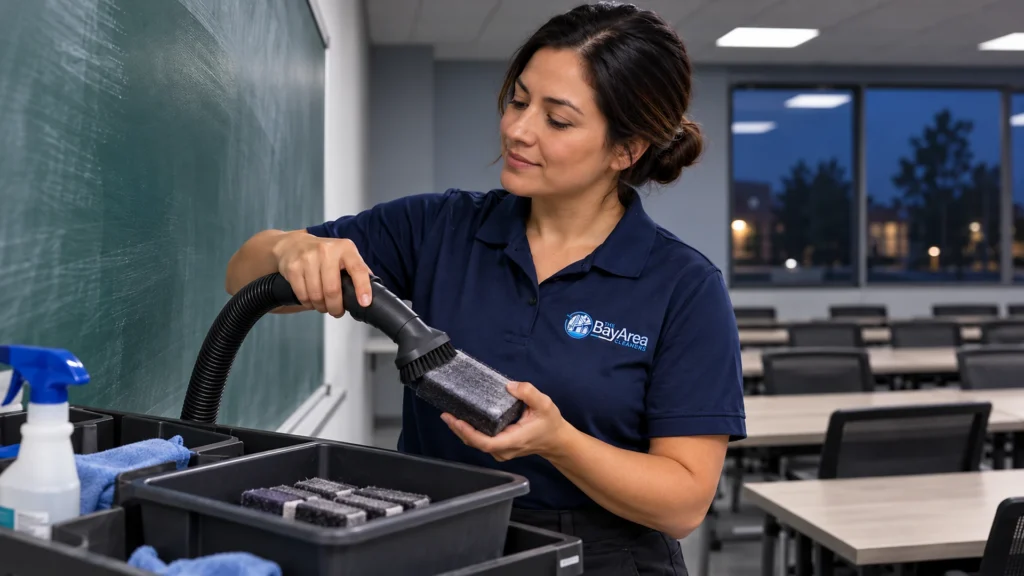
On a new chalkboard, the first marks can stay visible after erasing. Board makers prevent that with a step called chalking in, or conditioning.
Claridge compares it to seasoning a cast iron pan. Rub the long side of a piece of pure white chalk without a wax surface over the entire board, then erase it. PolyVision gives the same step for its chalkboards before first use, with a clean chalkboard eraser. Claridge then washes, rinses and squeegees the board before anyone writes on it.
Claridge warns that skipping this step on a new board may lead to poor performance. Neither maker includes it in routine cleaning. Painted boards are different: Rust-Oleum repeats conditioning after every cleaning.
If you’re setting up a training room or classroom before it opens, chalk in every new board on the first visit. It takes a few minutes per board and saves your first presenter a fight with marks that won’t erase. If a board still streaks after that, the eraser is usually the problem, so swap it for a clean one before you wash again.
Takeaway: Chalk in a new board with the side of a plain white stick and erase it before its first use. Painted boards get the same step after every cleaning.
How to Clean Chalkboard Paint?
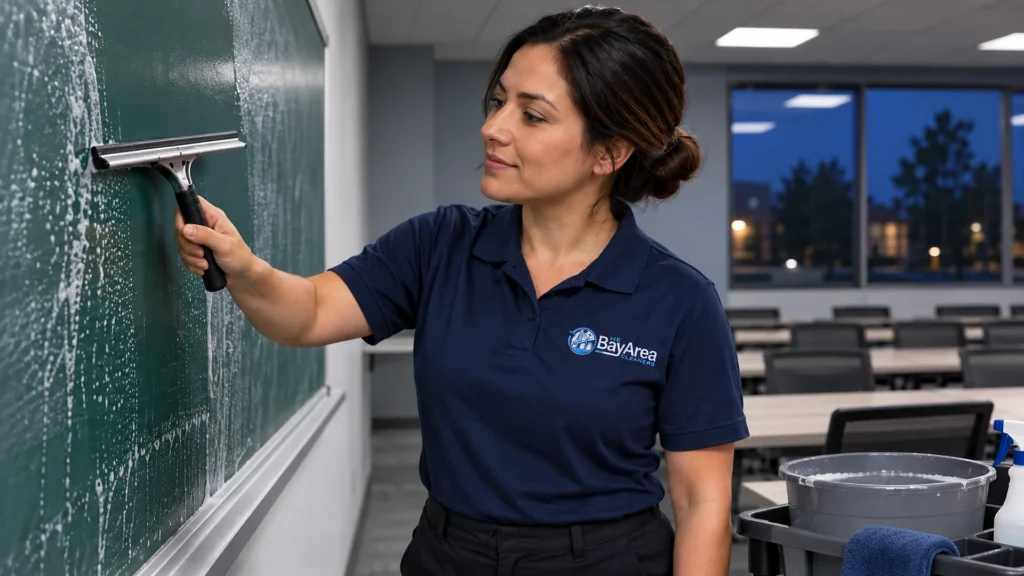
Painted boards follow the paint maker’s rules, not the board maker’s. Rust-Oleum’s technical data sheet for its chalkboard paint says the finish is ready to use after 3 days. It asks for 7 days before the surface is wiped with a damp cloth. If you aren’t sure which paint was used, ask whoever ordered the work for the product name and its data sheet.
That timing matters most after a remodel or a fresh coat in a breakroom. If a crew washes a new painted wall in the first week, it’s wiping a finish Rust-Oleum says isn’t ready for a damp cloth. Put the date the paint went on into the work order, and hold any wet cleaning until day 7.
Once 7 days have passed, Rust-Oleum’s answer to how to clean chalkboard paint is a damp cloth. It repeats the conditioning step after cleaning: rub the side of a piece of chalk over the surface and erase. Wring the cloth out hard, since a painted wall over drywall can’t take the water a porcelain board can.
Abrasive pads and scouring powders don’t belong on chalkboard paint any more than on a porcelain board. PolyVision rules them out on its chalkboards, along with wax-based cleaners and oily products. For a breakroom crew, how to clean chalkboard paint stops at a damp wipe and a fresh coat of chalk.
Takeaway: Wait 3 days before writing and 7 days before the first damp wipe. Use a well-wrung damp cloth after that, then condition the paint with chalk again.
How to Clean Chalkboard Walls in Offices and Cafes?
A chalkboard wall in a breakroom or cafe isn’t a classroom board. It’s a large painted area, often floor to ceiling, with outlets, trim and baseboard along its edges. How to clean chalkboard walls at that size is mostly about controlling dust and water.
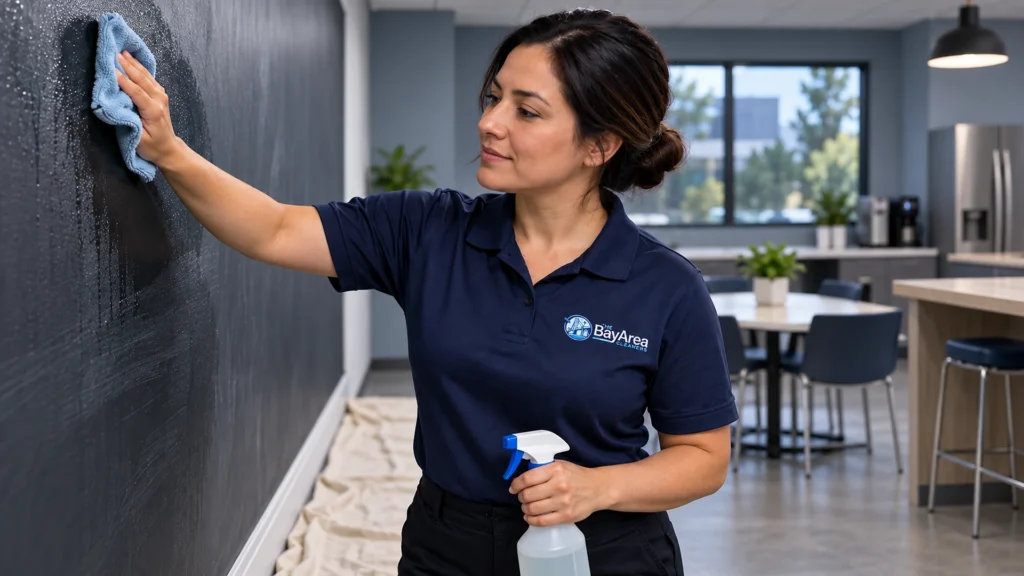
Lay a drop cloth or towels along the base of the wall, then start at the top and work down in sections an arm’s width across. Erase each section first, including around outlets and switch plates, and keep the damp cloth away from them. Wipe each section with a damp cloth wrung out hard, rinsing it often in clean water. Chalk mixed with water turns into a gray slurry, and a wet cloth spreads it into streaks and down onto the baseboard.
You may also like: Why Vallejo Businesses Need a Local Commercial Cleaning Company?
Chalk dust settles straight down, and the floor under a busy chalk wall picks it up all week. Detail dusting and wiping of baseboards and low surfaces catches what the nightly vacuum misses along that edge.
Vacuum the floor along a chalk wall before you mop it. Mopping first turns the dust into the same gray slurry that streaks the wall, and it dries as a film on hard floors. Learning how to clean chalkboard walls this way keeps the paint intact and the floor clean. Finish by conditioning the cleaned sections with chalk, as Rust-Oleum directs for its paint.
Takeaway: Work top down in small sections with a well-wrung cloth, keep it away from outlets and protect the floor and baseboard.
Cafe Menu Boards and Lobby Signs
A cafe menu board often gets rewritten more than any other chalk surface in a building. Staff erase and rewrite specials every morning, and the board rarely gets a real wash. The result is a gray film that makes new writing hard to read from across the room.
Agree on who does what. Cafe staff usually own the writing, so set the wash night with them, ideally the night before the menu gets rewritten. On a board written in chalk, ask staff to erase dry between washes so the crew starts from a dry surface.
Lobby signs and easel boards get handled, moved and leaned against walls. Wipe the frame and the back with a damp cloth when you wash the face, and let the whole sign dry before it goes back on its easel. A day porter on lobby floor rounds can pick up fallen chalk around the sign between nightly visits.
Liquid chalk markers are popular for cafe menus, and their labels list the surfaces they’re made for. If your menu board uses them, check the label against the board before the next rewrite. Marker that doesn’t suit the surface can leave ghost lines that no eraser lifts.
Takeaway: Set the wash night with cafe staff around the menu rewrite, dry signs fully before they go back up and check every marker against the board.
How to Clean Chalkboard Erasers Without Spreading Dust?
Erasers decide how clean a board looks. PolyVision warns that an eraser saturated with chalk dust can leave residue behind instead of removing it. Claridge and PolyVision both say to clean erasers regularly.
The old habit of clapping erasers together moves the dust into the room. New Jersey’s hazardous substance fact sheet for calcium carbonate lists chalk among its names. It warns that breathing the dust can irritate the nose, throat and lungs and cause coughing, and that contact can irritate the eyes and skin. The same sheet advises damp methods to control dust from spills, which is a good reason to wipe chalk trays and ledges damp instead of brushing them.
You may also like: High Dusting: Why Your Clean Floors Do Not Stay Clean
Indoors, how to clean chalkboard erasers is a matter of catching the dust. Vacuum the felt with a brush attachment. Outdoors, tap the eraser inside a lined trash can away from doors and air intakes, then tie off the liner.
The NIOSH Pocket Guide lists OSHA’s limits for calcium carbonate dust at 15 mg/m³ total and 5 mg/m³ respirable, averaged over an 8-hour shift. The irritation New Jersey lists is the everyday reason to capture eraser dust.
Keep erasers dry. A damp eraser smears chalk into the surface and dries stiff. Rotate two or three erasers per room so a clean one is always ready. That’s how to clean chalkboard erasers without trading a dusty board for a dusty room.
If your building has more than a few boards, keep a small eraser kit on each floor. Two clean erasers per room and a vacuum with a brush attachment cover most weeks.
Takeaway: Clean erasers often by vacuuming or tapping them into a lined can outdoors, never by clapping indoors. Keep them dry and rotate spares.
Wax Chalk, Chalk Markers and Other Causes of Ghosting
Ghosting is the faint outline of old writing that won’t erase. On a porcelain board, the usual cause is a product the surface wasn’t made for. PolyVision says to use standard chalk suitable for chalkboards and to avoid oil-based chalk and wax-based products.
Markers are the other cause. PolyVision rules out permanent markers, paint markers and chalk markers that aren’t suitable for the surface. Keep any marker off a chalkboard until someone has checked that it’s approved for that board.
If a board in your building already shows ghosting, wash it with warm water and let it dry fully before you try anything stronger. On a porcelain board, the phosphate-containing cleaner Claridge names is the next step. On a painted wall, Rust-Oleum lists a damp cloth and nothing stronger, so ghosting that stays after a wipe and fresh chalk points to a new coat of paint.
If you manage classrooms in a school or church, give teachers and volunteers the approved chalk and marker list. A short list posted by the chalk tray keeps the wrong marker off the board.
Takeaway: Use standard chalk, keep wax and oily chalk off the board and check every marker against the surface. Wash and dry fully before trying anything stronger.
Frequently Asked Questions
Which parts of how to clean chalkboard surfaces fit a nightly visit?
Erasing, wiping the chalk tray and vacuuming the floor under the board. Washing runs on a schedule, two to three times a week for regular use per Claridge. Give the crew a list of boards by room and type, including any wall still curing after a fresh coat of paint.
Does how to clean chalkboard paint change in the first week after painting?
Rust-Oleum’s data sheet says the finish is ready to use after 3 days and can take a damp-cloth wipe after 7 days. Before day 7, erase it with a dry eraser only. Write the paint date on your work order so the crew knows when the first wipe is allowed.
Does a breakroom chalk wall need its own plan for how to clean chalkboard walls?
It helps. Note which walls are painted, protect the floor and baseboard during a full wipe and keep the damp cloth away from outlets. If your wall runs behind a coffee station, wipe splashes off as they happen so they don’t dry into the paint.
What’s the best tool for how to clean chalkboard erasers in an office?
A vacuum with a brush attachment, since it captures the dust instead of spreading it. Keep erasers dry and rotate spares so each room always has a clean one. If no vacuum is handy, tap them into a lined can outdoors, never indoors.
Conclusion
A chalkboard stays clear with three habits. Use a clean eraser, wash on a schedule with water and a squeegee or dry cloth, and chalk in new boards, plus painted boards after each cleaning. The surface sets the limits, so porcelain boards can take a phosphate cleaner, painted walls get a damp cloth only and slate gets clean water only.
A crew that knows how to clean chalkboard surfaces protects the people in the room, too. Capture eraser dust instead of clapping it into the air, and keep wax chalk, oily cleaners and unapproved markers away from the board. A list of your boards by room and type keeps every one on the right routine.
Training rooms, breakrooms and the floors around chalk walls stay clean on The Bay Area Cleaners’ schedule for offices, schools and churches from Vallejo to San Mateo. Share which boards are porcelain, painted or slate when we walk the building, and each one gets its own routine on the schedule. Call 707-656-9339 for a free estimate.