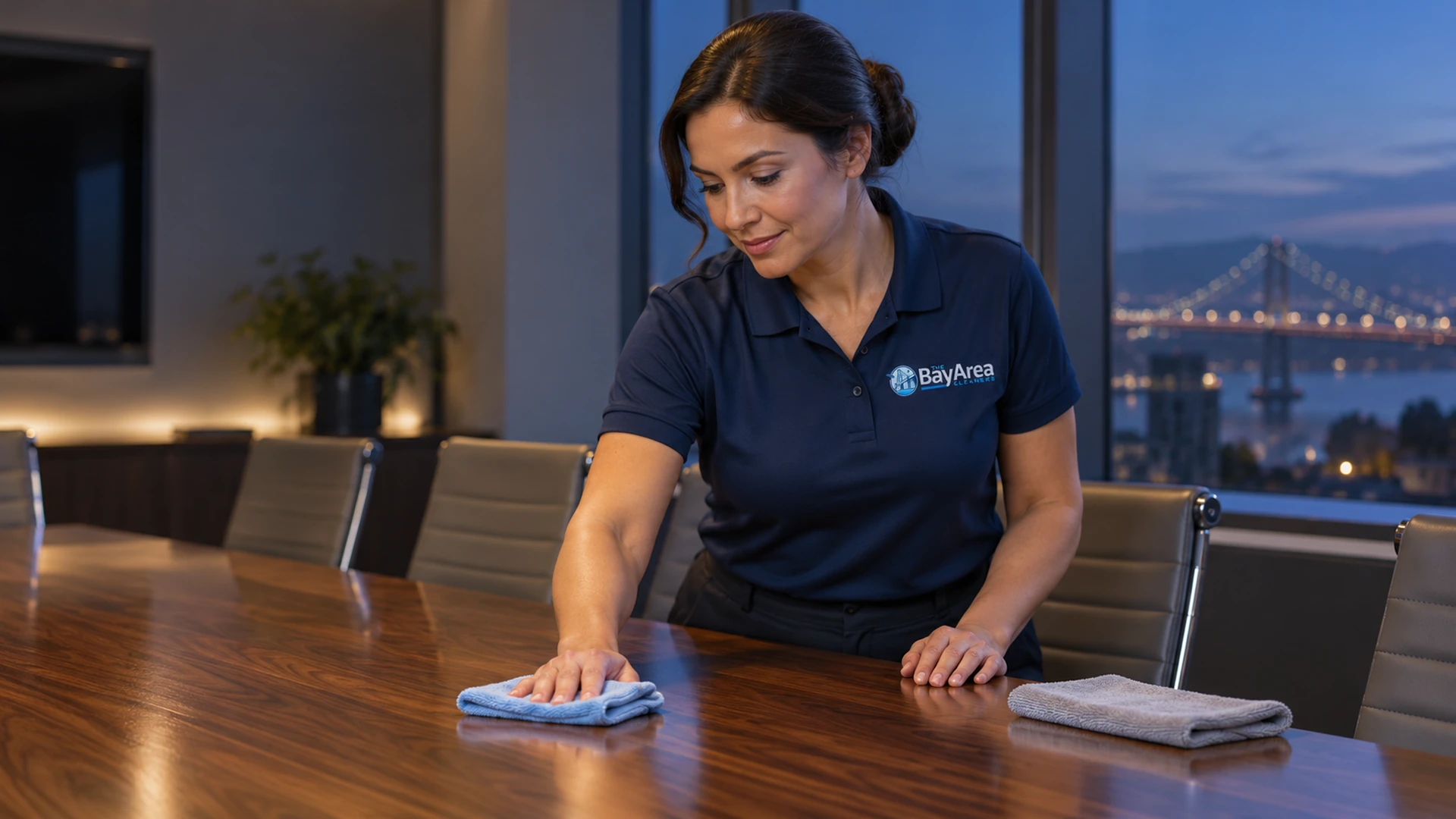

A shared office kitchen looks orderly after the evening cleaning visit, yet dirty mugs and food packaging appear before the next morning meeting. An employee may assume the cleaning crew handles everything, and the cleaner may reasonably avoid touching personal belongings. Without an office cleanliness policy, small daily issues have no clear owner. This guide shows office managers how to divide responsibilities, write practical rules, and address problems without making employees perform contracted janitorial work.
The quick version: An office cleanliness policy should explain what employees put away, what the cleaning provider handles under its written scope, and who responds when something falls outside either role. Keep shared areas accessible, name a contact for reporting problems, and distinguish ordinary tidying from trained cleaning work. Review the policy when office use or the cleaning agreement changes.
What Should an Office Cleanliness Policy Include?
An office cleanliness policy works when staff can identify a clear action and owner for each recurring problem. Write rules for shared rooms, workstations, waste, building access, and problem reporting, then compare them against the contracted cleaning scope. Office housekeeping rules should reflect the actual building rather than copying instructions from another workplace.
For example, consider a hypothetical suite with twenty employees, two meeting rooms, and a shared kitchenette. A cleaner arrives after closing, but desk clutter blocks some surfaces and the refrigerator contains food nobody claims. The policy should separate work employees can perform during the day from professional duties scheduled for the evening. It should never assume the cleaner may open drawers, move confidential records, or discard private items.
Identify the decisions people need to make
Begin with a short walkthrough and record where uncertainty repeatedly appears. Ask building managers, employees, and the service contact to describe the same situations. Differences in their answers reveal gaps worth fixing before adding more instructions. Keep a copy of the approved responsibilities at the facilities desk, where the office contact and vendor supervisor can check them when duties are questioned.
- Identify which personal belongings must be put away before a workstation can be cleaned.
- Name the person who reports overflowing bins, spills, blocked exits, or missing supplies.
- Mark shared appliances and storage spaces that staff manage rather than the cleaning crew.
- Record rooms requiring permission, supervision, or special handling of equipment.
- Specify who approves changes to a vendor’s cleaning work or service hours.
The office cleanliness policy is an operations document, not proof that a particular product removes a health risk. The CDC differentiates routine cleaning from disinfection and advises cleaning frequently touched surfaces regularly. Its recommendations concern community settings and do not replace requirements for specialized facilities. See the CDC guidance on facility cleaning when deciding how the policy describes hygiene tasks.
Takeaway: Write rules around observable situations, assign one owner to each issue, and keep confidential belongings outside routine cleaning instructions.
Which Office Cleaning Responsibilities Belong to Employees or Cleaners?
Office cleaning responsibilities should follow control and training, not assumptions about job titles. Employees usually control their dishes, documents, and personal clutter. Professional cleaners handle the services listed in the cleaning agreement, subject to access, safety, and the condition of each area.
A manager needs to compare the office cleanliness policy with the actual contract. The table answers a practical question: who acts first when a shared workspace needs attention? These are suggested allocations, not statements about any particular signed agreement. Document exceptions before employees begin using the table as an operational instruction.
| Situation | Employee or office staff | Contracted cleaner | Manager decision |
| Used meeting room | Remove materials and personal items | Clean accessible agreed surfaces | Set reset and access rules |
| Desk with paperwork | Secure papers and clear agreed zones | Clean permitted exposed surfaces | Define no-touch areas |
| Shared kitchen | Put away dishes and food | Clean assigned counters and floors | Assign appliance ownership |
| Full waste bin | Use correct bin and report overflow | Empty bins if listed in scope | Set overflow contact |
| Restroom supplies | Report empty dispensers | Refill when contracted | Confirm inventory owner |
The Bay Area Cleaners describes office cleaning services covering desks, meeting rooms, breakrooms, restrooms, reception areas, and floors. Those are published service categories, not proof that every task applies to every customer agreement. A facility manager should compare its purchased scope with the tasks it expects.
Keep access and authority distinct
For restroom tasks, the company’s restroom cleaning service outlines fixtures, waste, floors, and restocking. An office manager can use that page to start a service discussion, then confirm the agreed details in writing. Employees should report a supply shortage without assuming that purchasing or inventory control belongs to the cleaner.
Office cleaning responsibilities become easier to follow when every task has an actor, an access condition, and a person who can authorize exceptions. A supervisor can review disputed work without blaming either team for a task that nobody assigned. An office cleanliness policy can specify whether disputed access goes to facilities staff before further work starts.
Takeaway: Compare the policy against the signed scope, define what staff must clear, and give cleaners permission boundaries that protect belongings and equipment.
What Office Housekeeping Rules Should Employees Follow?
Office housekeeping rules should describe brief habits employees can follow during normal work. They should not convert office staff into an unpaid janitorial crew or direct them to handle substances they were never trained to use. Focus on personal items, shared property, waste, and prompt reporting.
For desks, define where employees should store loose papers and whether cleaners may touch keyboards or other electronics. For kitchens, identify who removes food from refrigerators and how abandoned containers are handled. A rule should specify the responsible team and notice process rather than authorizing surprise disposal of personal property.
Introduce the rules in a usable order
A short orientation sequence makes office cleaning etiquette easier for new staff to remember. Managers can include the following steps in onboarding or a team meeting. Each step addresses a separate decision.
- Show employees which areas are personal, shared, and restricted, using the actual floor plan rather than a generic diagram.
- Explain where food scraps, recycling, confidential paper, and ordinary waste should go under local building instructions.
- Ask employees to clear meeting tables and remove personal materials when their sessions end.
- Give a reporting route for spills, odors, blocked access, and broken dispensers instead of assigning unsafe tasks to whoever notices them.
- State when cleaners work and what items should be moved before an approved cleaning visit.
- Review examples during the first week so unclear rules can be corrected before they become habits.
The office cleanliness policy should avoid a blanket instruction to use disinfecting wipes everywhere. The CDC notes that regular cleaning is adequate in many routine situations and addresses additional disinfection when people have clearly been ill or other circumstances warrant it. The EPA explains that disinfectant labels govern appropriate use. Consult the EPA explanation of pesticide labels rather than making improvised product rules.
Ordinary employees may be asked to remove a cup, put paper in a bin, or notify the facility contact about a spill. Chemical application or cleanup involving an unknown substance needs a separate safety procedure and appropriately trained personnel. A workplace policy is not a substitute for that procedure.
Make office cleaning etiquette neutral and specific. Instead of telling staff to show respect by keeping everything immaculate, ask them to return shared supplies after meetings and leave access to agreed cleaning surfaces. This language gives managers something observable to discuss when rules are ignored.
Takeaway: Teach employees small actions they control, explain how to report exceptions, and reserve technical cleaning tasks for qualified personnel.
How Can Shared Rooms Stay Tidy Without Duplicating Work?
Shared rooms remain usable when occupants reset them and cleaners perform the assigned cleaning later. Office cleaning responsibilities should distinguish an immediate room reset from scheduled care. That separation limits interruptions and gives a clearer basis for discussing service quality.
A conference table may need loose materials removed between meetings, yet wiping the table with an approved product may belong to a daytime porter or scheduled cleaner. The correct answer depends on the agreement, occupancy, materials, and access. Do not write a rule that contradicts those conditions.
Match everyday events to the right response
The table asks which action belongs to the room user and which requires a designated support contact. Use it as a starting model, then update it for the building. It is not a universal cleaning schedule.
| Shared-space event | Immediate employee action | Assigned support response | What to confirm |
| Meeting ends | Remove notes and equipment | Clean agreed surfaces on schedule | Next booking and room access |
| Kitchen counter is cluttered | Remove dishes and personal food | Complete contracted surface care | Appliance and food ownership |
| Visitor reports a spill | Warn others and contact staff | Trained response under site procedure | Hazard location and access |
| Waste station fills early | Stop overfilling and report | Arrange contracted or site removal | Collection point and contact |
| Restroom dispenser runs low | Notify designated contact | Refill under agreed scope | Stock location and purchaser |
The office cleanliness policy should identify what happens when a problem needs attention before the next contracted visit. The Bay Area Cleaners publishes porter and day porter services for daytime needs. A manager can discuss whether that coverage is appropriate, without assuming the existing office contract includes a porter.
Office housekeeping rules should address meeting-room turnover without duplicating the work of a janitorial team. If employees leave the room ready for its next user, the cleaner can focus on the service tasks approved for that space. Document repeat problems instead of informally changing the provider’s duties.
You may also like: Commercial Cleaning Checklist: Sample, Score and Recheck Every Week.
The linked guide focuses on inspecting completed work across an office. This article serves a different purpose: assigning immediate responsibilities before and between cleaning visits.
Takeaway: Require occupants to reset shared rooms, provide a reporting route for urgent conditions, and leave contracted cleaning to the approved schedule.
How Should Office Cleaning Etiquette and Reports Be Communicated?
Office cleaning etiquette is easier to follow when employees know the rules, know why a task is theirs, and know where to report exceptions. A policy buried in an employee handbook cannot replace visible instructions and a clear contact process. Keep communications brief and consistent across departments.
Managers should appoint a single owner for policy updates and a backup when that person is unavailable. This doesn’t mean one person must perform every cleaning task. It means employees and contractors receive one version of the instructions and know who can resolve a disagreement. Date each office cleanliness policy revision and tell both teams which instruction changed.
Create a simple reporting loop
Use an agreed channel rather than several informal conversations. The following checklist makes a report useful without asking employees to diagnose a technical cleaning problem.
- Record the location and condition, such as a wet entryway or an empty soap dispenser, without adding claims about health effects.
- State whether the area needs immediate restriction, warning, or routine follow-up under the site’s safety process.
- Notify the assigned facilities contact rather than changing a cleaner’s instructions directly.
- Note whether the matter concerns employee conduct, the cleaning scope, building maintenance, or an unknown cause.
- Confirm who accepted the report and when the next status update will be provided.
An office cleanliness policy should distinguish reporting from inspection. A report describes a condition needing attention. An inspection checks agreed work against criteria after it should have been completed. The two records answer different questions and should not be treated as proof of the same thing.
For walking surfaces, OSHA’s 29 CFR 1910.22 requirements address clean, orderly conditions and recognized walking-surface hazards. Those employer obligations cannot be transferred away simply by assigning an employee or vendor a checklist. The policy should explain how a hazard reaches the responsible building team for timely action.
Employees should send new requests through the office contact instead of giving competing instructions to individual cleaners.
For teams using recurring janitorial services, the published description includes documented scopes and scheduled visits. An office manager should confirm the actual reporting contact and any escalation arrangements for their own account. Those details belong in a site-specific handoff, not a generic promise.
Takeaway: Give every report a location, contact, urgency classification, and owner, then separate cleaning requests from facility repairs and safety hazards.
How Can Managers Keep the Policy Useful Over Time?
An office cleanliness policy should change when occupancy, room use, or service arrangements change. Managers can review a few repeat problems rather than rewriting the whole policy each month. Check whether rules describe real decisions and whether staff can follow them during an ordinary workday.
Review the rules without inventing performance scores
Choose observable questions rather than arbitrary percentages. Did a room remain accessible for the scheduled cleaner? Were spills reported to the right contact? Did staff know which waste station to use? Did the building manager distinguish a missed contracted task from a room left cluttered after a meeting?
An office cleaning responsibilities review can use the following decisions:
- Keep a rule when staff understand it and the behavior supports safe access or usable shared space.
- Rewrite a rule when employees interpret the same instruction differently or lack the authority to act.
- Move work into the contracted scope only after discussing cost, staffing, timing, and permission with the vendor.
- Remove instructions that duplicate a building safety plan or contradict product and equipment directions.
- Clarify ownership when a recurring report passes between departments without resolution.
Avoid using cleanliness as a proxy for personal performance. A cluttered desk may involve active confidential work. A crowded meeting room may be waiting for the next booking. The office cleanliness policy should describe when and why areas need to be cleared, rather than judging how employees organize their entire workday.
Office housekeeping rules should be revisited when new people join and after a change in cleaning hours. Show the newest staff member the actual bin locations, the meeting-room reset practice, and the reporting route. Ask whether anything remains unclear, then change the text rather than adding another notice.
The provider may recommend a different service frequency after seeing traffic patterns, but a change should be reviewed and agreed by the authorized office contact. A revised office cleanliness policy should document any new room use that changes daily responsibilities.
Takeaway: Review recurring points of confusion, update responsibilities after operational changes, and seek written agreement before changing the vendor’s work.
Frequently Asked Questions
What belongs in an office cleanliness policy?
An office cleanliness policy should identify shared spaces, employee tidying actions, assigned professional cleaning, and a contact for exceptions. It should explain access restrictions and the handling of personal items. Avoid broad promises about health or productivity. The details need to reflect the building’s current cleaning agreement and normal use patterns.
What office housekeeping rules should employees follow?
Office housekeeping rules can cover storing personal belongings, clearing meeting tables, disposing of ordinary waste, and reporting problems. Employees should not be assigned specialized chemical cleaning merely through a general office reminder. Managers should explain where rules apply, who receives reports, and what happens when an area cannot be cleared before a cleaning visit.
How are office cleaning responsibilities divided between staff and providers?
Office cleaning responsibilities depend on the signed scope and each person’s control over a task. Employees manage their own materials and immediate room resets. Cleaners perform agreed services in accessible areas. The office manager decides who supplies materials, grants access, handles exceptions, and authorizes a change when a task falls between those groups.
What does office cleaning etiquette look like in shared spaces?
Office cleaning etiquette means leaving shared rooms usable, removing personal items after meetings, following waste instructions, and reporting problems through the designated channel. It does not require employees to perform every contracted cleaning task. A written rule is most useful when it names the expected action, location, and responsible contact without vague judgments about appearance.
What should an office do when cleaning and staff duties overlap?
When duties overlap, document the condition first and check the current service agreement before assigning blame. The manager can ask employees to clear personal items, clarify building access, or request a scope adjustment from the cleaner. Urgent hazards need the site’s safety response, not a delayed discussion about whose routine cleaning list includes them.
Conclusion
A useful office cleanliness policy lets employees care for their own materials and shared-room resets without taking over contracted cleaning work. It gives office managers a practical way to assign responsibilities, handle exceptions, and review rules as the building changes. If your Bay Area workplace needs a clearer service boundary, discuss its current cleaning scope with The Bay Area Cleaners at 707-656-9339. Start with the office areas, access restrictions, and tasks that need a named owner.