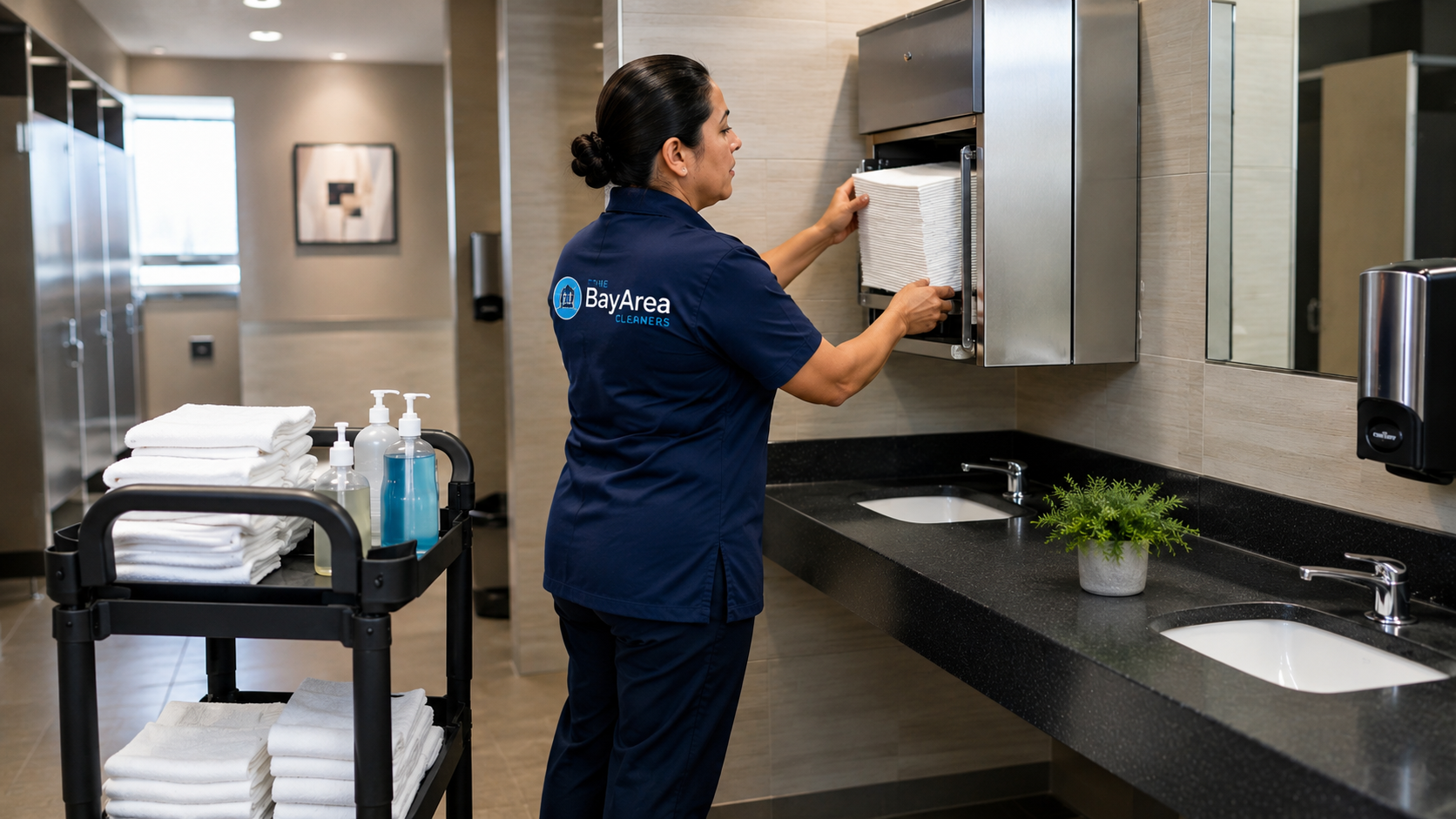
Ask a facilities manager what day porter services cost and most can guess a number. Ask what the role actually covers, and the answer gets vague fast: “restocking,” someone will say, or “keeping an eye on things.” That vagueness is exactly how buildings end up paying for coverage that was never scoped, then wondering why the afternoon still looks worse than the morning.
A restroom runs out of paper towels at 2 p.m. A spill sits in the lobby through a client visit. The break room that looked fine at 8 a.m. looks abandoned by 3 p.m.
None of that is a cleaning-quality problem. It’s a timing problem, and no amount of additional nightly hours fixes it. That’s the gap day porter services are built to close.
The quick version: this page covers what a day porter actually does, how the role differs from nightly janitorial, which buildings get real value from daytime coverage, and how to scope it so it’s priced and measured like a defined service instead of a vague add-on.
What a Day Porter Actually Does?
If you’re asking what a day porter is for the first time, the short answer is: someone who cleans and maintains your building during business hours instead of after them. A day porter service puts that person on site continuously throughout the day, not for one visit and gone. Day porter services exist precisely to close that continuous-coverage gap. Typical responsibilities include:
- Restroom checks and restocking throughout the day, not just at open and close.
- Spill response in lobbies, corridors, and common areas, usually within minutes rather than hours.
- Trash and recycling in high-traffic points that fill faster than a single nightly pass accounts for.
- Entry and lobby touch-ups, especially in wet weather, when tracked-in water and mud arrive all day.
- Break room and shared kitchen upkeep between the morning reset and closing.
- High-touch surface attention in shared spaces, on a rotation rather than a single daily wipe-down.
- Meeting and event room turnover between bookings, so back-to-back meetings don’t inherit the last group’s mess.
Some buildings add light non-cleaning duties: setting up conference rooms, moving deliveries, flagging maintenance issues spotted on rounds. Whether those belong in scope is a decision worth making on purpose, not by drift.
Takeaway: A day porter isn’t a second cleaning crew. It’s continuous, real-time coverage for the hours nightly janitorial can’t reach.
Day Porter vs. Nightly Janitorial: Two Different Jobs

These aren’t competing services. They solve different problems, and most buildings that get the best results run both.
What nightly janitorial handles
Work happens when the building is empty. Crews can move furniture, run floor equipment, and clean systematically without interruption. Deep and periodic work belongs here.
What a day porter handles
The porter’s work happens with people present, which changes what’s possible. Loud equipment and wet floors are disruptive during business hours. What a porter does instead is stay ahead of accumulation and respond to what happens in real time.
The diagnostic that tells you which one you need
Track complaints by time of day rather than by location. It’s the single most useful signal in facilities cleaning:
| When complaints cluster | What it usually means |
|---|---|
| Morning | The nightly scope is the problem, not the daytime coverage. |
| Afternoon | The building needs daytime coverage, not more nightly hours. |
Two buildings can generate the same number of complaints and need opposite fixes. Without the timing data, most managers respond by adding nightly hours, which does nothing for a 3 p.m. problem.
Takeaway: Complaint timing, not complaint volume, tells you whether to add nightly hours or daytime coverage.
You may also like: Commercial Window Cleaning for Hallways & Common Areas in Multi-Tenant Buildings
Why Daytime Coverage Has a Compliance and Economic Dimension?
Beyond appearances, some conditions are genuinely harder to maintain with an after-hours-only model, and the cost of getting it wrong isn’t only cosmetic.
Restrooms and consumables
OSHA requires employers to provide sanitary and immediately available toilet facilities, as summarized on its restrooms and sanitation overview. The underlying standard, 29 CFR 1910.141, also calls for washing facilities to be kept in sanitary condition with soap and hand-drying provisions supplied. A restroom stocked at 6 a.m. in a busy building isn’t necessarily stocked at 3 p.m., and nothing in a nightly schedule reaches that window.
Spills and walking surfaces
OSHA’s general requirements for walking-working surfaces, 29 CFR 1910.22, cover three things: workplaces and passageways must stay clean, orderly, and sanitary; floors must be kept clean and, to the extent feasible, dry; and surfaces must stay free of hazards such as leaks and spills. The full standard doesn’t say who has to be on site to meet it. But a spill at midday is a hazard until someone addresses it, and the response time depends entirely on whether anyone is there to respond.
High-touch surfaces during occupancy
The CDC recommends prioritizing cleaning of high-touch surfaces, noting that the more people who touch a surface, the higher the risk, and that high-traffic areas may warrant more frequent attention. Its cleaning and disinfecting guidance is also clear that routine cleaning with soap and water removes most germs, with disinfection reserved for defined circumstances. In a building where surfaces are touched continuously from 8 a.m. to 6 p.m., one overnight pass is one pass, however thorough it was.
The economic stake behind that guidance is real, even if no single provider controls the whole picture. The CDC Foundation estimates that productivity losses linked to worker illness and injury cost U.S. employers $225.8 billion annually, or roughly $1,685 per employee — and high-touch surfaces are a documented transmission point for the illnesses driving that figure. Daytime attention to those surfaces doesn’t eliminate that cost on its own, but it addresses the exact gap a nightly-only schedule leaves open for eight or more occupied hours a day.
Takeaway: None of this requires daytime coverage by law. It does mean the standards a nightly-only schedule struggles to meet are the same ones a day porter service is built to hold, and the cost of illness spread goes well beyond appearances.
Which Buildings Get Real Value From a Day Porter?

This isn’t about building size. It’s about traffic relative to size, and how visible the space is to people whose opinion matters. Day porter services tend to pay off fastest in the buildings below, and least in the ones after them.
Multi-tenant properties
Shared corridors, lobbies, and restrooms serve every tenant and belong to none of them. Condition drifts fastest in exactly these spaces, and complaints arrive from multiple directions at once.
Retail and customer-facing spaces
Entry areas and restrooms are part of the customer experience, and they degrade during the exact hours customers are present. Wet weather compresses that timeline dramatically.
Schools, churches, and event venues
Usage is concentrated rather than continuous. A building hosting three back-to-back events needs turnover between them, not a single reset overnight.
Offices with heavy shared amenities
Buildings with busy break rooms, cafés, or conference floors generate midday accumulation that a nightly crew arrives too late to prevent.
Where it usually isn’t worth it
Small, low-traffic suites with few restrooms and light occupancy rarely justify dedicated daytime coverage. The money that daytime coverage would cost is usually better spent on the periodic layer of the nightly scope: floor care, carpet extraction, and detail work.
Takeaway: Daytime coverage pays off where traffic is heavy relative to size, not simply where the building is large.
You may also like: How to Choose a Janitorial Service for Your Business
How to Scope Day Porter Coverage So It’s Actually Measurable?
Coverage is usually sold in hours, but hours alone aren’t a scope.
| Scope element | What to define |
|---|---|
| Hours and days | Full shift, split shift, or a targeted midday block. Many buildings solve most of the problem with a few well-placed hours. |
| Route and frequency | Which areas get checked and how many times per shift. “A restroom round every two hours” is a spec. “Keep restrooms stocked” is not. |
| Response protocol | What happens when something urgent occurs, who calls it in, and the expected response time. |
| Boundary with the nightly scope | Which tasks belong to the porter and which stay with the after-hours crew, so nothing is done twice and nothing is skipped by both. |
Floor work is the most common source of confusion. Porters handle spot response and entry maintenance during the day, while machine work stays in the after-hours floor care schedule. Restroom rounds during the day should likewise be defined against the full nightly restroom scope, not layered on top of it without a clear split.
Takeaway: If the scope fits in one sentence, it’s underspecified. Hours, route, response protocol, and the boundary with nightly work all need their own line.
How Day Porter Coverage Is Typically Priced?
Day porter cleaning coverage is usually billed one of two ways: an hourly rate for a defined shift, or a flat weekly rate once hours and route are locked in. Neither is inherently better; the right structure depends on how predictable the coverage need is.
A handful of variables drive cost more than anything else: total hours per week, whether coverage is one continuous block or split across the day, and the size of the route. A three-hour midday block covering one lobby is priced very differently from an eight-hour shift covering multiple floors, which is exactly why day porter service quotes vary so widely between buildings.
Split shifts typically cost more per hour than one continuous shift, since they require coordinating two arrivals instead of one. Buildings that concentrate their heaviest-traffic window into a single block often get more coverage for the same budget.
Takeaway: There’s no universal day-rate for this service, because the variables that set the price are specific to your building. A walkthrough is what turns hours into an accurate number.
How to Vet a Day Porter Provider Before You Sign?
Not every provider selling day porter cleaning coverage runs it the same way. Because the role runs unsupervised for most of its hours, the provider matters more here than for nightly janitorial, where a site visit at any hour can catch a problem. A few questions separate a provider built for this from one improvising it:
- Who is the porter’s direct supervisor, and how often do they check the site? A porter with no oversight for weeks at a time is a porter whose standards will drift.
- What’s the response time commitment for something urgent? “We’ll get to it” is not an answer. A specific number of minutes is.
- Is the porter the same person day to day, or a rotating assignment? Familiarity with the building’s specific problem spots is most of the value of the role.
- What happens if the porter is out sick? A provider without a backup plan turns one absence into a full day of no coverage.
- Is the scope written down, or verbal? If it isn’t in writing, it isn’t enforceable, and “that’s not what I understood” becomes the default outcome.
Takeaway: A provider that answers all five without hesitation has done this before. One that gets vague on any of them is asking you to find out the hard way.
Frequently Asked Questions
Is a day porter the same as a janitor?
No. The work overlaps, but the timing and purpose differ. A janitor resets the building when it’s empty; a porter maintains it while it’s occupied. Many buildings employ both, with clearly separated scopes.
Do I need full-time daytime coverage?
Usually not at first. Many buildings start with a targeted block covering their heaviest hours and expand only if the data supports it. Starting with a full shift often buys hours during periods that never needed them.
Can a day porter replace nightly cleaning?
In most buildings, no. Deep and periodic work needs an empty building, and equipment-based tasks are disruptive during business hours. Daytime coverage supplements the nightly scope rather than replacing it.
How do I measure whether it’s working?
Use the same diagnostic that told you to add it: complaint timing. If afternoon complaints drop and morning condition holds steady, the coverage is doing its job. If nothing changes, the hours are probably placed at the wrong time of day.
What shouldn’t be in a porter’s scope?
Anything requiring equipment that disrupts occupants, anything behind mechanical or electrical access panels, and any task belonging to a licensed trade. Reporting an issue is appropriate; repairing it isn’t.
How much does a day porter cost?
It depends on total hours, whether coverage is one continuous shift or split, and the size of the route. A walkthrough is what turns those variables into an accurate number, and there’s no charge for that visit.
Not Sure Whether Your Building Needs Daytime Coverage?
If complaints cluster in the afternoon, or shared restrooms and lobbies drift before closing, day porter services are usually the fix, not more nightly hours. We can walk the property, look at your traffic pattern, and put a scope in writing before you commit to anything. Call 707-656-9339 for a free estimate.